Pitcher plants often entice their insect victims with sweet nectar before trapping them in inescapable viscoelastic goo. But some species go even further. Nepenthes gracilis, a species native to Southeast Asia uses its leafy springboard to lure its prey. Once an ant crawls to the underside of the leaf, a falling rain drop will spell its doom. When drops hit the leaf, it deflects down and jerks up, thanks to its shape and stiffness. The motion catapults insects into the pitcher, where digestive fluids await. While we’ve seen some fast-moving plants before, this is a rare example of a plant with an externally-driven speed mechanism. With it, the pitcher plant doesn’t have to wait or expend any metabolic effort to reset for the next insect. (Image credit: GFC Collection/Alamy; research credit: A. Lenz and U. Bauer; via New Scientist)
Tag: biology

Absorbing Sound with Moth Wings
Manmade soundproofing tends to be porous and bulky or very limited in the range of frequencies it can handle. In contrast, moths are natural absorbers of ultrasound, having evolved to avoid reflecting those frequencies back to the bats hunting them. Researchers took the structures from a moth wing and applied them to an aluminum disk to see how the coating performed. They found that the moth wing’s structures reduced sound reflection by as much as 87% at the lowest frequency tested (20kHz, still beyond human hearing.) As researchers explore how the individual structures of the wing perform, they hope to adapt the moth’s prowess to soundproof within the human range of hearing. (Image and research credit: T. Neil et al.; via Physics World)

Escaping the Flood


Fire ants clump together into giant rafts to stay alive during floods. But these rafts won’t form with just any number of ants. Researchers found that individual ants will actually kick one another away. It’s not until there are about ten ants that the raft formation becomes stable. In this video, the team lays out their experiments and models for fire ant rafting, showing that capillary action helps draw the raft together and individual ants’ activity can destabilize rafts if they’re too small. (Image and video credit: H. Ko and D. Hu)

Swimming Together
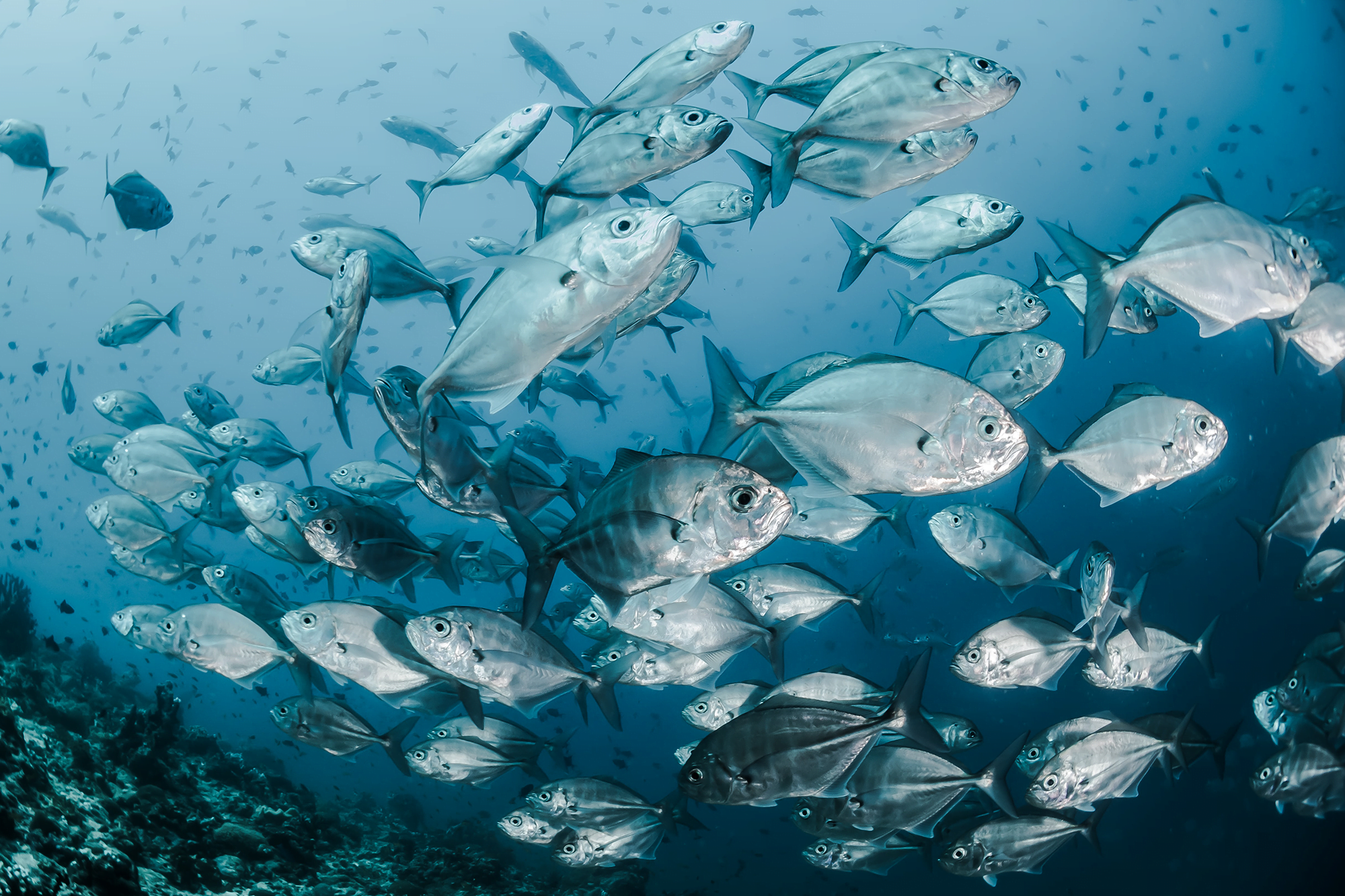
Scientists have long pondered the possibilities of hydrodynamic benefits to the ways fish school. But most analyses of schooling have assumed a fixed spacing that’s far more orderly than what we observe in nature. In this experiment, researchers instead used a pair of robotic swimmers (essentially hydrofoils) to explore a range of swimming formations. What they found was a map of places where a second swimmer could easily “lock in” to a position relative to the leader and have their positioning stabilized by interactions with the leader’s wake (lower image). Interestingly, the beneficial regions extend much further downstream for fish positioned diagonally to the leader than they do for one directly following. With such a wide range of easily-stabilized following positions, it’s no wonder that schools of fish are amorphous instead of strictly crystalline! (Image credit: top – S. Pena Lambarri, map – J. Newbolt et al.; research credit: J. Newbolt et al.)

The shaded areas of this map represent areas where a second swimmer can passively “lock-in” relative to the leader’s position, shown in gray. This data is based on tests with robotic swimmers. 
You’re Drunk, Toadlet


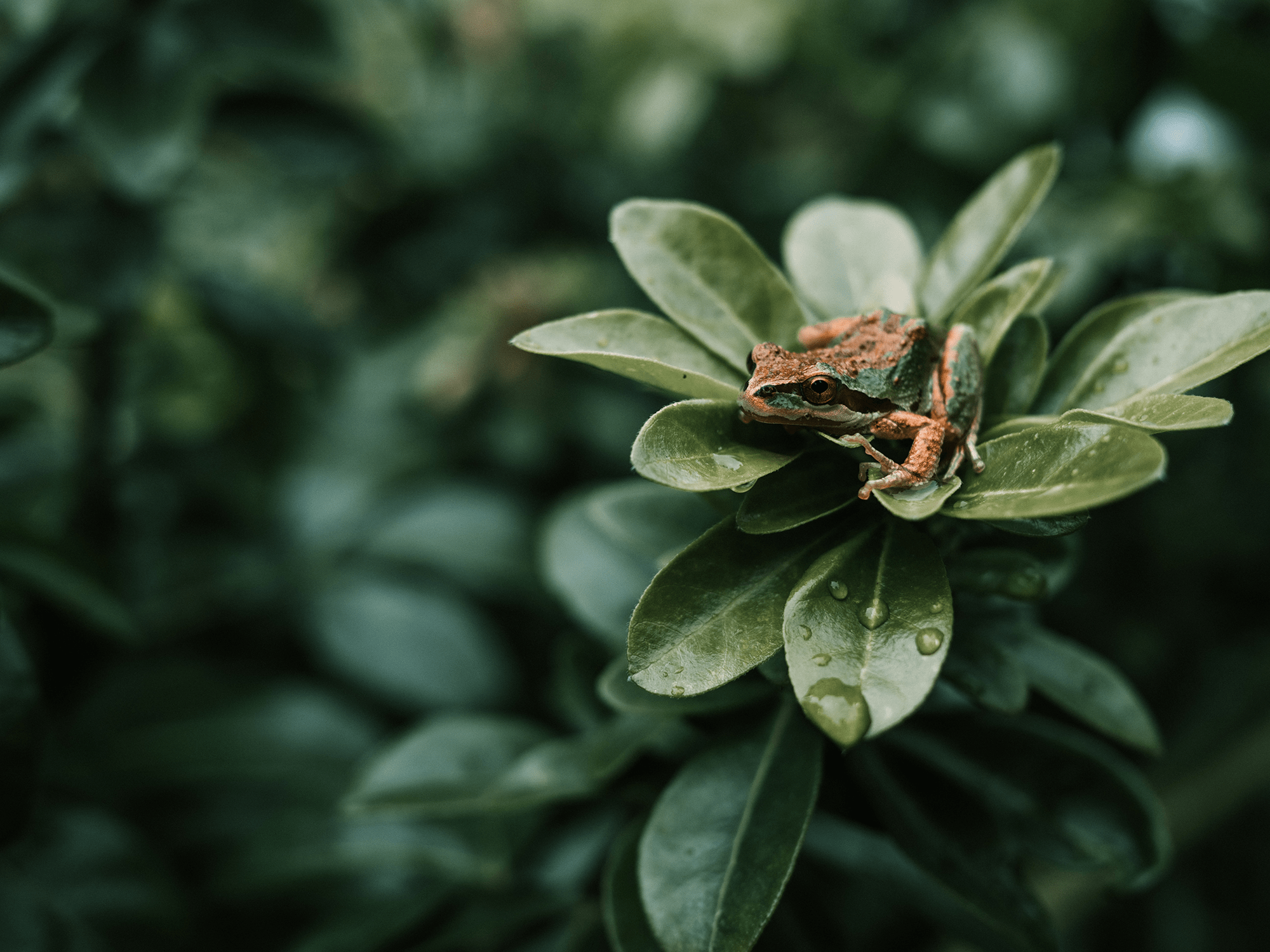
Most frogs and toads are excellent jumpers, taking off and landing with a control and grace that rivals elite athletes. Not so for the pumpkin toadlet. These species have become so miniaturized that the structures of their inner ears are too narrow for the fluid flow that helps frogs (and humans!) orient themselves in space. So while the toadlet certainly can jump, it careens through the air drunkenly and lands in any old direction. It’s hard not to laugh at their belly flops, somersaults, and straight-up head-first crashes. Fortunately, being so small, these landings don’t seem to hurt the toadlets, but one imagines they’re unpleasant nevertheless. Left to their own devices, the pumpkin toadlet prefers walking, slowly, like a chameleon; it might be the only way to stay within the limits of its inner ear. (Image credits: top – S. Kikuchi, others – R. Essner, Jr. et al.; research credit: R. Essner, Jr. et al.; via The Atlantic; submitted by Kam-Yung Soh)

Swimming in Complex Fluids
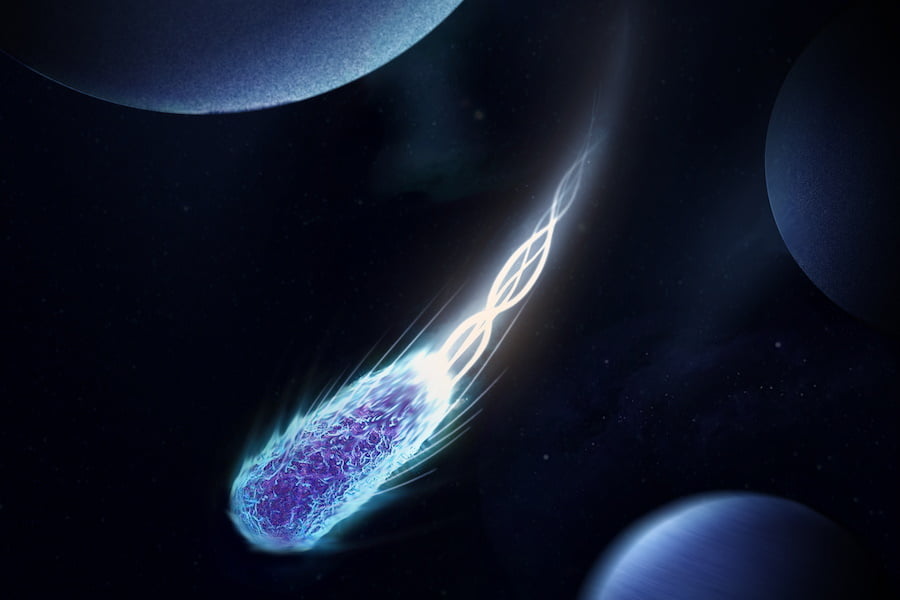
Bacteria like E. coli swim using flagella, helical filaments attached to biological motors on their bodies. By rotating the flagella, the bacterium generates thrust that propels it forward. Oddly, though, researchers observed decades ago that bacteria actually travel faster through complex fluids — like those with polymers or particles in them — than they do through simple fluids like water. A new study using colloids — small particles suspended in a liquid — shows why.
The researchers compared bacteria swimming through polymer-filled fluids and colloidal fluids and found strong overlap both qualitatively and quantitatively. They observed, for example, that bacteria swim in straighter lines — they wobble less — in complex fluids. The reason, according to the authors, is the hydrodynamic influence of the added materials. Essentially, when a bacterium swims near a colloid or piece of polymer, the particle exerts a torque on the microswimmer that reduces its wobble and enhances its speed. (Image credit: Cheng Research Group; research credit: S. Kamdar et al.; via Physics World)
Recreating Flocks


Birds, fish, and other creatures form amazing, undulating swarms of individuals. How these collectives comes together and move continues to fascinate scientists. Here, researchers look at simple particles with two “instructions,” if you will. One causes the particle to self-navigate toward a target; the other causes short-range repulsion if the particle gets too close to another one. With only these two simple guidelines, a flock of these particles forms complex, ever-changing flows! (Image and video credit: M. Casiulis and D. Levine)
Flying With Geese

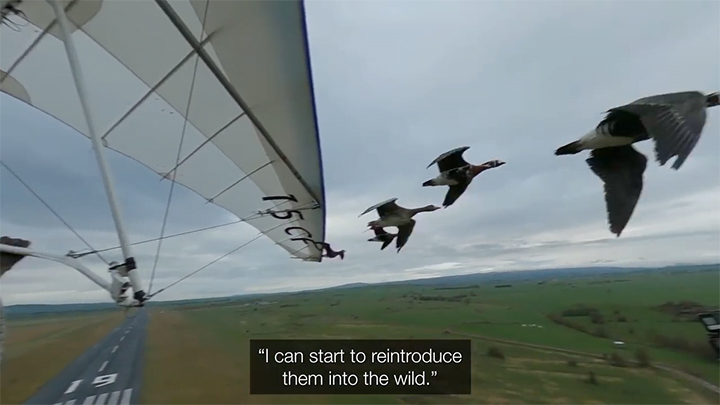

Some people fly with geese to train them for wind tunnel tests, and some people fly with them to teach them safer migratory paths. Today’s video focuses on the latter, specifically conservationist Christian Moullec, who has spent decades living and flying with lesser white-fronted geese as part of an effort to save the threatened species. He flies with them using an ultralight aircraft, exercising daily to prepare for the cross-continental migration. To help fund the effort, he offers passengers a spot on his short flights, letting people fly with the birds! (Image and video credit: T. Scott; via Colossal)

Moving By (Intestinal) Wave


A word of warning: today’s post includes visuals of digestion taking place in (non-human) embryonic intestines.
Our bodies rely on waves driven by muscle contractions to move both fluids and solids, whether through the esophagus, the ureter, the fallopian tubes, or the intestines. In areas where mixing is unnecessary, those waves move in a single direction, transporting the contents one-way. But in the intestines, mixing is critical to enhancing nutrient absorption, so mammal intestines have wave trains that move both forwards and backwards.
The majority of waves move downstream, carrying waste toward its exit (Images 1 and 2). But occasionally, upstream waves collide with their downstream counterparts to force material together, both mixing and delaying progress in order to allow better nutrient uptake along the intestinal walls (Image 3). (Image credits: top – S. Bughdaryan, others – R. Amedzrovi Agbesi and N. Chavalier; research credit: R. Amedzrovi Agbesi and N. Chavalier; via APS Physics)

Perching Aerodynamics
When birds come in for a landing, they pitch back and heave their wings as they come to a stop in a perching maneuver. Some birds, researchers noticed, partially fold their wings during the move, creating what’s known as a swept wing. Curious as to the effect of this sweep, the team recreated the wing motion of a perching bird using two flat plates — one rectangular and one swept — and measured the flow around them during the maneuver. They found that the swept wing had greater lift, thanks to a spanwise flow inherent to swept wings that helped stabilize the leading-edge vortex. (Image credit: D. George; research credit: D. Adhikari et al.; via APS Physics)