Like humans, plants can spread pathogens to one another. Although scientists had observed correlations between rainfall and the spread of diseases among plants, this study is one of the first to look at the fluid dynamics of leaf and rainfall interaction. When a raindrop hits a leaf, it doesn’t simply splash as it would against an immobile surface. The impact of the drop deforms the leaf, and the plant’s rebound significantly affects the trajectory and size of the resulting droplets. Depending on factors like the leaf’s stiffness, a large drop, carrying many pathogens, may rebound and splatter onto a neighboring leaf. Other leaves tend to catapult out many smaller droplets, which may fly farther afield but carry fewer pathogens. For more, check out the press release or the original research paper. (Video credit: Massachusetts Institute of Technology; research credit: Bourouiba Research Group)
Tag: biology

Why Joints Pop
Joints like our knuckles are lubricated with liquid called the synovial fluid. When manipulated, these joints can pop or crack audibly. For half a century, researchers have thought the cracking sound joints under tension make was the result of bubbles in the synovial fluid collapsing. But a new cine magnetic resonance imaging (MRI) study shows that the sound is generated during bubble inception and that the cavity persists after the sound. When the bones of the joint are pulled, viscous forces resist their separation. With enough force, the joints separate suddenly, causing a pressure drop in the synovial fluid that forms a vapor-filled cavity in the joint. According to the real-time MRI observations, this is when the sound is generated. The cavity does eventually dissipate, they found, but only well after the pop. The whole joint-cracking process is consistent with the tribonucleation mechanism seen in machinery. (Image credit: G. Kawchuk et al.; GIF via skunkbear, source video)

How Eyelashes Work
New research shows that eyelashes divert airflow around the eye, serving as a passive filter that reduces dust collection and controls evaporation. Mammal hairs in places like the nose act as ram filters that trap the particles that hit them and which require regular cleaning via sneezing. Eyelashes, on the other hand, prevent dust collection by altering airflow at the surface of the eye. At the optimal length of roughly 1/3rd the width of an eye, eyelashes create a stagnation zone near the eye surface that forces air to travel above rather than through the eyelashes. This results in lower shear stress and lower flow speeds at the eye surface, both of which help reduce evaporation and shield the eye from dust. Lashes can get too long, though; the researchers found that longer lashes tended to channel higher flow speeds toward the eye surface, leading to faster evaporation rates. Thus, donning longer fake eyelashes may dry out your eyes. (Image credit: G. Diaz Fornaro; research credit: G. Amador et al.; via skunkbear)

Singing Toads
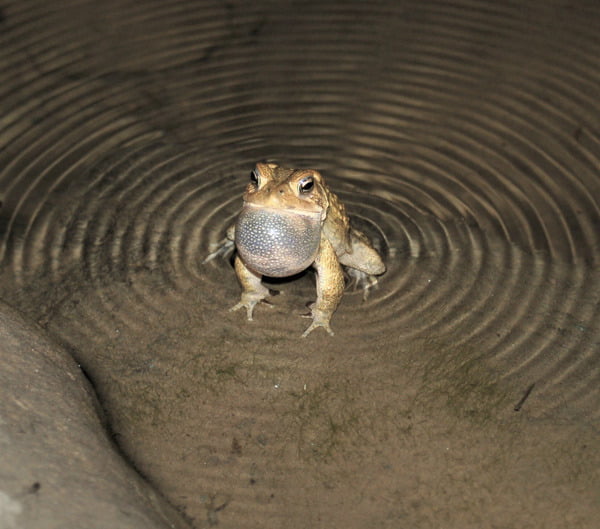
Many male frog and toad species sing during warmer months to attract mates. Some, like the American toad in the photo above, can be heard for an impressive distance. Here’s a video of an American toad in action. To sing, these amphibians close their mouth and nostrils, then force air from their lungs past their larynx and into a vocal sac. As with human sound-making, forcing air past the frog’s larynx vibrates its vocal cords and generates noise. That noise resonates in the vocal sac, amplifying the sound and driving the ripples seen in the photo. (Image credit: D. Kaneski; submitted by romannumeralfive)

Swimming Through Sand
Shovel-nosed snakes and sandfish lizards both swim through granular materials like sand. Researchers at Georgia Tech used x-rays to observe their subsurface motions. Despite their different shapes, the long, slender snake and the shorter, wider lizard both move under the sand by projecting traveling waves along their bodies. The snake’s long, skinny body allows it to have more bends along its length, which increases its transport efficiency because it allows the snake to move mostly through the tunnel created by its head’s passage. In contrast, the sandfish’s motions fluidize the sand around it, enabling it to swim. Although the snake is faster, both animals have optimized their motions for fast, low-energy transit according to their body type. (Video credit: Georgia Tech; research credit: S. Sharpe et al.; via io9)

Filter-Feeding
Sponges are filter-feeding marine animals that rely on water flow to obtain their nutrients and remove waste. By injecting non-toxic fluorescein dye at their base, one can visualize the flow they induce in the water. Only seconds after the dye is introduced, the sponges have pumped it in, through, and out. Different parts of the sponge filter particles of various sizes for food. Oxygen and carbon dioxide are transported, respectively, into and out of cells via diffusion. In this way, the sponge’s pumping fulfills digestive, respiratory, and excretory functions. (Image credit: Jonathan Bird’s Blue World, source video; submitted by Jason C)

Colonial Life


Hydroids are small underwater animals that often live in colonies made up of individual polyps. The colony is interconnected through the gastrovascular system, which is responsible for both digestion and respiration. In the images above, a single polyp in the colony has been fed food dyed with a fluorescent tracer. The polyp serves as a circulating pump and, as the food is digested and the tracer released, more and more of the colony becomes visible. Watch the full video and read more about the experiment. (Video credit and submission: L. Buss Lab)
The Physics of Sneezing
Sneezing can be a major factor in the spread of some illnesses. Not only does sneezing spew out a cloud of tiny pathogen-bearing droplets, but it also releases a warm, moist jet of air. Flows like this that combine both liquid and gas phases are called multiphase flows, and they can be a challenge to study because of the interactions between the phases. For example, the buoyancy of the air jet helps keep smaller droplets aloft, allowing them to travel further or even get picked up and spread by environmental systems. Researchers hope that studying the fluid dynamics and mathematics of these turbulent multiphase clouds will help predict and control the spread of pathogens. Check out the Bourouiba research group for more. (Video credit: Science Friday)

Bioluminescence
In the dark of the ocean, some animals have evolved to use bioluminescence as a defense. In the animation above, an ostracod, one of the tiny crustaceans seen flitting near the top of the tank, has just been swallowed by a cardinal fish. When threatened, the ostracod ejects two chemicals, luciferin and luciferase, which, when combined, emit light. Because the glow would draw undesirable attention to the cardinal fish, it spits out the ostracod and the glowing liquid and flees. Check out the full video clip over at BBC News. Other crustaceans, including several species of shrimp, also spit out bioluminescent fluids defensively. (Image credit: BBC, source video; via @amyleerobinson)

The Churning of Corals


Corals may appear static, but near the surface the tiny hair-like cilia of these polyps are churning the water. Although it has been known for some time that corals have cilia, scientists had previously assumed they only moved water parallel to the coral’s surface. Instead recent flow visualizations show that the cilia’s movements generate larger-scale vortical flows near the coral that can help draw fresh nutrients in as well as flush waste away. This means that, instead of being reliant on currents and tides, corals can exert some control on their environment in order to get what they need. This insight into coral cilia may shed some light on the micro- and macroscopic flows generated by other cilia, like those in our lungs. For a similar example of seemingly-passive organisms generating their own flows, check out how mushrooms create air currents to spread their spores. (Image credits: O. Shapiro et al. and MIT News; source video; h/t to Katie B)