Tag: biology

  • Featured Video Play Icon

    The Unsinkable Pygmy Gecko

    The Brazilian pygmy gecko is a tiny inhabitant of the Amazon rainforest, growing to no longer than 24 mm. But these tiny lizards have some incredible superpowers when it comes to surviving the rainforest’s deluges. The gecko’s surface is superhydrophobic — water repellent — thanks to millions of tiny hairs that create air pockets between water and the gecko’s skin. This superhydrophobic surface, combined with the gecko’s tiny stature, allow it to sit atop water, supported entirely by surface tension. (Image and video credit: BBC Earth)

  • The Fluidity of Worm Blobs

    The Fluidity of Worm Blobs

    The aquatic blackworm forms blobs composed of thousands of individual worms for protection against evaporation, light, and heat. The worms braid themselves together (Image 1). Once a blob forms, it is extremely viscoelastic, displaying properties both solid and fluid in nature (Image 2).

    The worm blobs act like a collective; they bunch up to prevent evaporation that would desiccate the worms. Under intense light, the blob contracts (Image 3). The worms also prefer colder temperatures (again, to prevent evaporation) and will move toward the colder side of a temperature gradient. Under dim light, they’ll move individually, but in brighter light, the worms move collectively as a blob (Image 4).

    To do so, worms on the colder side of the blob pull toward the cold, whereas worms elsewhere in the blob wiggle (Image 5). Their wiggling helps lift the blob and reduce its friction so that the pulling worms can move the blob in the right direction. For more, check out this excellent thread by one of the authors. (Image and research credit: Y. Ozkan-Aydin et al.; via S. Bhamla; submitted by Maximilian S.)

  • How Wombats Make Stackable Feces

    How Wombats Make Stackable Feces

    Wombats are unique among the animal kingdom for their ability to produce cubic feces approximately the size and shape of dice. Researchers found that wombats accomplish this geometric feat thanks to the structure of their intestines, which have bands of differing stiffness that run the full length of their guts. When the intestines contract, the stiffer bands contract first, gradually shaping and sculpting the corners of the feces.

    The results have implications both for manufacturing soft materials and for human health. One of the early effects of colon cancer is a stiffening of portions of the intestine; that means that doctors may be able to use changes in the shape of a patient’s feces as a warning sign for diagnosis. (Image and research credit: P. Yang et al.; video credit: Royal Society of Chemistry; via Gizmodo)

  • Flexible Wings Aid Butterfly Flight

    Flexible Wings Aid Butterfly Flight

    Butterflies are some of the oddest flyers of the insect world, given the large size of their wings relative to their bodies. That could be a recipe for inefficient flight, but a new study shows that butterflies’ large flexible wings actually help them take off quickly.

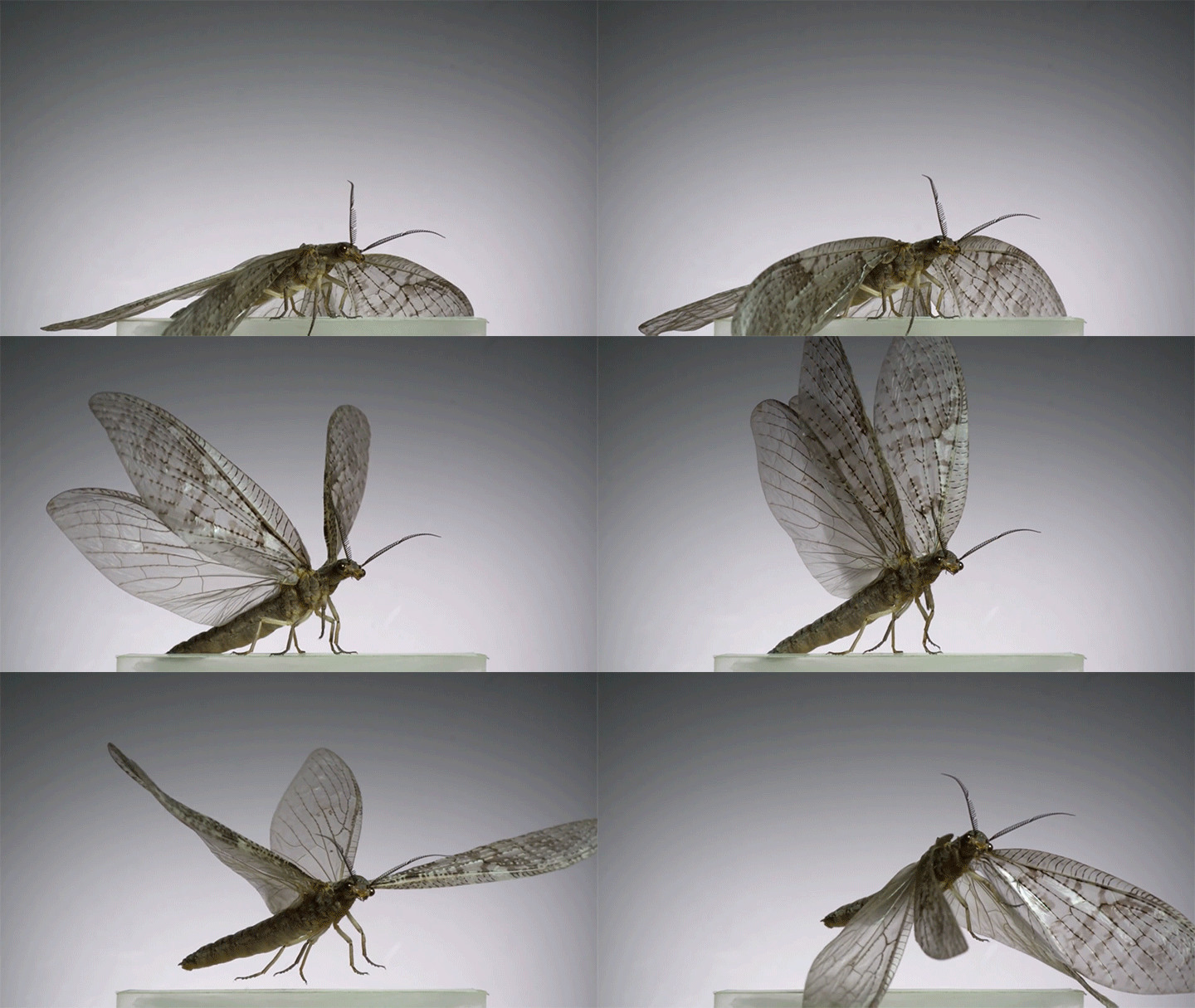
    When lifting their wings, butterflies use an unusual clapping motion, with the leading edges of their wings coming together before the rest of the wings. This motion helps cup and direct air, creating most of the butterfly’s thrust, according to the researchers. The wings’ flexibility is key to this. Using artificial wings — both stiff and flexible — researchers found that the flexible wings generated 22% more useful impulse and were 28% more efficient. For a tiny flyer with frequent take-offs, that’s an enormous savings! (Image, video, and research credit: L. Johansson and P. Henningsson; via BBC; submitted by Kam-Yung Soh)

  • Sand Traps

    Sand Traps

    Antlion larvae catch prey by digging conical pits in sand. The steep walls of the trap are near the angle of repose, the largest angle a granular material can maintain before grains slide down. When a hapless ant wanders into the trap, the antlion throws sand from the center of the pit, triggering a sandslide that carries the ant downward. The act of flinging sand also helps the antlion maintain the pit, correcting any disruptions to the pit’s steep sides caused by its flailing prey. (Image and research credit: S. Büsse et al.; via Science)

  • Featured Video Play Icon

    Rocket Yeast

    Usually, microbial colonies are grown on a solid substrate, but what happens when they grow on a liquid surface? That’s the question explored in this Gallery of Fluid Motion video featuring colonies of brewer’s yeast on various liquid substrates. When the viscosity of the liquid is low enough, the colony actually gets pulled apart (Image 2). This behavior is driven by a convective flow in the liquid caused by the colony’s own growth. As the yeast grow, they deplete nearby sugar, creating a density gradient that triggers convection beneath the colony. (Image, video, and research credit: S. Atis et al.)

  • Hammerhead Hydrodynamics

    Hammerhead Hydrodynamics

    Hammerhead sharks have some of the most distinctive craniums in the ocean, which begs the question: how do they swim with that head? New computational fluid dynamics studies suggest that their long foil-shaped heads help the sharks maneuver swiftly, but they come at the cost of substantially higher drag. The researchers found that drag on the hammerhead’s cranium required energy expenditures more than 10 times higher than other sharks, but since the study looked at heads only, it’s possible that the rest of the shark’s positioning helps mitigate that cost. (Image credit: shark – J. Allert, CFD – M. Gaylord et al.; research credit: M. Gaylord et al.; via NYTimes; submitted by Kam-Yung Soh)

    Pressure contours and streamlines around a hammerhead shark head.
  • Featured Video Play Icon

    Rolling Off a Duck’s Back

    Ducks and other water fowl need protection from the elements. Fortunately for them, the structure of their feathers cleverly helps them shed water. As seen in this video, feathers have tiny hooks, called barbicels, that act like Velcro, zipping the individual barbs of a feather together to keep water out. When birds preen, they’re using their bills to rezip any sections that came loose. They also use their bills to spread a waxy substance onto the feathers to give them even more waterproofing. All together, these measures help the birds keep out cold water and trap warm air in the down near their skin. (Image and video credit: Deep Look)

  • Sensing Obstacles Through Flow

    Sensing Obstacles Through Flow

    Mosquitoes, bats, and even eels use non-visual means to sense their environments. For mosquitoes, part of their obstacle avoidance comes from the exquisite sensitivity of their antennae, which are able to sense subtle changes in the air flow around them as they approach a wall or the ground. Researchers used this same technique to help a quadcopter avoid crashing by adding air pressure sensors that respond to the changes in the copter’s wake as it approaches the ground. (Image and research credit: T. Nakata et al.; via Science)

  • Collecting Animal Tears

    Collecting Animal Tears

    Like humans, most vertebrates rely on tear films to keep their eyes moist and protected from the environment. But compared to humans, some animals’ tears have superior staying power. The caiman, for example, can go up to 2 hours between blinks without their eyes drying out; in contrast, humans have to blink about 15 times per minute – and sometimes even that isn’t enough to keep our eyes moist!

    Researchers are collecting animal tears and studying their composition to better understand how their tears protect vision. Subtle changes in chemical make-up can lead to large variations in performance; just look at the many dried tear patterns in Image 2. Scientists hope that understanding other species’ tears will help us develop better treatments for our own vision problems. As someone who struggles with dry eyes at times, I’d be happy for some caiman-tear-inspired eye drops! (Image credit: A. Oriá; research credit: A. Raposo et al.; via NYTimes; submitted by Kam-Yung Soh)