When birds come in for a landing, they pitch back and heave their wings as they come to a stop in a perching maneuver. Some birds, researchers noticed, partially fold their wings during the move, creating what’s known as a swept wing. Curious as to the effect of this sweep, the team recreated the wing motion of a perching bird using two flat plates — one rectangular and one swept — and measured the flow around them during the maneuver. They found that the swept wing had greater lift, thanks to a spanwise flow inherent to swept wings that helped stabilize the leading-edge vortex. (Image credit: D. George; research credit: D. Adhikari et al.; via APS Physics)
Tag: swept wing

Flow on Commercial Wings
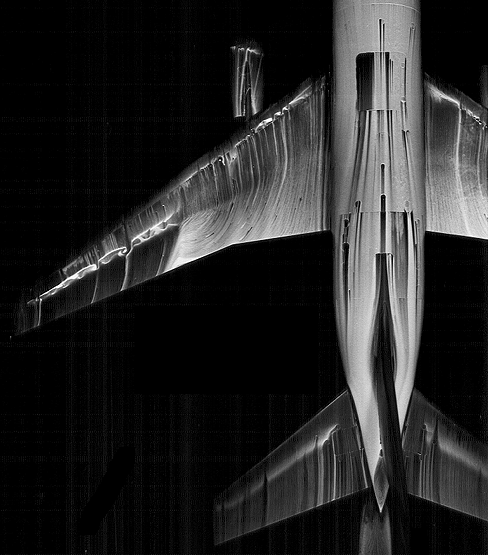
Even in an era of supercomputers, there is a place for quick and dirty methods of flow visualization. Here we see a model of a swept wing like those seen on many commercial airliners. It was painted with a layer of fluorescent oil, then placed in a wind tunnel and subjected to flow. As air blows across the model, it moves the oil, leaving behind streaks that show how air near the surface moves.
We can see, for example, that near the fuselage, the air flows mostly front to back across the wing. That’s what we expect, especially for a wing generating lift. But further out on the wing, the flow moves mostly along the wing, not across it. There’s also a distinctive line running just a short ways behind the leading edge on this outer section of wing. It looks as though air flowing over the wing separated at this point, leaving disordered and unhelpful flow behind. It’s likely that the model was tested at an angle of attack where the outer section of the wing was beginning to stall. (Image credit: ARA)

Why Do Backwards Wings Exist?


Over the years, there have been many odd airplane designs, but one you probably haven’t seen much is the forward-swept wing. While most early aircraft featured straight wings, rear-swept wings are fairly common today, especially among commercial airliners. A rear-swept wing has its forward-most point at the root of the ring, where it attaches to the fuselage. The sweep breaks up the incoming flow into a chordwise component that flows from the leading edge to the trailing edge of the wing and a spanwise component that flows along the wing. Compared to straight wings, a swept wing provides better stability and control when flying at transonic speeds where shock waves can form on the wing (even though the plane itself is not supersonic).
The trouble with rear-swept wings is that when they stall, they do so from the wingtips inward. Since the ailerons that control the plane’s orientation are out near the wingtips, that’s a problem. Forward-swept wings were supposed to solve this issue because they would stall from the root outward. But they came with a whole new set of problems, which included the need for robust onboard computers controlling them constantly to keep them in stable flight. In the end, the disadvantages outweighed any gains and so, for the most part, the forward-swept wing design has seen little flight time. (Image and video credit: Real Engineering)

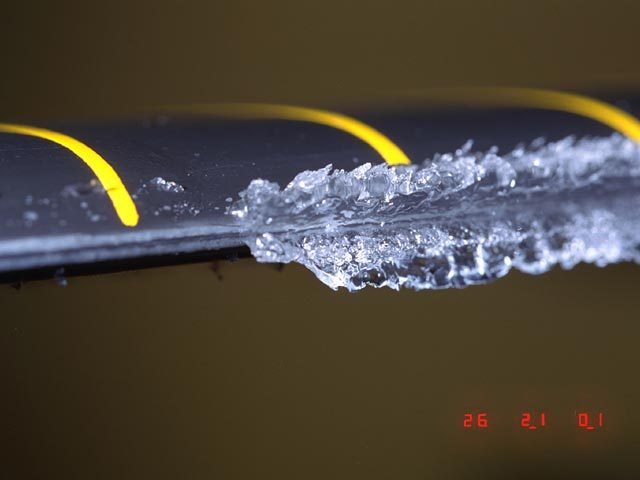
Icing on Airplane Wings
Icing on airplane wings remains little understood and a major hazard. These photos show examples of ice formation along the leading edge of a swept wing. If an aircraft flies through a cloud of supercooled water droplets, the droplets will freeze shortly after impact with the aircraft’s wings. As ice continues to build up in strange shapes, the aerodynamic profile of the wing changes, which can lead to disastrous effects as the stall and control characteristics of the wing shift. (Photo credit: NASA Glenn Research Center)

Flow Over Swept Wings
Flow over a swept wing behaves very differently than a straight fixed wing or an airfoil. Instead of flowing straight along the chord of the wing in a two-dimensional fashion, air is also directed along the wing, parallel to the leading edge. The above oil flow visualization on a swept wing airplane model shows this curvature of streamlines. As a result of this three-dimensional flow behavior, boundary layers on swept wings are subject to the crossflow instability, which manifests as co-rotating vortices aligned to within a few degrees of the streamlines. Triggering this boundary layer instability can lead to turbulence and higher drag for the aircraft.