Search results for: “waves”

  • Featured Video Play Icon

    Mach Diamonds

    Joe asks:

    Why does this rocket have that repeating pattern in its exhaust? I’m amazed that it’s so stable for so far as distance from the nozzle.

    Excellent question! The diamond-shaped pattern seen in the rocket’s exhaust is actually a series of reflected shock waves and expansion fans. The rocket’s nozzle is designed to be efficient at high altitudes, which means that, at its nominal design altitude, the shape of the nozzle is such that the exhaust gases will be expanded to the same pressure as the ambient atmosphere. At sea level, the nozzle is overexpanded, meaning that the exhaust gases have been expanded to a lower pressure than the ambient. The supersonic exhaust has to reach ambient pressure, and it does so through an oblique shock right at the exit of the nozzle. However, the oblique shock, in addition to raising the pressure, turns the gases toward the exhaust centerline. To ensure flow symmetry, two additional oblique shocks form. But then the exhaust is at a higher pressure than ambient. Expansion fans form to reduce the pressure, but those, too, affect the direction the exhaust gases flow. The pattern, then, is a series of progressively weaker oblique shocks and expansion fans that raise the exhaust gas pressure to that of the ambient atmosphere.
  • Featured Video Play Icon

    Seeing the Invisible

    Schlieren photography is a common experimental flow visualization technique, especially in supersonic flows (where it enables one to see shock waves). Here the Science Channel’s “Cool Stuff: How It Works” show explains the technique and shows some examples from everyday life.

  • Vibrating Oobleck

    [original media no longer available]

    This video explores some of the non-Newtonian behaviors of oobleck when shaken. The pattern across the surface once the vibrations start is called Faraday waves, a type of nonlinear standing wave that forms once a critical vibrational frequency is passed and the flat surface of the fluid becomes unstable. Toward the end of the video, the frequency of the vibrations is increased until “finger-like protrusions” form. This is a behavior exhibited by shear-thickening non-Newtonian fluids.

  • Featured Video Play Icon

    Wave Pool

    This Japanese pool, lined with computer-controlled actuators, uses the principle of wave interference to create complex shapes at the center of the pool. While we may be more familiar with wave interference using light or sound, the principles remain the same for a wave in a fluid. (via Gizmodo and phredgreen)

  • Featured Video Play Icon

    Supersonic

    Moving supersonically–faster than the local speed of sound–can cause some awesome effects. Among these are vapor cones (a.k.a. Prandlt-Glauert singularities), shock waves, and, of course, the sonic boom.

  • Flying Fish Aerodynamics

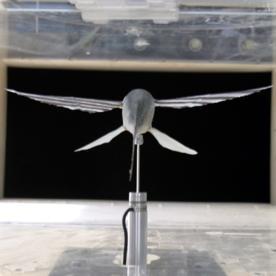
    Flying Fish Aerodynamics

    New research using wind tunnel measurements of (dead) flying fish is giving new insight into how these fish are able to fly over the waves. Lift and drag data indicates that flying fish have a gliding ability comparable to soaring birds like hawks! #

  • Featured Video Play Icon

    The Sound of Helium

    Gases of different density are good for more than just physics demonstrations. They also affect the transmission of sound waves, thereby altering our perception of pitch. As fun as sulfur hexafluoride is, though, don’t go playing with it at home; it’s an extremely potent greenhouse gas.

  • Featured Video Play Icon

    Breaking the Sound Barrier

    The shock waves propagating in front of an Atlas V rocket after launch decimate a rainbow-like effect called a sun dog. #