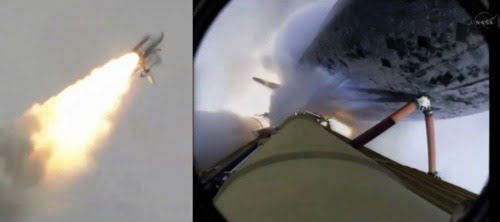
The launch of the Solar Dynamics Observatory (SDO) last year provided a rarely seen glimpse of how shock waves affect the atmosphere during launch, but only recently have researchers explained the white column that seemed to follow SDO toward orbit. Simulations indicate that the shock waves from the rocket aligned the ice crystals in the atmosphere into an array of spinning tops. Individual crystals precess as a result of the rocket passing; the column is part of a larger oval that would have been visible had the ice crystals covered a larger range. See Wired for more. #
Search results for: “waves”
Reader Question: Froude vs. Reynolds
@spooferbarnabas asks: I was wondering what the difference is between Froude’s number and Reynold’s number? they seem very similar
Fluid dynamicists often use nondimensional numbers to characterize different flows because it’s possible to find similarity in their behaviors this way. The Reynolds number is the most common of these dimensionless numbers and is equal to (fluid density)*(mean fluid velocity)*(characteristic length)/(fluid dynamic viscosity). The Reynolds number is considered a ratio of total momentum (or inertial forces) to the molecular momentum (or viscous forces). A small Reynolds number indicates a flow dominated by viscosity; whereas a flow with a large Reynolds number is considered one where viscous forces have little effect.
The Froude number, in contrast, focuses on resistance to flow caused by gravitational effects, not molecular effects. It is defined as (mean fluid velocity)/(characteristic wave propagation velocity). Initially, it was developed to describe the resistance of a model floating in water when towed at a given speed. As the boat’s hull moves through the water, it creates a wave that travels forward (and backward in the form of the wake), carrying information about the boat–much like pressure waves travel before and behind a subsonic aircraft. The speed of the wave created by the boat depends on gravity (see shallow water waves). The closer the boat’s speed comes to the water wave’s speed, the greater the resistance the boat experiences. In this respect, the Froude number is actually analogous to the Mach number in compressible fluids.
I hope that helps explain some of the differences!

Vibrating Fluid Interfaces
The Faraday instability forms when a fluid interface is vibrated. This high-speed video shows the differences in the shapes formed by a vibrated fluid interface when the two fluids are miscible–capable of mixing–and when they are immiscible–like oil and water. Note how the miscible interface breaks down quickly into turbulence, but the immiscible interface maintains a complex shape.

Soap Bubble Shapes
The shapes of soap bubbles are determined by surface tension, which ensures the smallest surface area for a given contained volume. (#) Their iridescent colors are created by the interference and refraction of light waves passing through the nonuniform thickness of the bubble, as well as to the motion of the soap mixture itself.
Photo credit: found via fuckyeaheyegasms, originally from teacupofmoons

Mach Diamonds
Joe asks:
Why does this rocket have that repeating pattern in its exhaust? I’m amazed that it’s so stable for so far as distance from the nozzle.
Excellent question! The diamond-shaped pattern seen in the rocket’s exhaust is actually a series of reflected shock waves and expansion fans. The rocket’s nozzle is designed to be efficient at high altitudes, which means that, at its nominal design altitude, the shape of the nozzle is such that the exhaust gases will be expanded to the same pressure as the ambient atmosphere. At sea level, the nozzle is overexpanded, meaning that the exhaust gases have been expanded to a lower pressure than the ambient. The supersonic exhaust has to reach ambient pressure, and it does so through an oblique shock right at the exit of the nozzle. However, the oblique shock, in addition to raising the pressure, turns the gases toward the exhaust centerline. To ensure flow symmetry, two additional oblique shocks form. But then the exhaust is at a higher pressure than ambient. Expansion fans form to reduce the pressure, but those, too, affect the direction the exhaust gases flow. The pattern, then, is a series of progressively weaker oblique shocks and expansion fans that raise the exhaust gas pressure to that of the ambient atmosphere.

Seeing the Invisible
Schlieren photography is a common experimental flow visualization technique, especially in supersonic flows (where it enables one to see shock waves). Here the Science Channel’s “Cool Stuff: How It Works” show explains the technique and shows some examples from everyday life.
Vibrating Oobleck
[original media no longer available]
This video explores some of the non-Newtonian behaviors of oobleck when shaken. The pattern across the surface once the vibrations start is called Faraday waves, a type of nonlinear standing wave that forms once a critical vibrational frequency is passed and the flat surface of the fluid becomes unstable. Toward the end of the video, the frequency of the vibrations is increased until “finger-like protrusions” form. This is a behavior exhibited by shear-thickening non-Newtonian fluids.

Wave Pool
This Japanese pool, lined with computer-controlled actuators, uses the principle of wave interference to create complex shapes at the center of the pool. While we may be more familiar with wave interference using light or sound, the principles remain the same for a wave in a fluid. (via Gizmodo and phredgreen)

Supersonic
Moving supersonically–faster than the local speed of sound–can cause some awesome effects. Among these are vapor cones (a.k.a. Prandlt-Glauert singularities), shock waves, and, of course, the sonic boom.