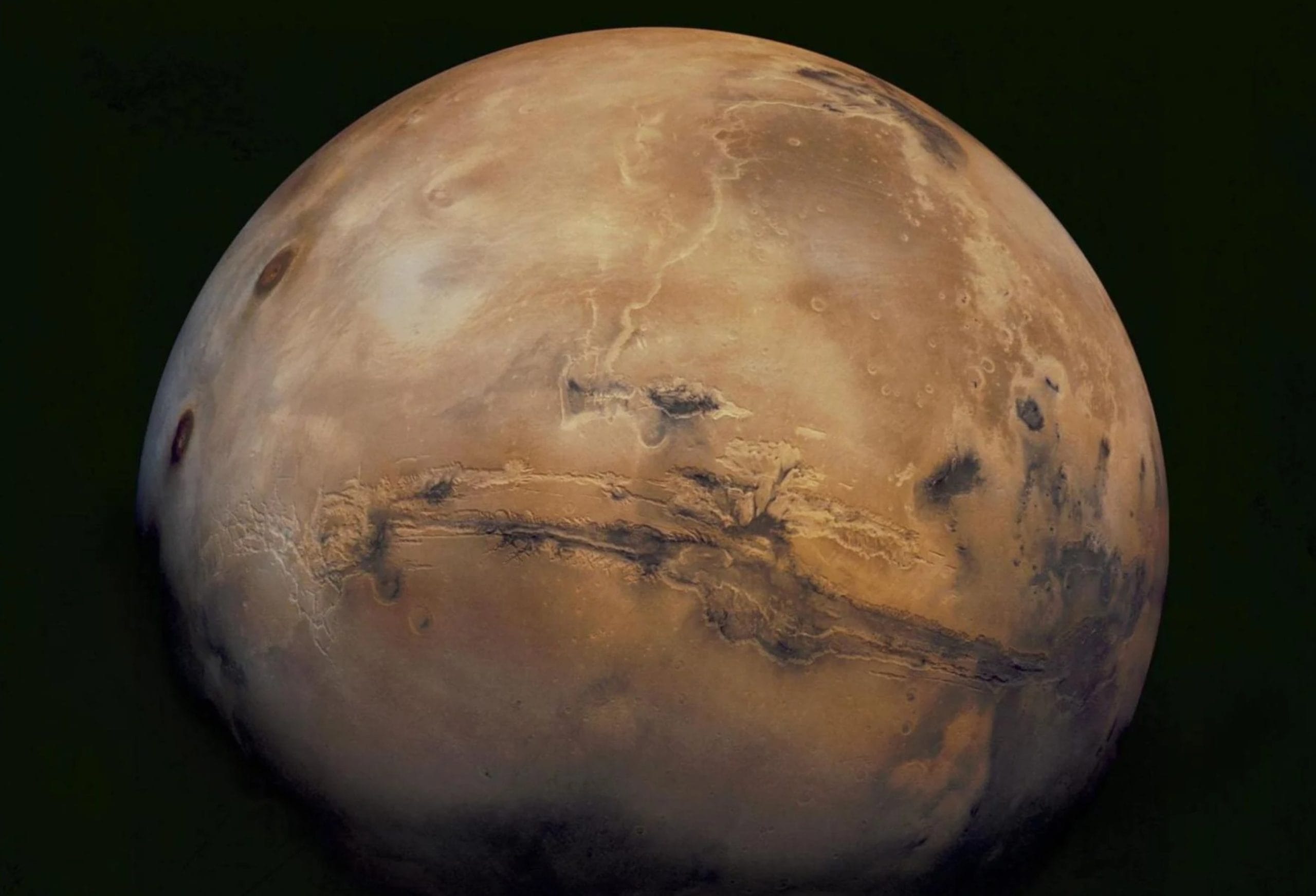
Mars was once a warmer, wetter place, swathed in a thick and protective atmosphere. Unlike Earth, Mars lacks a strong global magnetic field, which allows the solar wind to strip its atmosphere, but the exact mechanisms of that process have been unclear. But a new study has caught the process in action.
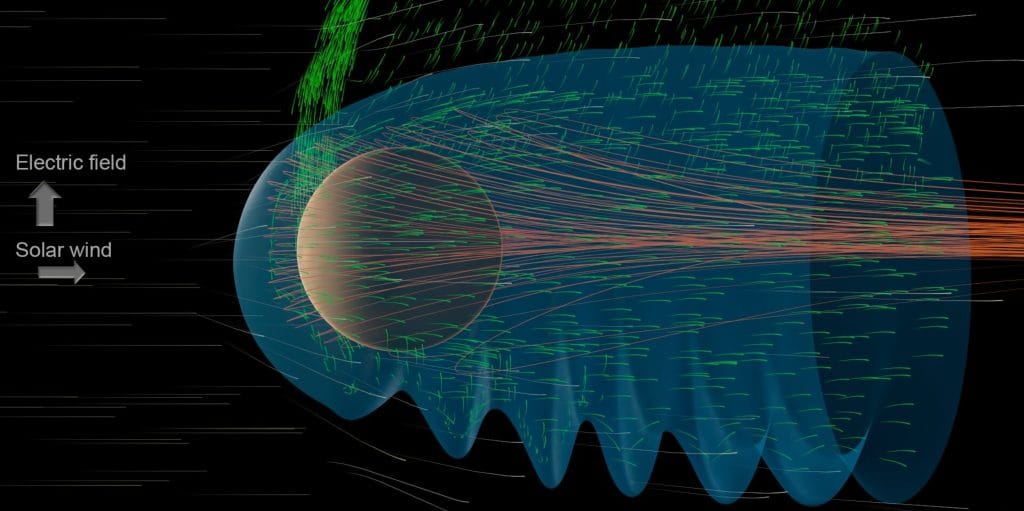
By combining simultaneous measurements from two spacecraft–NASA’s MAVEN and China’s Tianwen-1–the team was able to monitor the upstream solar wind conditions and the atmospheric ions escaping. They found that previously-observed “plasma clouds” in the Martian atmosphere result from a Kelvin-Helmholtz instability between the solar wind and Mars’ electric field. Within these clouds, the ion flux is ten to a hundred times greater than at steady-state conditions.
This mechanism directly couples ion escape from Mars’ atmosphere to the solar wind, and it’s likely that this process plays out for other unmagnetized planets as well. (Image credit: Mars – NASA, illustration – C. Zhang et al.; research credit: C. Zhang et al.; via Gizmodo)






Leave a Reply