Search results for: “water droplet”

  • Featured Video Play Icon

    Droplet Bounce

    This high-speed video shows the remarkable resilience of a water droplet upon impact against as a solid surface. The droplet deforms into a pancake-shape, with its center depressing almost flat before rebounding upward. The rest of the drop follows, splitting into several droplets as capillary waves dance across its surface. When one satellite drop almost escapes, the main droplet just barely comes in contact with it, the coalescence enough to tip surface tension into pulling them together instead of breaking them apart.  (Video credit: K. Suh/ChemistryWorldUK)

  • Featured Video Play Icon

    Breaking into Droplets

    A falling column of liquid, like the water from your faucet, will tend to break up into a series of droplets due to the Plateau-Rayleigh instability. This instability is driven by surface tension. Small variations in the radius of the column occur naturally. Where the radius shrinks, the pressure due to surface tension increases, causing liquid to flow away, which shrinks the column’s radius even further. Eventually the column pinches off and breaks into droplets. What’s especially neat is that the size of the final droplets can be predicted based on the column’s initial radius and the wavelength of its disturbances. (Video credit: BYU Splash Lab)

  • Featured Video Play Icon

    Encapsulating Droplets

    In applications like drug delivery, it’s often desirable to encapsulate one or more liquid droplets in an additional immiscible fluid. These drops-within-drops, called double emulsions, are typically a multi-step process, created from the innermost drop outward. In this new microfluidic technique, though, researchers are able to create multi-component emulsions in a single step. A double-bored capillary tube creates the two inner droplets (both water, dyed different colors) while oil flows down the outside of the injection tube to encapsulate the droplets. The multi-component double emulsions then flow as one to the right in the outer carrier fluid. The spacing of the capillary tubes is critical to prevent the inner droplets from coalescing with one another. (Video credit: L. L. A. Adams et al.)

  • Featured Video Play Icon

    Shocking Droplets

    Typical liquid drops will break apart into long, stretched ligaments and a spray of tiny droplets when deformed. But with just a small addition of polymers, these same liquids become viscoelastic and capable of some pretty incredible behaviors. This video shows a viscoelastic drop being struck by a shock wave that passes from right to left. The droplet is smashed and deformed, then stretches into jellyfish-like sheet of liquid. But incredibly, the elastic forces in the droplet are enough to hold it together. Researchers are interested in understanding these behaviors for many applications, including preventing accidental explosions caused by explosive fuels atomizing in air. (Video credit: T. Theofanous et al.)

  • Bouncing to Mix Oil and Water

    Bouncing to Mix Oil and Water

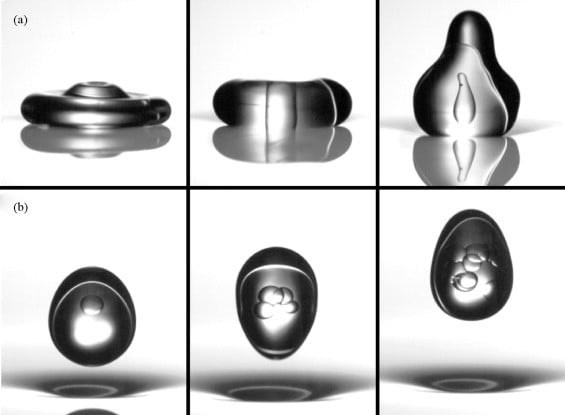
    Mixing immiscible liquids–like oil and water–is tough. The best one can usually do is create an emulsion, in which droplets of one fluid are suspended in another. The series of images above shows a double emulsion consisting of oil and water that’s been formed by bouncing the compound droplet on a vibrating bath. The vibration of the liquid surface keeps the droplet from coalescing with the bath and the deformation provides mixing. The top row shows the initial impact while the bottom row of images shows the droplet after many bounces. As time goes on, the layer of oil around the compound drop becomes a cluster of tiny droplets contained within the water portion of the drop. (Photo credit: D. Terwagne et al.)

  • Featured Video Play Icon

    Skittering Droplets

    Water splattered onto a a hot skillet will skitter and skip across the surface on a thin layer of vapor due to the Leidenfrost effect. The partial vaporization of the droplet provides a low-friction cushion for the droplet to glide on and acts as an insulating layer that delays the vaporization of the rest of the droplet. Modernist Cuisine shows us how serene this common and sometimes explosive effect looks at 3,000 frames per second. (On the topic of cooking, you can use the Leidenfrost effect to see if your skillet is hot enough when making pancakes. If a few droplets of water skitter across the pan before sizzling away, then your pan is ready for batter!) (Video credit: Modernist Cuisine; submitted by Eban B.)

  • Featured Video Play Icon

    Making Metal Water-Repellent

    Chemical treatments can be used to render metals hydrophobic, causing water to bead on the surface rather than spreading to wet it. Treating the surface by immersing it in boiling water before applying the chemicals creates a nanoscale texture that accentuates the hydrophobicity. Even on a common metal like aluminum, this combination of texturing and chemical treatment leads to superhydrophobic behavior. Here the technique is demonstrated by spraying water droplets on a piece of treated aluminum. (Video credit: B. Rosenberg et al.; submitted by D. Quinn)

  • Featured Video Play Icon

    Spitting Droplets

    Any phenomenon in fluid dynamics typically involves the interaction and competition of many different forces. Sometimes these forces are of very different magnitudes, and it can be difficult to determine their effects. This video focuses on capillary force, which is responsible for a liquid’s ability to climb up the walls of its container, creating a meniscus and allowing plants and trees to passively draw water up from their roots. Being intermolecular in nature, capillary forces can be quite slight in comparison to gravitational forces, and thus it’s beneficial to study them in the absence of gravity.

    In the 1950s, drop tower experiments simulating microgravity studied the capillary-driven motion of fluids up a glass tube that was partially submerged in a pool of fluid. Without gravity acting against it, capillary action would draw the fluid up to the top of the glass tube, but no droplets would be ejected. In the current research, a nozzle has been added to the tubes, which accelerates the capillary flow. In this case, both in terrestrial labs and aboard the International Space Station, the momentum of the flow is sufficient to invert the meniscus from concave to convex, allowing a jet of fluid out of the tube. At this point, surface tension instabilities take over, breaking the fluid into droplets. (Video credit: A. Wollman et al.)

  • Featured Video Play Icon

    The Water Bridge

    This short film offers an artistic look at the phenomenon of the water bridge. When subjected to a large voltage difference, such as the 30 kV used in the film, flow can be induced between water in two separated beakers. This creates a water bridge seemingly floating on air. There are two main forces opposing the bridge: gravity, which causes it to sag, and capillary action, which tries to thin the bridge to the point where it will break into droplets. These forces are countered by polarization forces induced at the liquid interface due to the electrical field separating the water’s positive and negative charges. This separation of charges creates normal stresses along the water surface, which counteracts the gravitational and capillary forces on the bridge. The artist has done a beautiful job of capturing the unsteadiness and delicacy of the phenomenon. (Video credit: Lariontsev Nick)

  • Reader Question: Snow from Boiling Water?

    [original media no longer available]

    Reader kylewpppd asks:

    Have you seen the post of a man in Siberia throwing boiling water off of his balcony? Can you provide a better explanation of what’s going on?

    As you can see in the video (and in many similar examples on YouTube), tossing near boiling water into extremely cold air results in an instant snowstorm. Several effects are going on here. The first thing to understand is how heat is transferred between objects or fluids of differing temperatures. The rate at which heat is transferred depends on the temperature difference between the air and the water; the larger that temperature difference is the faster heat is transferred. However, as that temperature difference decreases, so does the rate of heat transfer. So even though hot water will initially lose heat very quickly to its surroundings, water that is initially cold will still reach equilibrium with the cold air faster. Therefore, all things being equal, hot water does not freeze faster than cold water, as one might suspect from the video.

    The key to the hot water’s fast-freeze here is not just the large temperature difference, though. It’s the fact that the water is being tossed. When the water leaves the pot, it tends to break up into droplets, which quickly increases the surface area exposed to the cold air, and the rate of heat transfer depends on surface area as well! A smaller droplet will also freeze much more quickly than a larger droplet.

    What would happen if room temperature water were used instead of boiling water? In all likelihood, a big cold bunch of water would hit the ground. Why? It turns out that both the viscosity and the surface tension of water decrease with increasing temperature. This means that a pot of hot water will tend to break into smaller droplets when tossed than the cold water would. Smaller droplets means less mass to freeze per droplet and a larger surface area (adding up all the surface area of all the droplets) exposed. Hence, faster freezing!