Search results for: “water droplet”

  • Featured Video Play Icon

    The Droplet Slide

    One of the joys of science is the sense of discovery that can come even from looking at something seemingly simple. Take, for example, a water droplet sitting on a plate. If you slowly tilt the plate, the droplet’s shape will shift until a critical angle where it starts sliding down the plate. But what happens to two initially different droplets? As this video shows, tilting two droplets of initially different shapes and returning them to horizontal causes the droplets to assume the same shape. There’s a universal behavior at work here–like nature has a kind of reset button that makes gravity and surface tension work together such that a droplet will assume a preferred shape. For an experimentalist, it’s certainly a handy way to create repeatable experiments! (Video credit: M. Musterd et al.)

  • Boiling Water in Oil

    Boiling Water in Oil

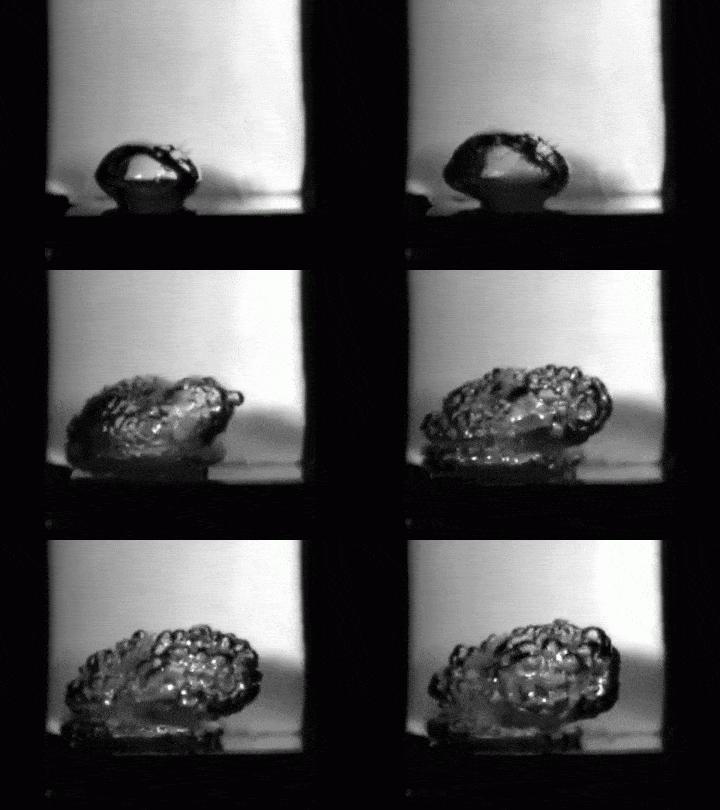
    Most people know that throwing water into hot oil is a bad idea. But, as dramatic as the results can be, the boiling of a water droplet submerged in oil is remarkably beautiful, as seen in the animations above. The initial water droplet expands as it shifts from liquid to vapor (top). At a critical volume, the expansion occurs explosively (middle), causing the bubble to overexpand relative to the pressure of the surrounding fluid. The higher pressure of the oil around it collapses the drop, which then re-expands, creating the cycle we see in the final two animations. This oscillation triggers a Rayleigh-Taylor type instability along the bubble’s interface, causing the surface corrugations observed. The vapor bubble will continue to rise through the oil, eventually breaking the surface and scattering hot oil droplets.  (Image credits: R. Zenit, source)

  • Controlling Droplet Bounce

    Controlling Droplet Bounce

    Water repellent, or hydrophobic, surfaces are common in nature, including lotus leaves, many insects, and even some geckos. These hydrophobic surfaces typically gain their water-repelling ability from extremely tiny nanoscale structures in the form of tiny hairs or specially textured surfaces. But, while the nanoscale structures impart superhydrophobicity, researchers have found that larger macroscale structures can improve water-repellent characteristics by reducing a drop’s time of contact with the surface. A smaller contact time means less chance of contamination on self-cleaning surfaces. It’s also helpful in preventing water from freezing on contact to cold surfaces – valuable, for example, in protecting airplane wings’ leading edges from icing over. This combination of nanoscale and macroscale, water-repelling structures can be found in nature, too, such as on the wings of butterflies, which must quickly shed water in order to fly. (Image credits: K. Hounsell et al.A. Gauthier et al., source video)

  • Alligators Water Dancing

    Alligators Water Dancing

    Amorous alligators call to mates with a behavior known as water dancing. Their audible bellows are accompanied by infrasonic soundvibrations below the 20 Hz limit of human hearing. These vibrations from their lungs excite Faraday waves in the water near the alligator’s back and make the surface explode in a dance of jets and atomized droplets. I’ve seen similar results in other instances of vibration, but this may be the only example of this I’ve seen in the wild. Researchers studying the phenomenon noted that the frequency of sound the alligators emit corresponds to a wavelength equal to the spacing of the raised scales, or scutes, on the alligators’ backs. They hypothesize that the shape of the scutes helps males create the display.  (Image credit: N. Marven, source; research credit: P. Moriarty and R. Holt; h/t to io9)

    ——————

    Don’t forget about our FYFD survey! I’ve teamed up with researcher Paige Brown Jarreau to create a survey of FYFD readers. By participating, you’ll be helping me improve FYFD and contributing to novel academic research on the readers of science blogs. It should only take 10-15 minutes to complete. You can find the survey here. Please take a few minutes to participate and share!

  • Featured Video Play Icon

    Water in Oil

    Pouring water on an oil fire is a quick way to cause almost explosive results. Since water is denser than oil, it quickly sinks to the bottom of a container, heating up as it does. When the water reaches its boiling point, it evaporates and expands as steam. That phase change involves a huge change in volume, a fact made especially clear in the video below. The steam expands and rises, throwing droplets of oil upward and outward. These smaller atomized droplets are easier to combust, which, in the case of the video above, causes a veritable cloud of flames if a fire has already started. 

    (Video credits: The Slow Mo Guys and N. Moore)

  • Featured Video Play Icon

    Make Your Own Dancing Droplets

    As a follow-up to last week’s “dancing droplet” post, here’s a video that describes how to recreate the experiment yourself at home. The droplet motion is driven by the two-component structure of the droplets, where differing evaporation rates and surface tension values between the two fluids in the drop cause the attractions and chasing behavior you see. To demonstrate this at home, you’ll need glass, fire (for sterilization), tweezers, a pipette, water, and food coloring. Looks like a fun way to spend a weekend afternoon! (Video credit: M. Prakash et al.; via io9)

  • Dancing Droplets

    Dancing Droplets

    What makes drops of food coloring able to dance, chase, sort themselves, or align with one another? This unexpected behavior is a consequence of food coloring consisting of two mixed liquids: water and propylene glycol. Both have their own surface tension properties and evaporation rates, which ultimately drives the behavior you see in the animations above. Both long-range and short-range interactions are observed. The former are due to vapor from each droplet adsorbing onto the glass around the droplet, thereby changing the local surface tension and causing nearby drops to feel an attractive force. The short-range effects are also surface-tension-driven. Droplets with lower surface tension will naturally try to flow toward areas of higher surface tension, which causes them to “chase” dissimilar adjacent drops. You can learn more about the research in the videos linked below (especially the last two), or you can read about the work in this article or the original research paper. (Image credit: N. Cira et al., source videos 1, 2, 3, 4; GIFs via freshphotons; submitted by entropy-perturbation)

  • Viscous Droplet Impacts

    Viscous Droplet Impacts

    Viscosity can have a notable effect on droplet impacts. This poster demonstrates with snapshots from three droplet impacts. The blue drops are dyed water, and the red ones are a more viscous water-glycerol mixture. When the two water droplets impact, a skirt forms between them, then spreads outward into a sheet with a thicker, uneven rim before retracting. The second row shows a water droplet impacting a water-glycerol droplet. The less viscous water droplet deforms faster, wrapping around and mixing into the other drop before rebounding in a jet. The last row switches the impacts, with the more viscous drop falling onto the water. As in the previous case, the water deforms faster than the water-glycerol. The two mix during spreading and rebound slower. In the last timestep shown, the droplet is still contracting, but it does rebound as a jet thereafter. (Image credit: T. Fanning et al.)

  • Featured Video Play Icon

    Supercooling Water

    Supercooling is the process of lowering a fluid’s temperature below its freezing point without the fluid becoming solid. Though this may sound bizarre, it’s an effect you can recreate easily in your refrigerator, as detailed in the video above. Supercooling shows up in nature as well, particularly with water droplets at high altitudes. If a plane flies through supercooled water droplets, it can create icing problems on the aircraft’s wings. Alternatively, flying through supercooled water vapor can cause a hole-punch cloud to form when the vapor flash-freezes into snow. (Video credit: SciShow)

  • Featured Video Play Icon

    Shooting Droplets with Lasers

    Last week we saw what happens when a solid projectile hits a water droplet; today’s video shows the impact of a laser pulse on a droplet. Several things happen here, but at very different speeds. When the laser impacts, it vaporizes part of the droplet within nanoseconds. A shock wave spreads from the point of impact and a cloud of mist sprays out. This also generates pressure on the impact face of the droplet, but it takes milliseconds–millions of nanoseconds–for the droplet to start moving and deforming. The subsequent explosion of the drop depends both on the laser energy and focus, which determine the size of the impulse imparted to the droplet. The motivation for the work is extreme ultraviolet lithography–a technique used for manufacturing next-generation semiconductor integrated circuits–which uses lasers to vaporize microscopic droplets during the manufacturing process. (Video credit: A. Klein et al.)