Playing with a giant water balloon and high-speed cameras is like a giant experiment in surface tension, right up until the tensile strength of the balloon comes into play. The rippling in the balloon is reminiscent of the motion of droplet breakup or impact on superhydrophobic surfaces. (submitted by Daniel B)
Search results for: “water droplet”

Droplet Impact on Superhydrophobic Surfaces
High-speed video of water droplets impacting on superhydrophobic surfaces demonstrates the impressive elasticity and surface tension of the droplets. Impacts vibrate and reflect through the droplet, but only a drop from the largest height actually causes breakup.
Dancing Droplets
When a droplet falls onto a larger pool of the same liquid, it briefly sits on a layer of air that prevents coalescence. When that air drains away, the coalescence cascade–in which the droplet breaks into progressively smaller droplets until fully absorbed–begins. But if you vibrate the pool of liquid, the droplet bounces, effectively injecting more air between it and the pool. This prevents coalescence. What’s really neat here is that the researchers demonstrate this effect with arrays of droplets dancing in formation.
Water Drops at 10,000 FPS
We’ve seen water droplets join a larger pool at 2,000 frames per second, but what about 10,000 frames per second? (via Gizmodo)
Zero-G Water Bubbles
Astronaut Don Pettit narrates some of his experiments with air and water droplets in microgravity in this video. The lack of body forces and buoyancy in microgravity means that surface tension effects frequently dominate. Pettit’s demonstrations also involve some fun basic physics with bubble behaviors inside of water droplets. See more of Pettit’s Saturday Morning Science videos for additional microgravity fluid mechanics.
Freezing Via Ice Bridge
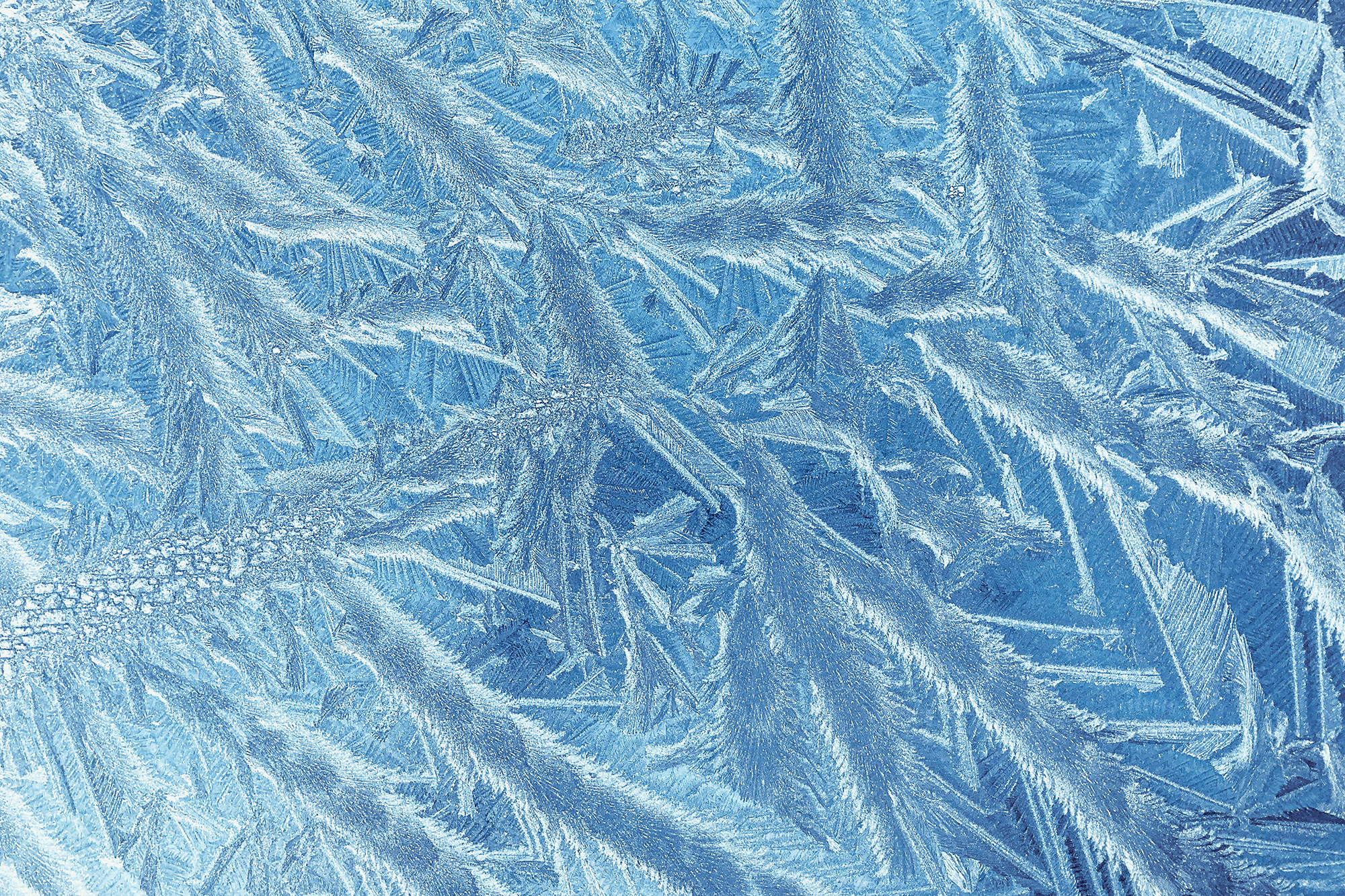
For frost to spread on a surface, individual water droplets freeze and then spread the freezing front to a nearby droplet. Frequently that happens through an ice bridge that connects one droplet to the next. On hydrophilic surfaces, the bridge grows along the surface, slowly connected one droplet to the next and the next until the entire surface is covered in frost. On superhydrophobic surfaces, frost still spreads via ice bridge, but those ice bridges are suspended in the air, cantilevered out from the frozen droplet. You can watch the process in the image below.
The researchers found that frost was later to form and slower to spread on these superhydrophobic surfaces, which could be valuable for applications like the heat exchanger found in heat pumps. Once a heat exchanger’s finned surface is frost-covered, its efficiency plummets. The team suggests that coating these surfaces to be superhydrophobic could help keep them operating efficiently longer in cold and humid conditions. (Image credit: frost – K. Shimizu, experiment – S. Yang et al.; research credit: S. Yang et al.; via Physics World)
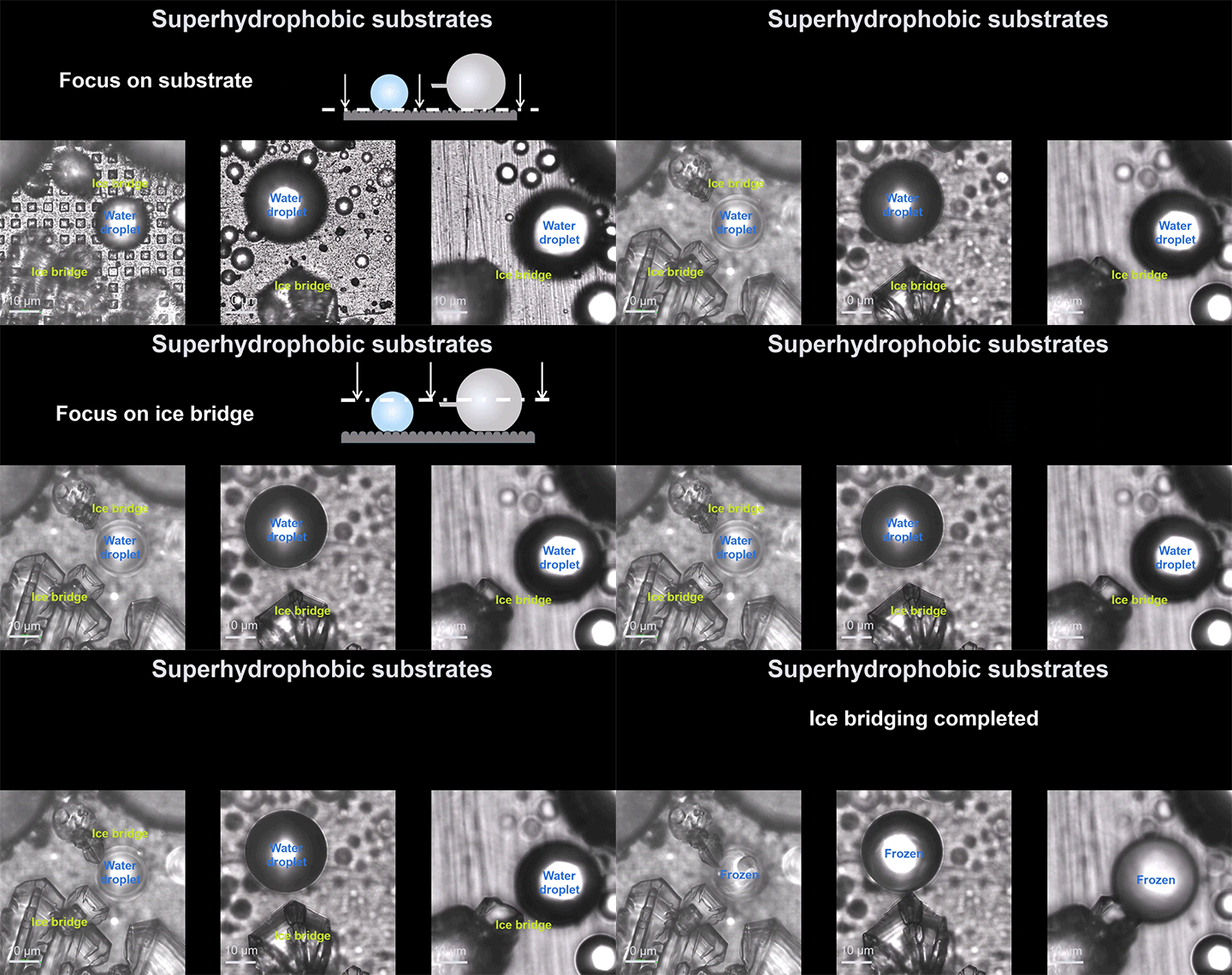
Animation of a suspended ice bridge growing between water droplets on a superhydrophobic surface. Fediverse Reactions
-
Marangoni Bursting With Surfactants

![Black and white image of a film pulled outward and breaking into droplets. Text reads, "The [0.05%] surfactant renders the ejected droplets prone to 'popping'."](https://fyfluiddynamics.com/wp-content/uploads/surfburst2-1024x576.png "Black and white image of a film pulled outward and breaking into droplets. Text reads, \"The [0.05%] surfactant renders the ejected droplets prone to 'popping'.\"")
![Black and white image of a film pulled outward and spreading in unevenly. Text reads, "When surfactant concentration is further increased [to 1%], drop spreading resumes."](https://fyfluiddynamics.com/wp-content/uploads/surfburst3-1024x576.png "Black and white image of a film pulled outward and spreading in unevenly. Text reads, \"When surfactant concentration is further increased [to 1%], drop spreading resumes.\"")

![Black and white image of a film pulled outward and breaking into droplets. Text reads, "The [0.05%] surfactant renders the ejected droplets prone to 'popping'."](https://fyfluiddynamics.com/wp-content/uploads/surfburst2.png)
![Black and white image of a film pulled outward and spreading in unevenly. Text reads, "When surfactant concentration is further increased [to 1%], drop spreading resumes."](https://fyfluiddynamics.com/wp-content/uploads/surfburst3.png)
A few years ago, researchers described how an alcohol-water droplet atop an oil bath could pull itself apart through surface tension forces. Dubbed Marangoni bursting, this phenomena has shown up several times since. Here, researchers explore a twist on the behavior by adding surfactants to see how they affect the bursting phenomenon. (Video and image credit: K. Wu and H. Stone; via GFM)
Fediverse Reactions
-

Dusty Clouds Make More Ice
Even when colder than its freezing point, water droplets have trouble freezing–unless there’s an impurity like dust that they can cling to. It’s been long understood in the lab that adding dust allows water to freeze at warmer temperatures, but proving that at atmospheric scales has been harder. But a new analysis of decades’ worth of satellite imagery has done just that. The team showed that a tenfold increase in dust doubled the likelihood of cloud tops freezing.
Since ice-topped clouds reflect sunlight and trap heat differently than water-topped ones, this connection between dust and icy clouds has important climate implications. (Image and research credit: D. Villanueva et al.; via Eos)
Fediverse Reactions
-
Falling From the Sky


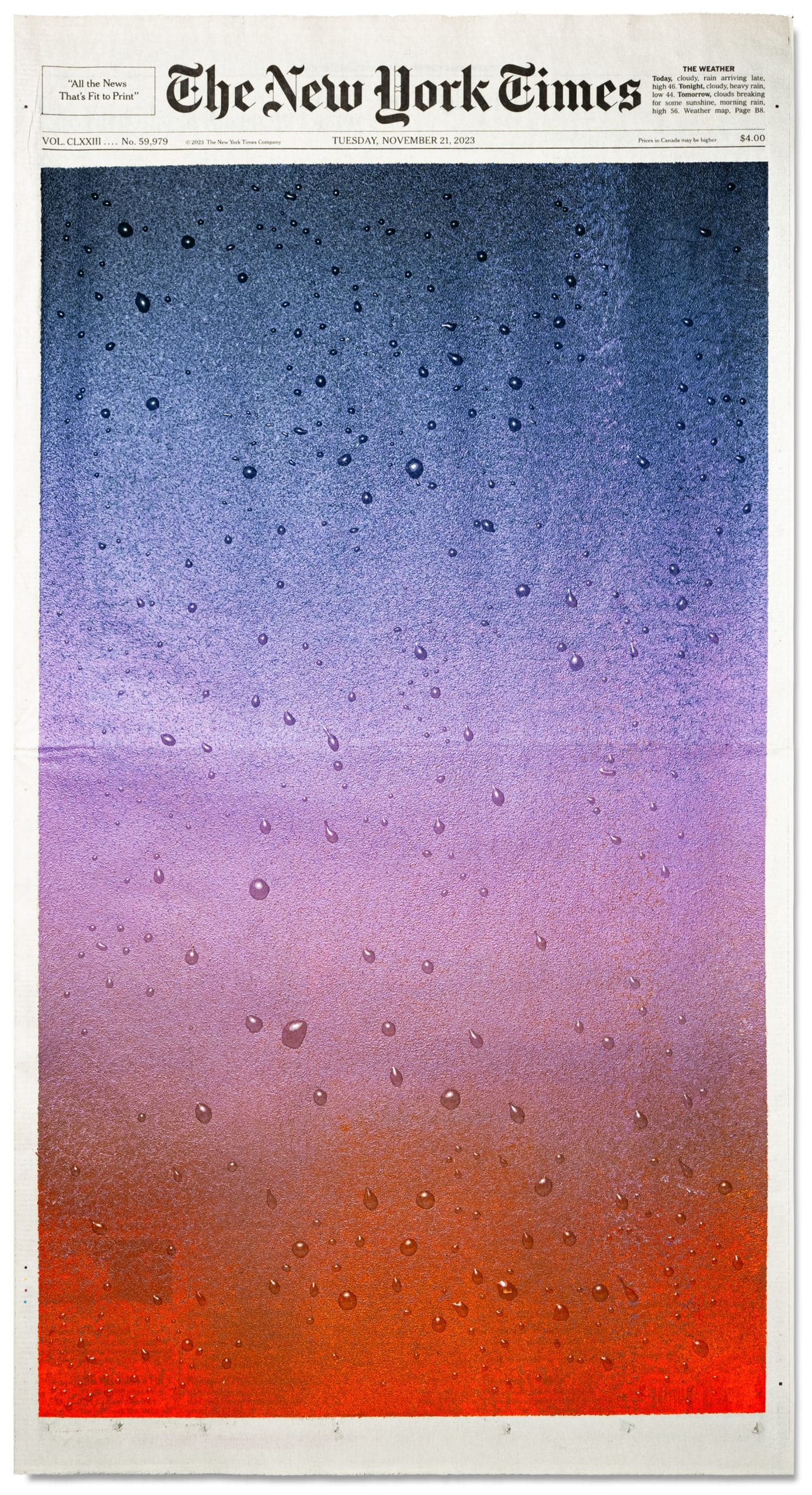
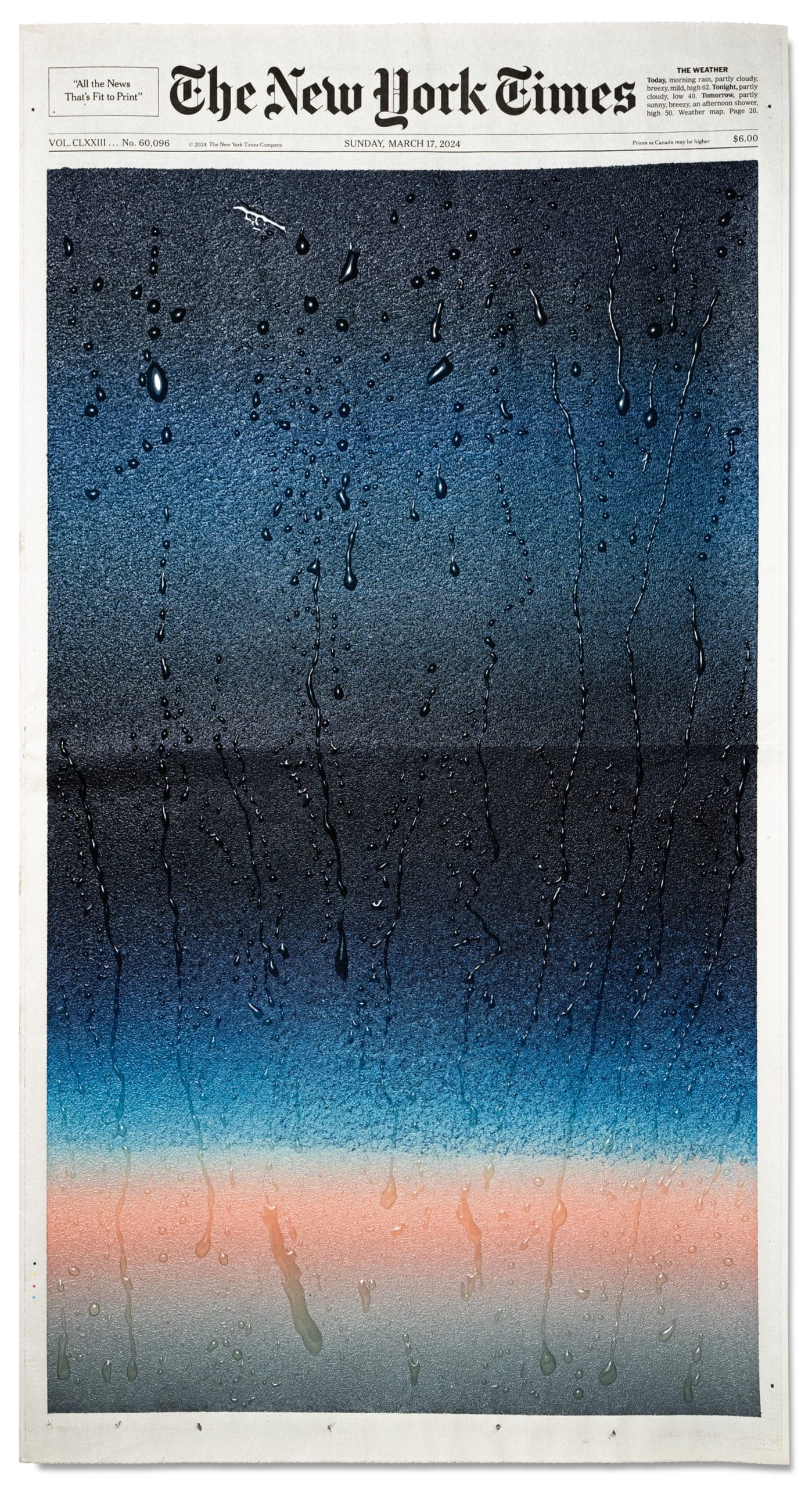

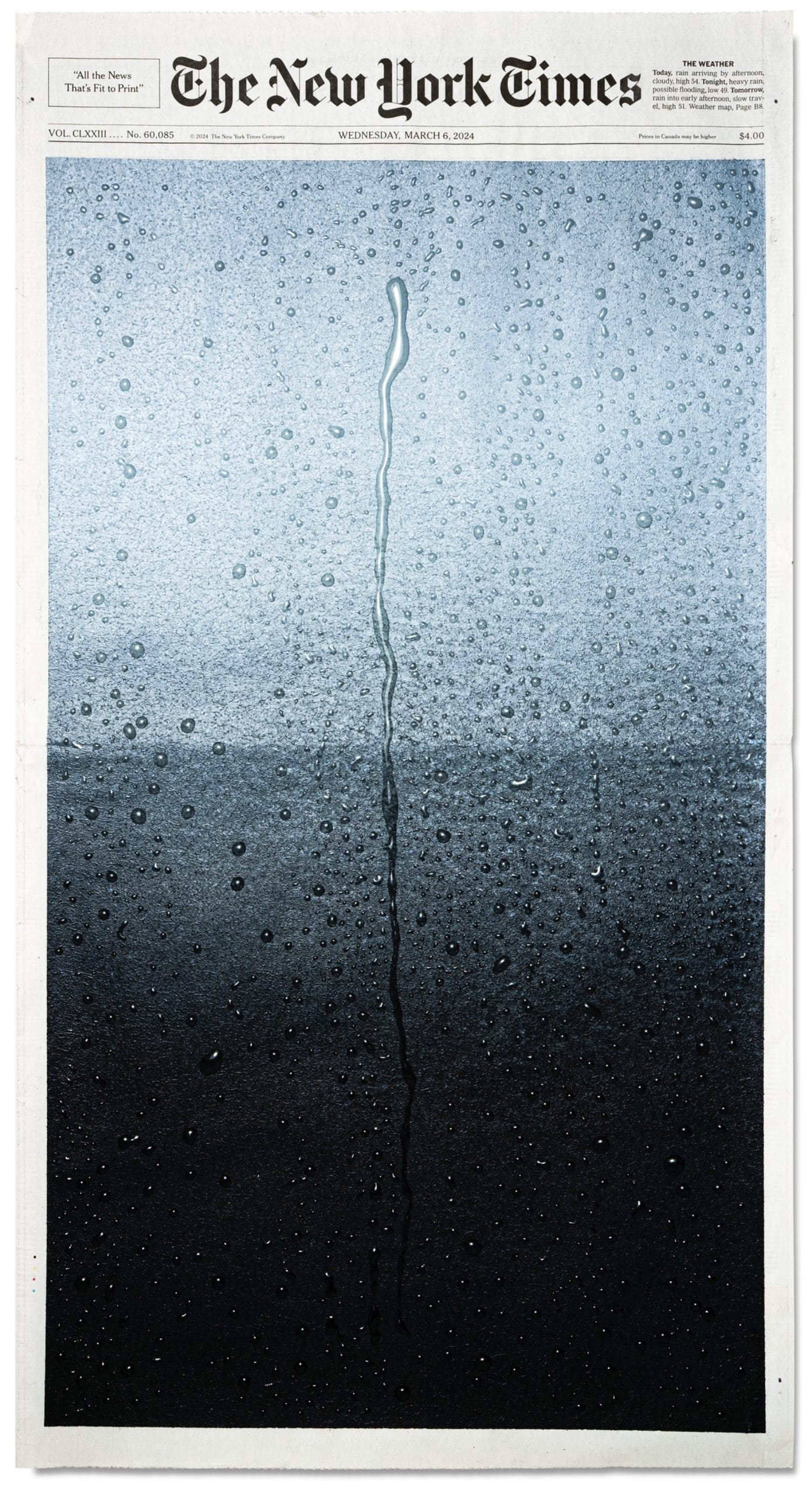
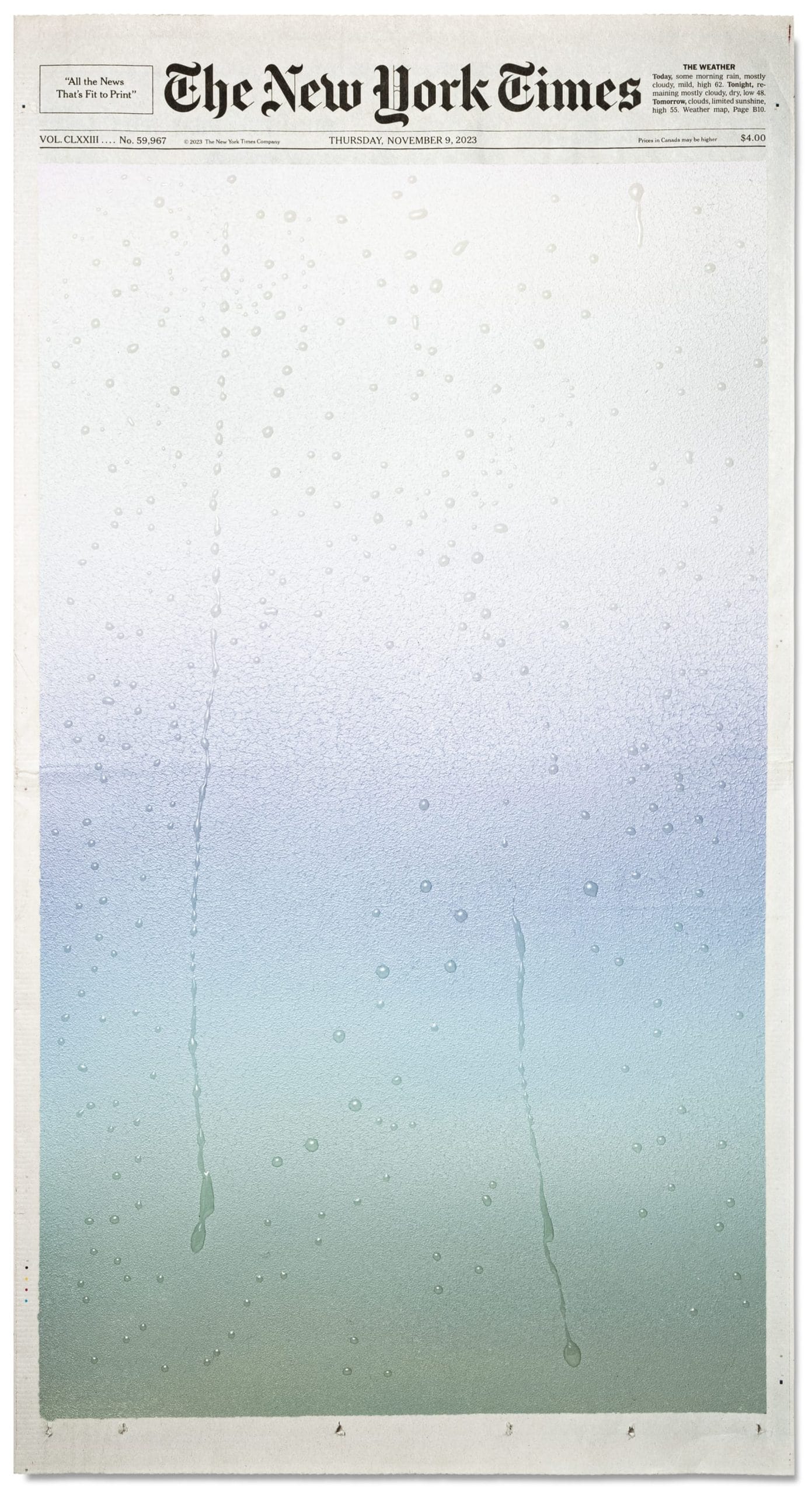
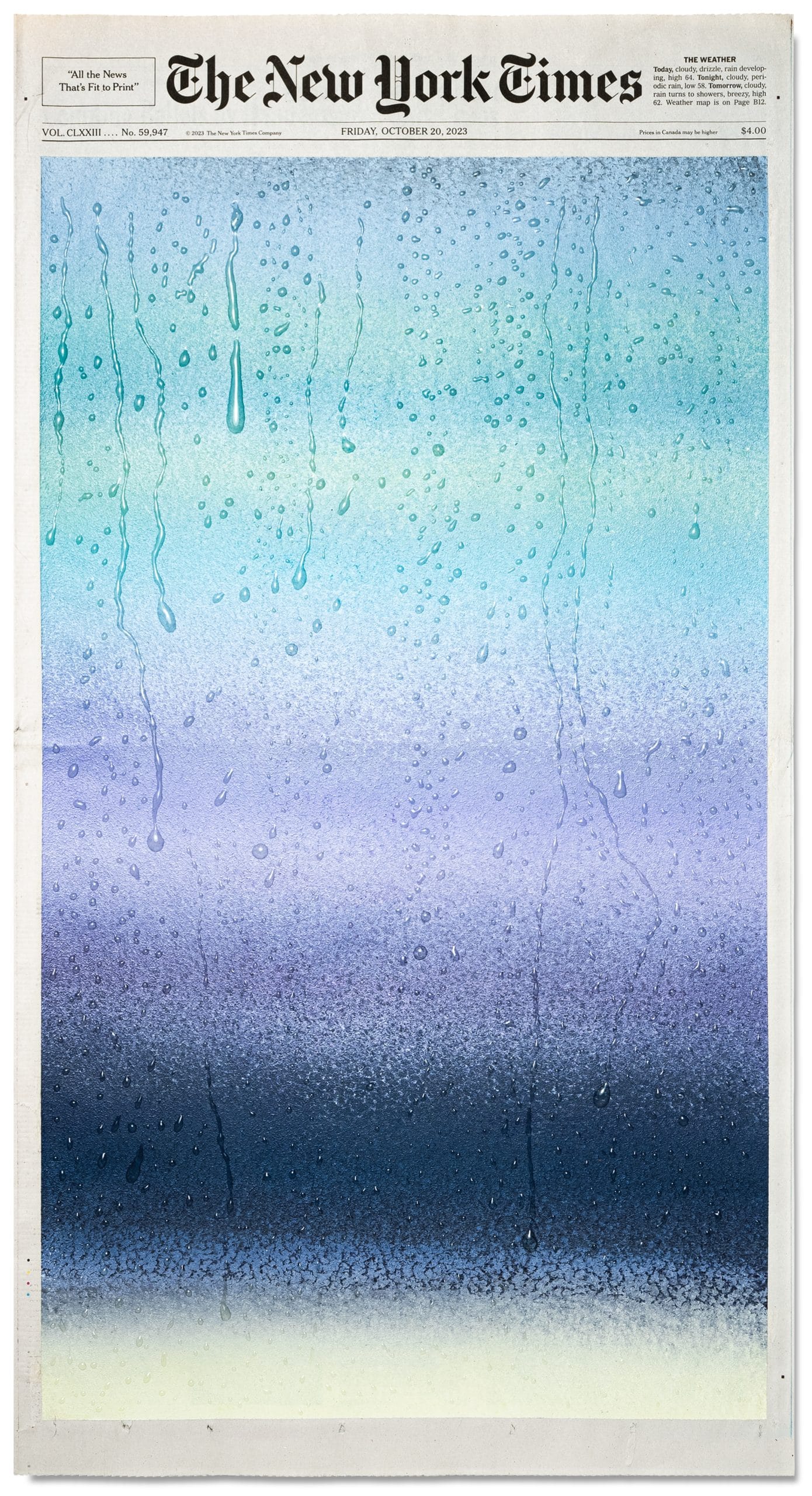


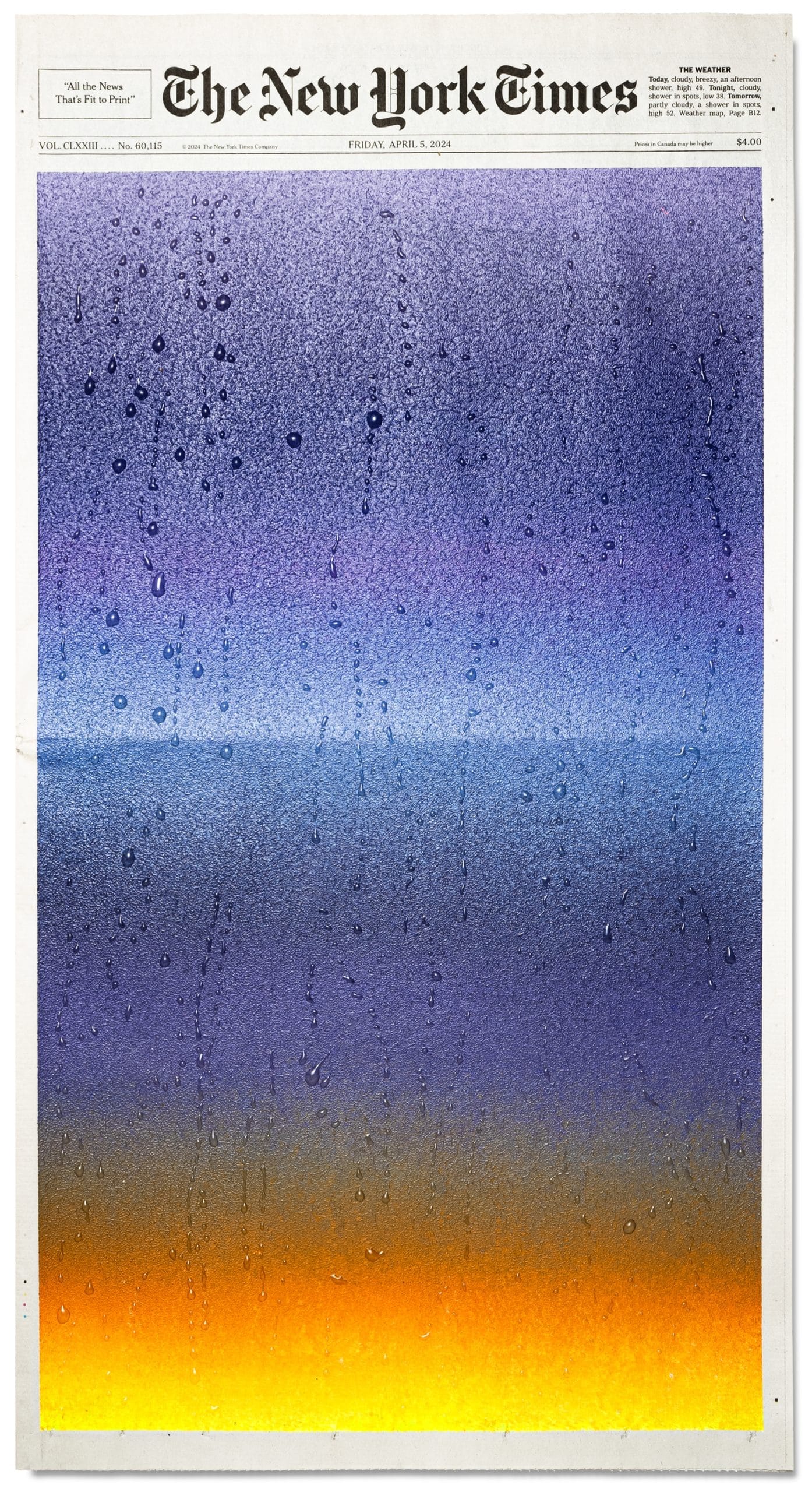
Artist Sho Shibuya paints daily meditations on a copy of The New York Times. These particular examples are part of a recent collection, Falling From the Sky, that features realistic trompe l’oeil droplets that celebrate rain and rainy days. Having spent many an hour contemplating water droplets on my window, I love these. (Image credits: S. Shibuya; via Colossal)
Fediverse Reactions
-
Evaporating Off Butterfly Scales
This award-winning macro video shows scattered water droplets evaporating off a butterfly‘s wing. At first glance, it’s hard to see any motion outside of the camera’s sweep, but if you focus on one drop at a time, you’ll see them shrinking. For most of their lifetime, these tiny drops are nearly spherical; that’s due to the hydrophobic, water-shedding nature of the wing. But as the drops get smaller and less spherical, you may notice how the drop distorts the scales it adheres to. Wherever the drop touches, the wing scales are pulled up, and, when the drop is gone, the scales settle back down. This is a subtle but neat demonstration of the water’s adhesive power. (Video and image credit: J. McClellan; via Nikon Small World in Motion)

Water droplets evaporate from the wing of a peacock butterfly. Fediverse Reactions
-