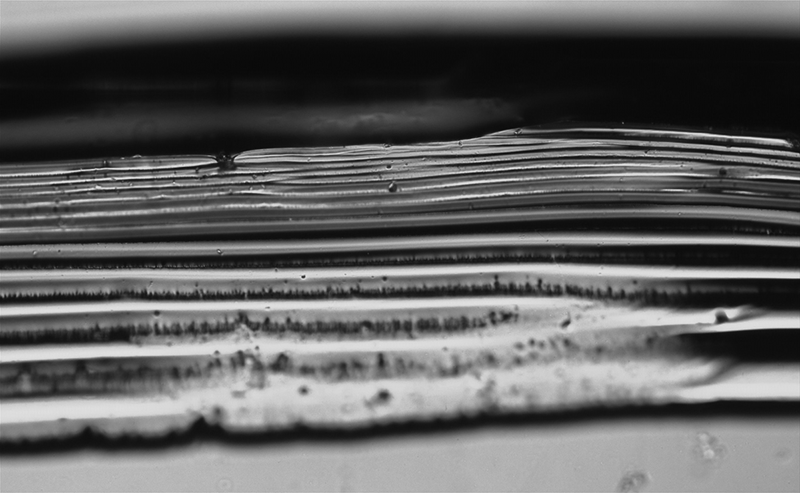
Condensation forms beads of water on a surface. When suddenly cooled, those drops begin to freeze into frost. This video looks at the process in optical and in infrared, revealing the patterns of spreading frost and the tiny ice bridges that link one freezing drop to the next. (Video and image credit: D. Paulovics et al.)
Search results for: “water droplet”

The Sound of Bubbles
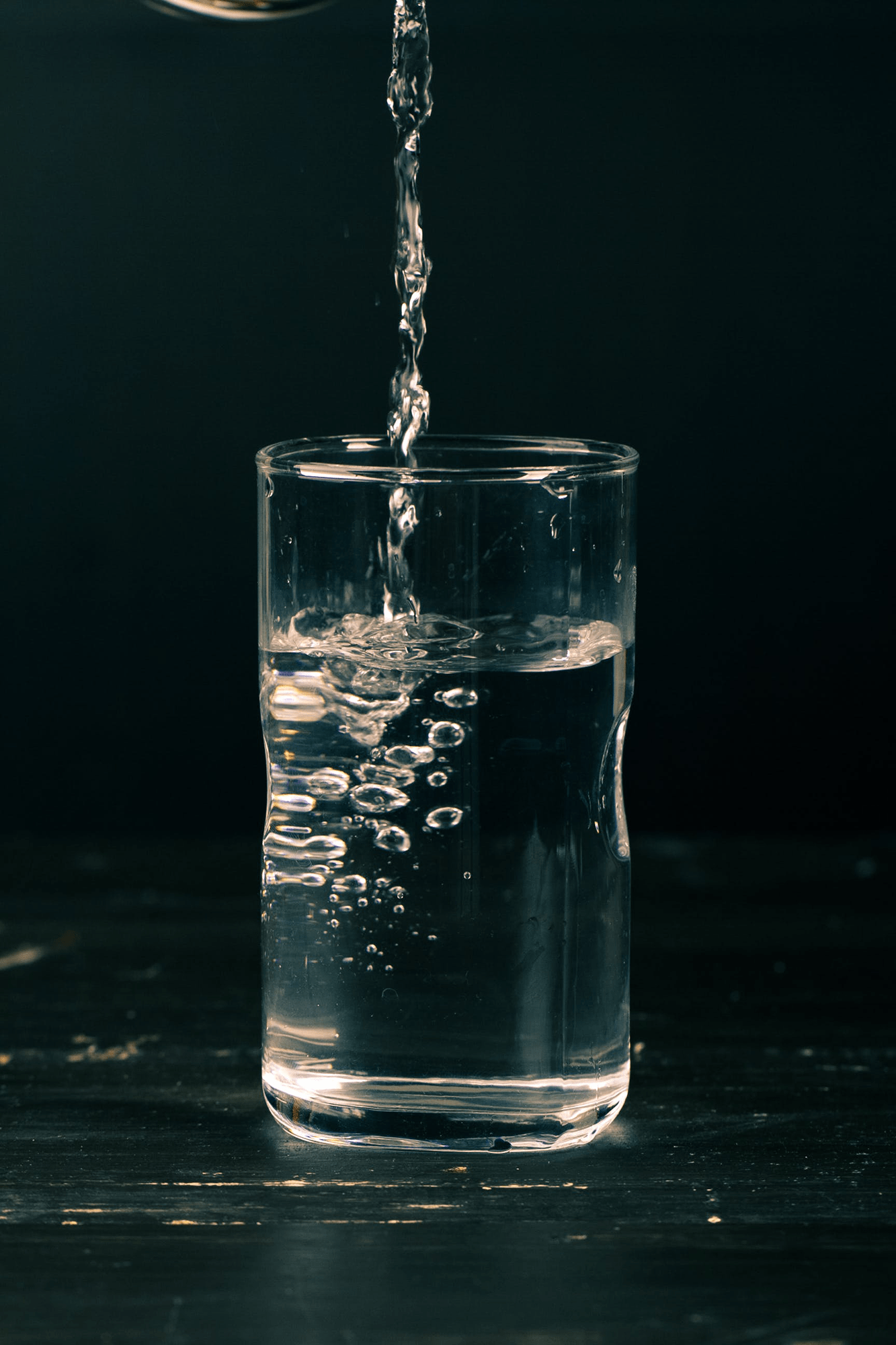
Every day I stand in front of my refrigerator and listen to the water dispenser pouring water into my glass. The skinny, fast-moving jet of water plunges into the pool, creating a flurry of bubbles. Those bubbles come from air the water jet pulls in with it, and the sound the water makes (minus the fridge’s noises) comes from those bubbles. A short, laminar jet will make fewer bubbles and, therefore, be quieter than a a jet that falls farther before hitting the water.
The reason? That tall jet falls for long enough that its walls start to wobble or even break up completely into separate droplets. Compared to a smooth jet, these wobbly or broken-up jets pull in more air and create more bubbles. That makes them louder. Researchers even suggest that listening to these bubbles can give a noninvasive method for finding how much fresh oxygen is in the water. (Image credit: R. Piedra; research credit: M. Boudina et al.; via APS Physics)

Drying Unaffected by Humidity
Water evaporates faster in dry conditions than in humid ones, but the same isn’t true of paint. Instead, paint’s drying time is largely independent of the day’s humidity. That’s because of paint’s long chains of polymers. As water in the paint evaporates, these polymers are drawn to the surface, forming a viscoelastic layer that hinders evaporation and keeps the drying rate independent up to about 80 percent humidity.

Illustration depicting evaporation of water (left) and evaporation of a polymer solution (right). As water evaporates from the polymer solution, it draws polymers to the surface, where they form a layer that hinders evaporation and makes its rate independent of humidity. The polymer layer explains why evaporation isn’t affected by humidity at longer times, but researchers also saw humidity-independent evaporation early in their experiments. Under a microscope, they discovered a thin gel layer (top image) covering the air-polymer interface. They propose that this fast-forming layer further hinders evaporation. Their findings may be significant for virus-laden respiratory droplets, which also contain polymers. (Image and research credit: M. Huisman et al.; see also J. Salmon et al.; via APS Physics)

Beneath the Surface
Signs of a ship’s passage can persist long after it’s gone. The churn of its propellers and the oil leaked from its engines leave a mark on the water’s surface that, in some cases, is visible even from orbit. But the frothy wake of a ship is no easy place to measure; there are simply too many bubbles. To reveal the physics behind that froth, these researchers turned to direct numerical simulation, a type of computational fluid dynamics that calculates the full details of a flow, typically using a supercomputer to do so.
In their poster, the blue field of wavy lines shows turbulence under the water’s surface. For (relative) simplicity, the turbulence is statistically uniform — as opposed to matching a particular ship’s wake. The interface between air and water is shown in red. The water surface is complex and undulating, spotted with bubbles trapped below the water and droplets flying through the air. Simulations like these help scientists focus on the detailed mechanisms that connect the turbulent water to the complex air-water surface. Once those are understood, researchers can develop models that approximate the physics for more specific situations, like the passage of a cargo ship. (Image credit: A. Calado and E. Balaras)

Sliding on Fibers
Water drops slide down spiderwebs, along the spines of desert plants, and across the armored exterior of horned lizards. Thin, grooved surfaces like these pop up frequently in nature when organisms need to direct water. A recent study of droplets sliding on fibers suggests why.
A drop sliding down a fiber is constantly shrinking, leaving a little of itself behind as a thin film that coats the fiber. The thicker a fiber is, the slower the drop moves along it. Similarly, if you bundle multiple fibers together, a drop will travel slower along the thicker bundle. But, to the researchers’ surprise, droplets actually travel faster on bundles than they do along single fibers of the same overall diameter. The key to this result seems to be the tiny grooves between fibers in a bundle. Water fills these areas, creating a “rail” along which the droplets slide more efficiently.
The team hope to put their new insights to use on a water harvester that could help capture precious moisture in arid environments, much like those desert-dwelling plants and lizards do. (Image and research credit: M. Leonard et al.; via Physics World)

The Best of FYFD 2023
A fresh year means a look back at what was popular last year on FYFD. Usually, I give a numeric list of the top 10 posts, but this year the analytics weren’t as clear. So, instead, I’m combining from a few different sources and presenting an unordered list of some of the site’s most popular content. Here you go:
- Eroding the Sphinx
- Getting Water Out of Your Ear
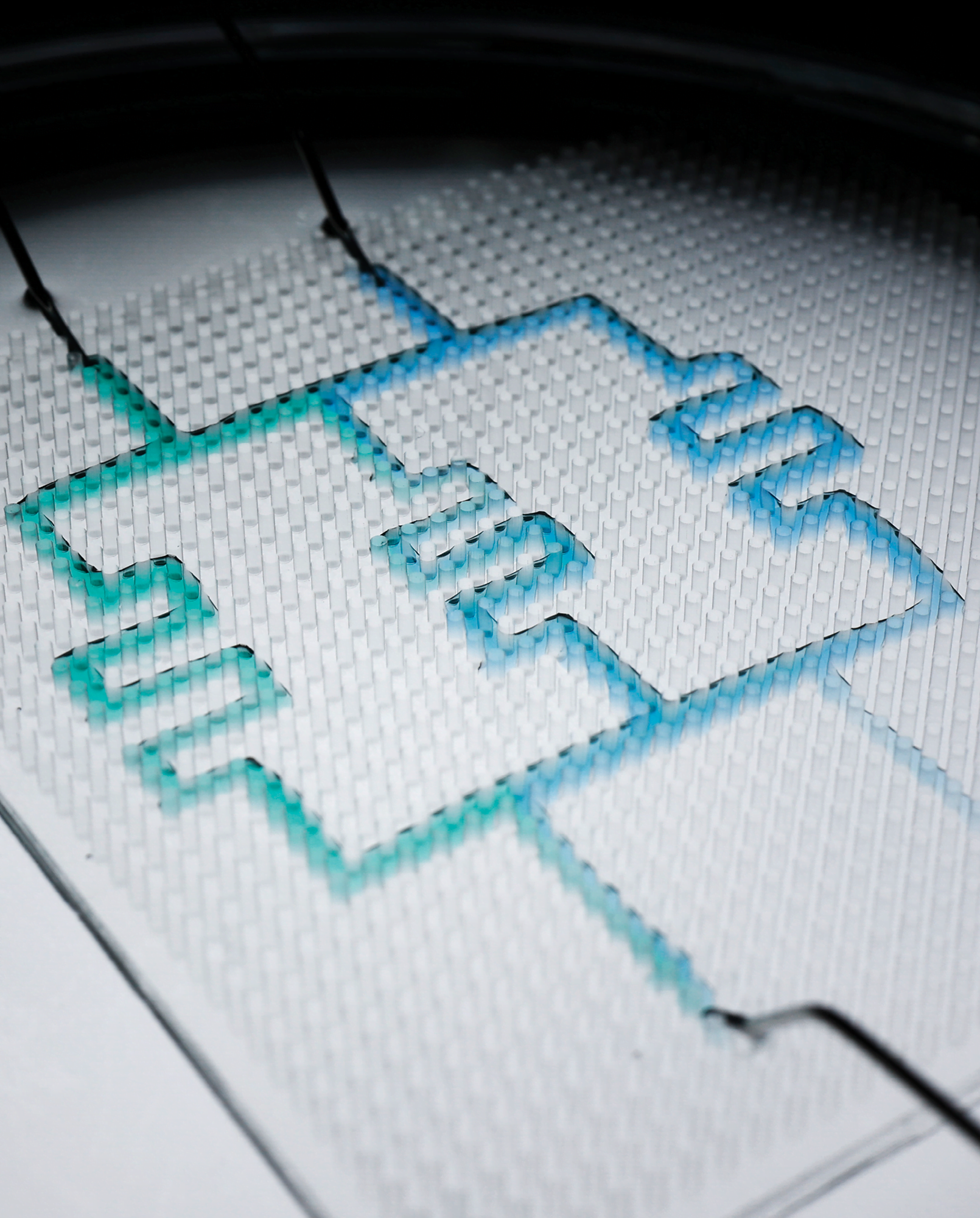
- Can Water Solve a Maze?
- Dandelion Seeds
- Black Holes in a Bathtub
- Mixing With E. coli
- Beneath the Cavity
- Leidenfrost Explosions
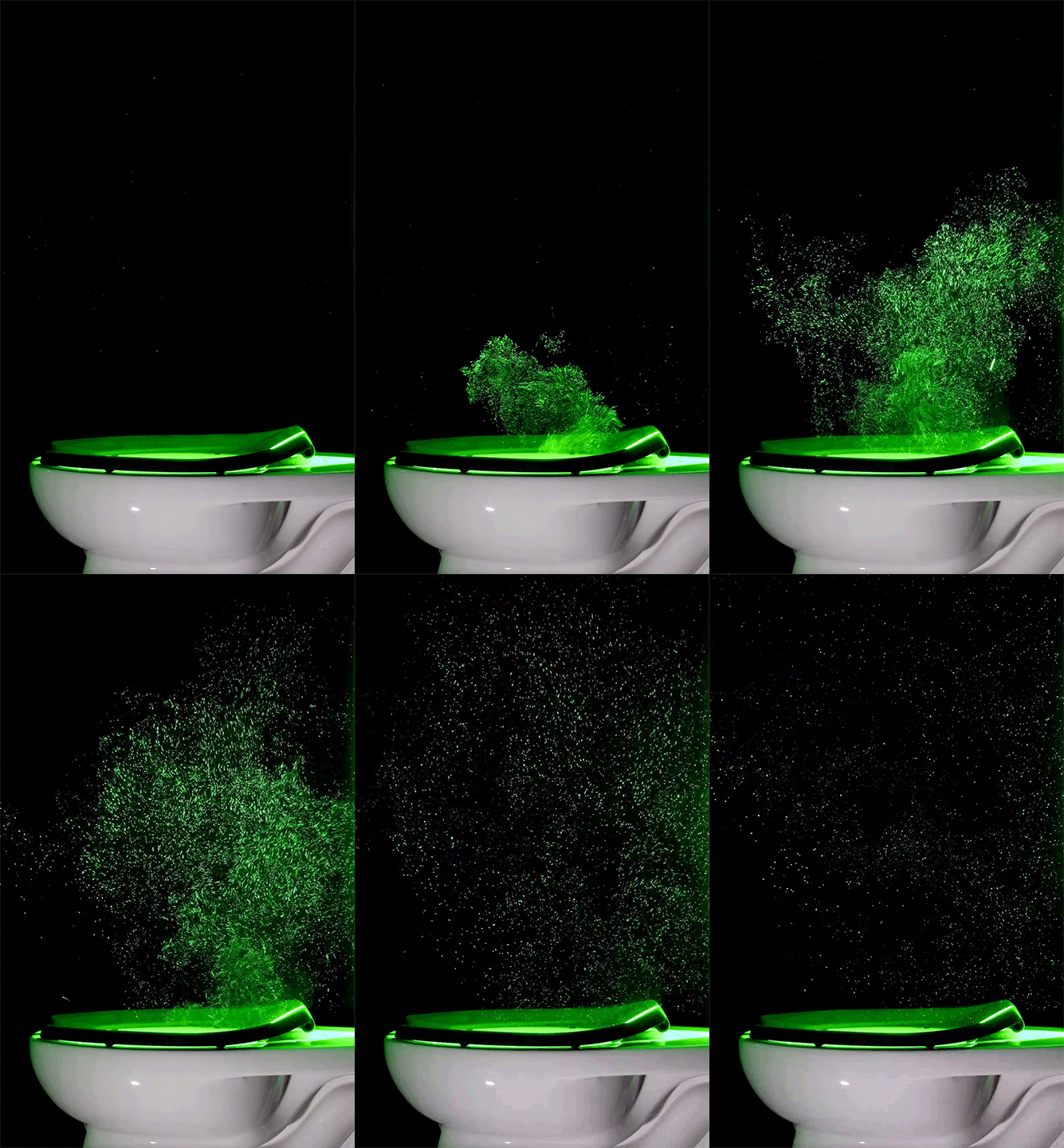
- Toilet Plumes
- Exascale Simulations
- Ghosts of Rivers Past
- Blood Flow in a Fin
- Snake Tracks
- Lagoon Nebula
- “Chaosmosis”
I’m really pleased with the mix of topics this year; many of these topics are straight from research papers, and others are artists’ works. At least one is both. From swimming bacteria to star-birthing nebulas, fluid dynamics are everywhere!
If you enjoy FYFD, please remember that it’s a reader-supported website. I don’t run ads and it’s been years since my last sponsored post. You can help support the site by becoming a patron, making a one-time donation, buying some merch, or simply by sharing on social media. And if you find yourself struggling to remember to check the website, remember you can get FYFD in your inbox every two weeks with our newsletter. Happy New Year!
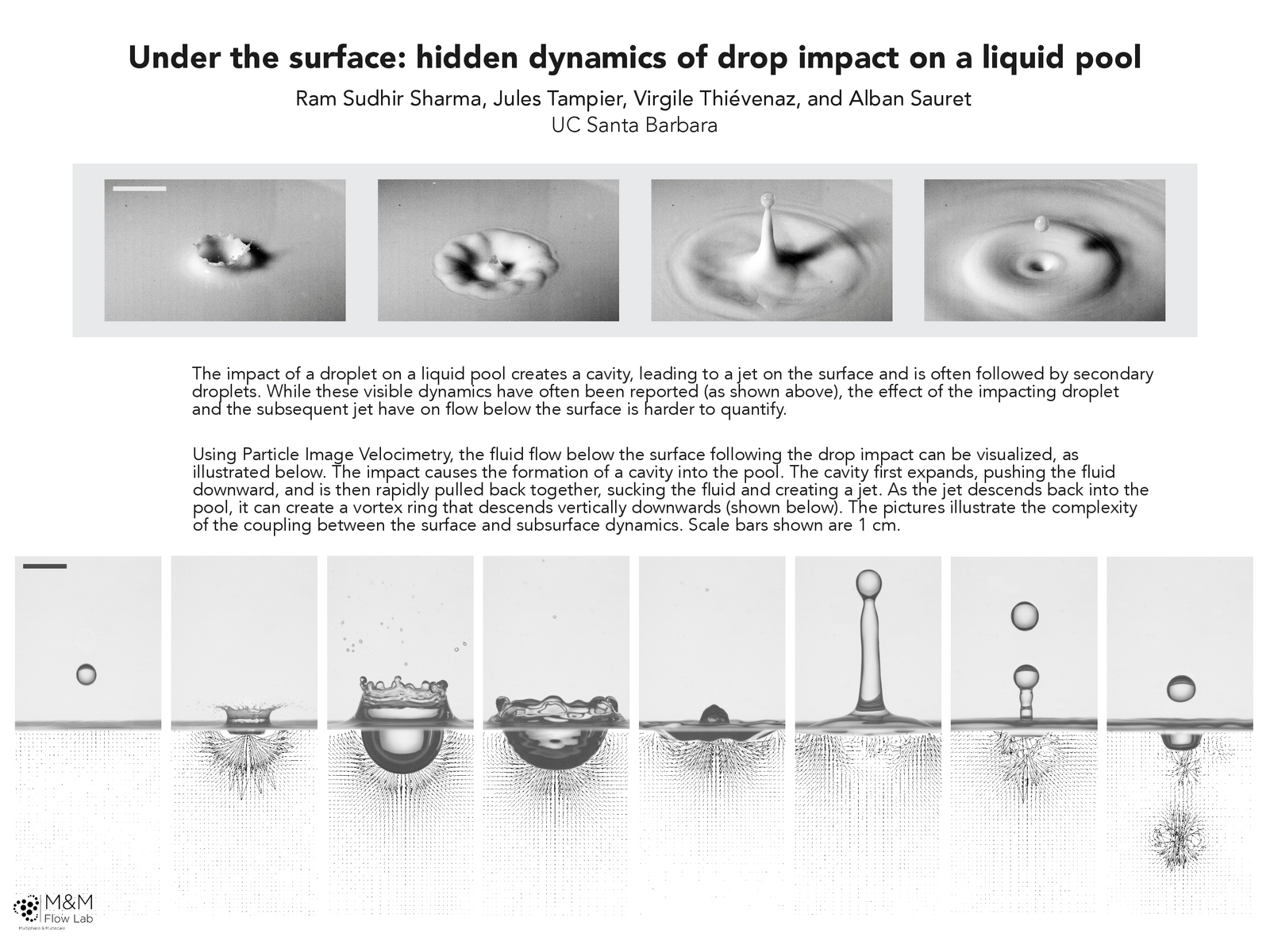
(Image credits: sphinx – S. Boury et al., ear model – S. Kim et al., maze – S. Mould, dandelion – S. Chaudhry, water tank – P. Ammon, e. coli – R. Ran et al., drop impact – R. Sharma et al., Leidenfrost – L. Gledhill, toilet – J. Crimaldi et al., engine sim – N. Wimer et al., rivers – D. Coe, fin – F. Weston, snake – P. Schmid, nebula – J. Drudis and C. Sasse, flames – C. Almarcha et al.)

Imitating a Cough
Coughing and sneezing create violent air flows in and around our bodies. As that fast air rushes over mucus layers in our lungs, throat, and sinuses, the resulting flow breaks up the mucus into droplets. To explore the details of that process, researchers built a “cough machine” that sends a rush of air over a thin film of water mixed with glycerol. The setup allows them to observe the physics in a way that’s nearly impossible in a human cough or sneeze.

Imitating a cough: high-speed video shows how a thin film made of water and glycerol breaks down in a strong airflow. Parts of the film inflate into hollow bags that form thinner weak spots. When the film breaks in those places, it forms rims and ligaments that create a spray of droplets. As seen above, air flowing past shears the viscous fluid, stretching it out. The leading edge of the film destabilizes and breaks into large drops, but it’s what comes next that really gets things going. Areas of the film inflate to form hollow bags. When sections of the bag thin to about 1 micron, the film ruptures and the bags burst. This triggers a cascade of instabilities in the film’s rim that ultimately rip the film into a spray of tiny aerosol droplets. The researchers found that, despite their tiny size, these droplets collectively carry a large volume of liquid, making them all the more important for understanding transmission of respiratory illnesses. (Image credit: top – A. Piacquadio, experiment – P. Kant et al.; research credit: P. Kant et al.)

Viscoelasticity and Bubbles
Bursting bubbles enhance our drinks, seed our clouds, and affect our health. Because these bubbles are so small, they’re easily affected by changes at the interface, like surfactants, Marangoni effects, or, as a recent study shows, viscoelasticity.

A bubble released in pure water pops at the surface, creating a rebounding jet and a daughter droplet. In clean water, a bubble’s burst generates a rebounding jet that shoots off one or more daughter droplets, as seen in the animation above. But when researchers added proteins that modify only the water’s surface, they found something very different. As seen below, the bursting bubble no longer generated a jet, and, instead of forming droplets, it made a single, tiny daughter bubble. The difference, they found, comes from the added viscoelasticity of the surface. The long protein molecules resist getting stretched, which damps out the tiny waves that surface tension usually produces on the collapsing bubble cavity. (Image and research credit: B. Ji et al.; submission by Jie F.)

When the surface of water is viscoelastic, a bursting bubble creates no jet and a daughter bubble instead of a drop. 
Aquatic Escape Artists
Springtails are tiny hexapods found living on the air-water interface. Like other creatures living at the interface, they sometimes need to make a quick escape. For the springtail, that means a high-flying leap, driven by their fork-shaped furcula. The springtail soars into the air, where it contorts its body and uses aerodynamic forces — along with a droplet it carries on its belly — to orient itself. For landing, it uses that droplet as a sticky anchor that helps it adhere to water (or ground) instead of bouncing. Nailing that landing sets it up to make another daring escape as quickly as needed. (Video and image credit: Deep Look; research credit: V. Ortega-Jimenez et al.)

Puddle Depth Matters for Stalagmites
In a cave, mineral-rich water drips from the ceiling, spreading ions used to build stalagmites. A recent study considers how the depth of a pool affects the droplet’s splash and how material from the droplet spreads. The authors found several scenarios that vary widely depending on pool depth.

A droplet falling into a shallow pool creates a splash that quickly breaks up into droplets. This flings the red droplet material in many directions. A drop falling into a shallow pool had a splash that quickly broke up into droplets (above). By dyeing the pool green and the droplet red, they could track where the droplet’s material wound up. The spray of small droplets carried fluid far, but the main point of impact had a strong concentration of the drop’s fluid.

With a deeper pool, the drop’s impact creates a thick crown splash that collapses in on itself. The drop’s fluid is quickly mixed into the pool. In contrast, a deeper pool sent up a thick-walled splash crown that collapsed in on itself. This droplet’s material saw lots of mixing with the pool, but only near the point of impact. From their work, the authors concluded that models of stalagmite growth should incorporate pool depth in order to capture how minerals actually concentrate and move. (Image credit: cave – H. Roberson, others – J. Parmentier et al.; research credit: J. Parmentier et al.; via APS Physics; submitted by Kam-Yung Soh)