Search results for: “vortex”

  • Featured Video Play Icon

    Walking in the Wake of a Cylinder

    A cylinder in a flow produces a series of alternating vortices known as a von Karman vortex street. Changing the flow speed and rotating the cylinder both allow researchers to tune the frequency of these shed vortices. What happens to an object in the wake?

    For a simple hydrofoil tethered to the cylinder, the object wends back and forth along the vortices. But when that hydrofoil sits at the end of a double-pendulum, something very interesting happens. The whole apparatus follows a consistent trajectory similar to a human walking gait. Researchers are using this motion to build a robot that will help physical therapy patients regain a natural walking style. (Image and video credit: A. Carleton et al.)

  • Breaking Clots With Sound

    Breaking Clots With Sound

    Clots that block blood flow away from the brain are one of the most common causes of strokes for younger people. If caught early, anticoagulants can sometimes resolve the issue, but the treatment fails in 20-40% of cases. Now researchers are investigating a new ultrasound technique capable of quickly and effectively removing these clots.

    An illustration of the vortex ultrasound technique breaking up a blood clot.
    An illustration of the vortex ultrasound technique breaking up a blood clot.

    The group attached a 2 x 2 array of ultrasound transducers to the tip of a catheter like those doctors feed through blood vessels in other interventions. The offset between each ultrasound transducer creates a vortex-like flow when the array is activated. The helical wavefront creates shear stress along the clot’s face, helping to break it up faster. In one test, the new technique broke up a clot and completely restored flow in just 8 minutes. Pharmaceutical treatments take at least 15 hours and average closer to 29 hours.

    The team is moving forward to animal trials next and hope, with success there, to bring the technique to clinical studies. (Image credit: abstract – C. Josh, illustration – X. Jiang and C. Shi; research credit: B. Zhang et al.; via Physics World)

  • Beneath the Cavity

    Beneath the Cavity

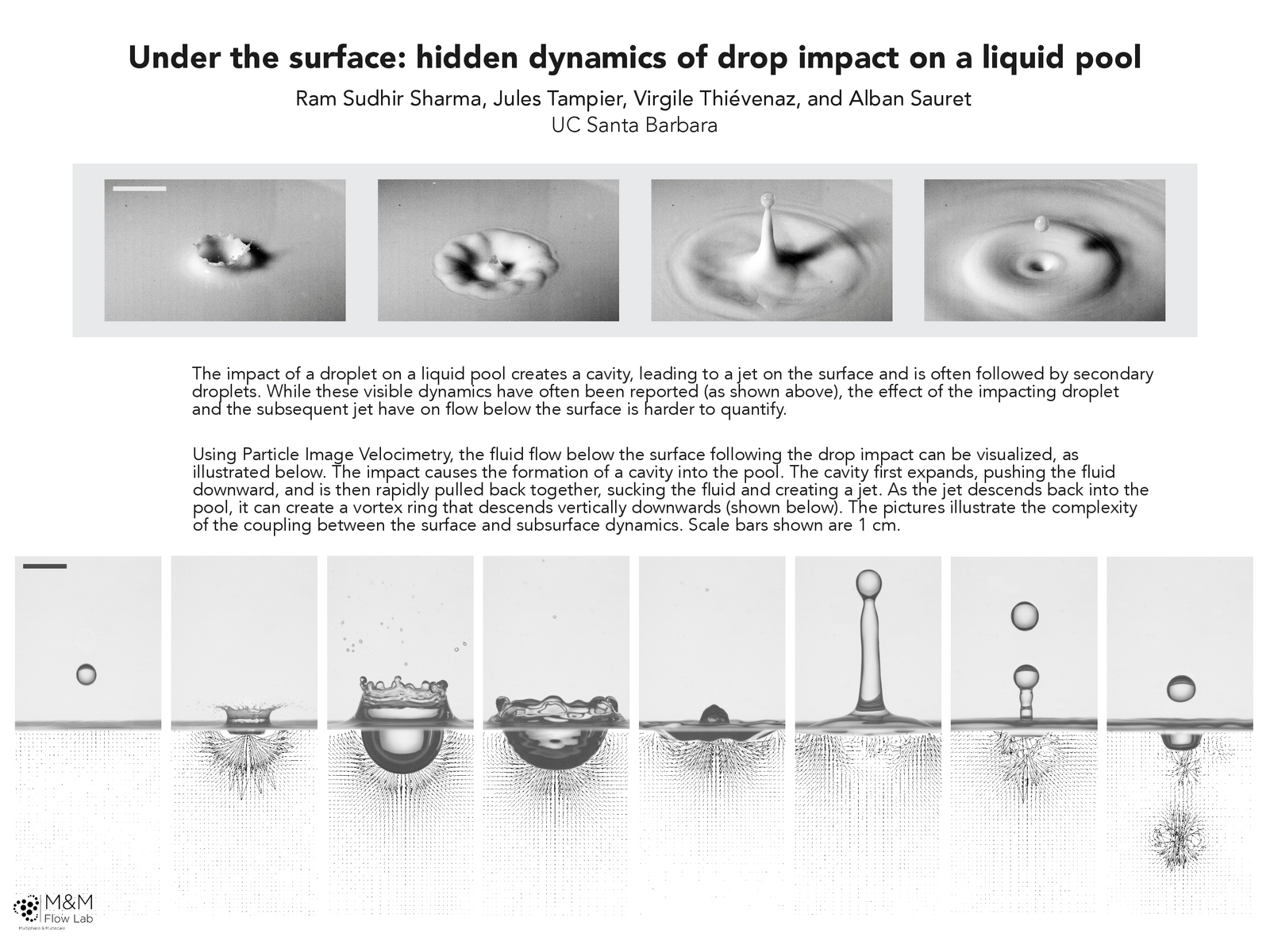
    When a drop falls into a pool of liquid, it creates a distinctive cavity, followed by a jet. From above the surface, this process is well-studied. But this poster offers us a glimpse of what goes on beneath the surface, using particle image velocimetry. This technique follows the paths of tiny particles in the fluid to reveal how the fluid moves.

    As the cavity grows, fluid is pushed away. But the cavity’s reversal comes with a change in flow direction. The arrows now point toward the shrinking cavity — and they’re much larger, indicating a strong inward flow. It’s this convergence that creates the Worthington jet that rebounds from the surface. And, as the jet falls back, its momentum gets transferred into a vortex ring that drifts downward from the point of impact. (Image credit: R. Sharma et al.)

  • Flamingo Fluid Dynamics

    Flamingo Fluid Dynamics

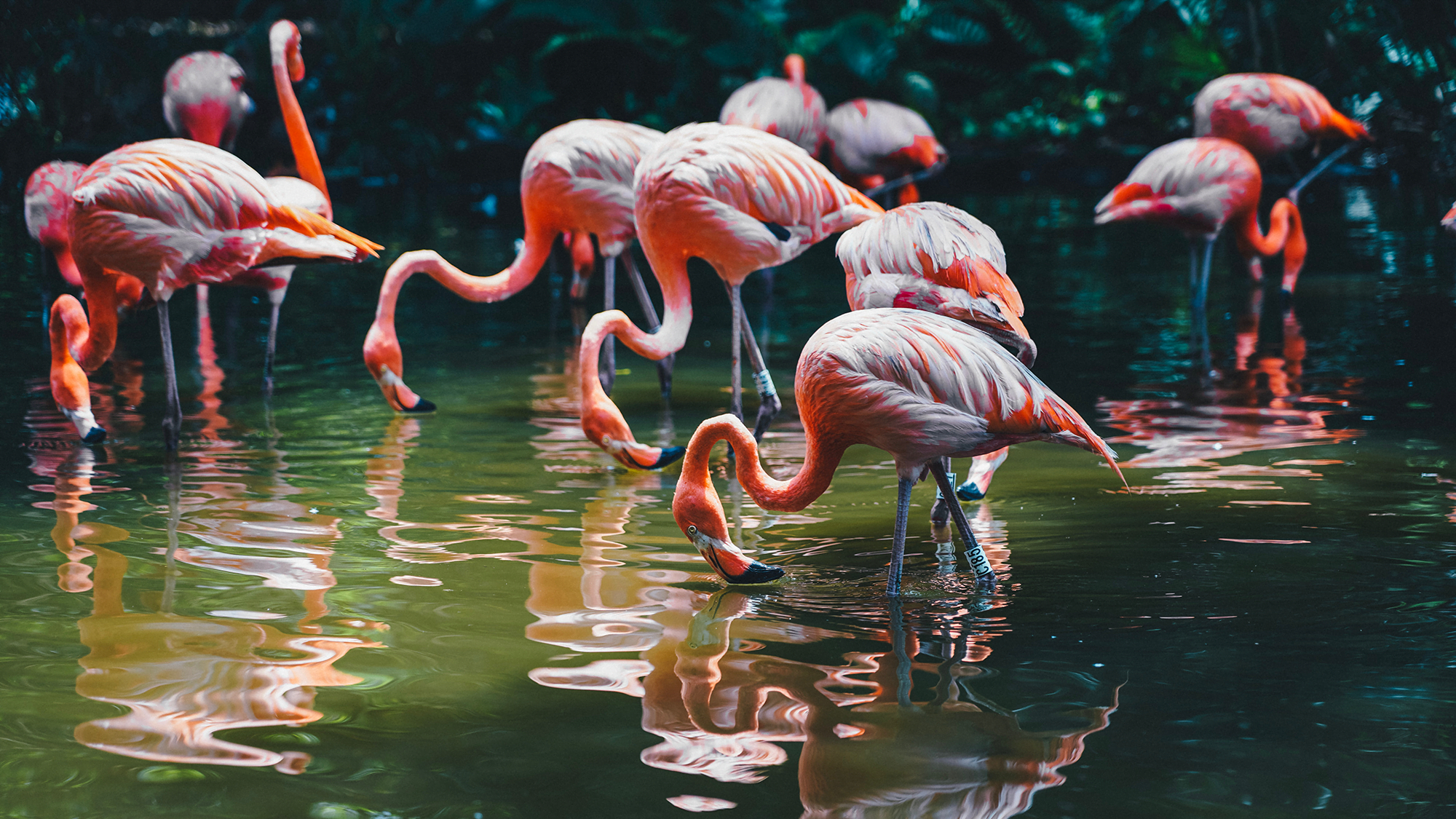
    Flamingos strut and dance and bob, but there’s more to these comical birds than meets the eye. Flamingos can thrive in nutrient-poor environments that other birds eschew, like salt flats and alkaline lakes. Their secret, it turns out, is a mastery of fluid dynamics.

    Researchers studying the behaviors of the Nashville Zoo’s flamingo flock discovered that their seemingly silly behaviors all had fluid dynamical consequences. When the birds stomped and danced in small circles, it stirred up the muck in the water they eat from. With their beaks below the surface, the birds then opened and closed their mouths, darting their tongues in and out; this generated suction to carry food particles toward them. Periodically, they’d bob their heads up, creating a vortex for extra suction. Even their walking, which they did while skimming the water surface with their bills facing backward, generated flows that helped carry food to their mouths. (Image credit: cshong; research credit: V. Ortega-Jiménez et al.; via Science; submitted by Kam-Yung Soh)

  • Featured Video Play Icon

    Listen to a Martian Dust Devil

    A lucky encounter led the Perseverance rover to record the first-ever sound of a dust devil on Mars. The rover happened to have its microphone on (something that only happens a few minutes every month) just as a dust devil swept directly over the rover. Check out the video above to see and hear what Perseverance captured.

    Using the rover’s instrumentation, researchers worked out that the dust devil was at least 118 meters tall and about 25 meters wide. The team was even able to determine the density of dust in the vortex from the sound of individual grain impacts captured in the acoustic signal! Serendipitous as the experience was, planetary scientists may now look to include microphones on more missions, since we now know how to get useful meteorological data from them. (Video credit: JPL-Caltech/NASA; image credit: LPL/NASA; research credit: N. Murdoch et al.; via AGU Eos; submitted by Kam-Yung Soh)

  • Black Holes in a Bathtub

    Black Holes in a Bathtub

    Physicist Silke Weinfurtner studies fluids, not for themselves, but for what they can teach us about black holes, cosmic inflation, and quantum gravity. Black holes are notoriously difficult to study directly, but, mathematically speaking, it’s possible to set up a fluid system that behaves in the same way a black hole does. The result is a bathtub-like arrangement with a central vortex, seen above. And within this “bathtub,” Weinfurtner and her colleagues can directly measure sound waves equivalent to Hawking radiation, the theoretical means by which black holes emit heat. Learn more about these analogue gravity experiments in her interview over at Quanta Magazine. (Image credit: P. Ammon; via Quanta Magazine; submitted by clogwog)

  • Featured Video Play Icon

    Spinning Liquids With Lego

    One way to explore the effects of spinning liquids at high-speeds is to build an expensive and precise lab apparatus. Another method is to raid the Lego bin. Here, a YouTuber builds ever-more-elaborate Lego constructions to spin a sphere of water. He begins with a relatively straightforward magnetic stirrer that creates a bathtub vortex in his sphere, but as the set-up grows, he eventually encases the sphere to spin the entire thing at high-speed. It’s a cool way to see how spinning liquids react, from forming a vortex to spin coating the interior of the sphere and to generating a parabolic interface between air and liquid. Set-ups like these are not merely for fun, though; scientists use them to simulate the interiors of planets. (Image and video credit: Brick Technology; submitted by clogwog)

  • Featured Video Play Icon

    Walking in the Wake

    Flow visualization is an important tool in fluid dynamics, and scientists have many ways to capture and visualize flow information. But our methods are not the only — or even the best — ways to express a flow. Here, engineers teamed up with architects and artists to explore the flow behind an oscillating cylinder. When free to move forward-and-backward the cylinder’s wake takes on three distinctively forms. The team explored many ways to display the wakes — drawings, 3D-printed sculptures, and more — before ultimately building an art installation that lets visitors walk through the wake to experience it. I love the creativity of these interdisciplinary efforts. To see a similar, yet very different, take on the wake of a cylinder, check out this interpretative dance. (Image and video credit: P. Boersma et al.)

  • Featured Video Play Icon

    A Fractal Raft From a Spinning Top

    File this one under Cool Things I Would Have Never Thought Of. In this video, researchers play around with the flow around a spinning top and end up creating a fractal, granular raft. By immersing a top in dyed fluid, they show the toroidal vortices that form around the spinning toy. Then, instead of dye, they add a stretchy elastomer compound that cures over time. The elastomer stretches into thin ligaments in the swirling flow around the top. Eventually, it breaks apart into spherical drops of all different sizes.

    Once the top is removed, the elastomer drops slowly float to the surface. Surface tension and the Cheerios effect draw the drops together, and because of their many sizes, the rafts that form are fractal. (Image and video credit: B. Keshavarz and M. Geri)

  • Featured Video Play Icon

    “Reconfiguring It Out”

    Leaves flutter and bend in the breeze, changing their shape in response to the flow. Here, researchers investigate this behavior using flexible disks pulled through water. The more flexible the disk and the faster the flow, the more cup-like the disk’s final shape. Adding tracer particles to the water allows them to visualize the flow behind the disk. Every disk leaves a donut-shaped vortex ring spinning in its wake, but the more reconfigured the disk, the narrower the vortex. This, ultimately, reduces drag on the disk. That’s why trees in heavy winds streamline their branches and leaves; that flexibility lowers the drag the tree’s roots have to anchor against. (Image and video credit: M. Baskaran et al.)