Tag: cylinder

  • Featured Video Play Icon

    “Kármán Vortex Street”

    Although engineers often consider fluid mechanics through the lens of mathematics, that’s far from the only way to understand fluid physics. Today’s video is an alternative interpretation of a classic flow — the flow around a cylinder — created in a collaboration between dancers and engineers. The result is what they call a “physics-constrained dance improvisation” that shows how the flow changes as its speed increases. I love this concept! It highlights the visual and qualitative differences between flow states and maintains space for artistic creativity. Be sure to watch the full video! (Video and submission credit: J. Capecelatro et al.)

  • Robotic Research Facilities

    Robotic Research Facilities

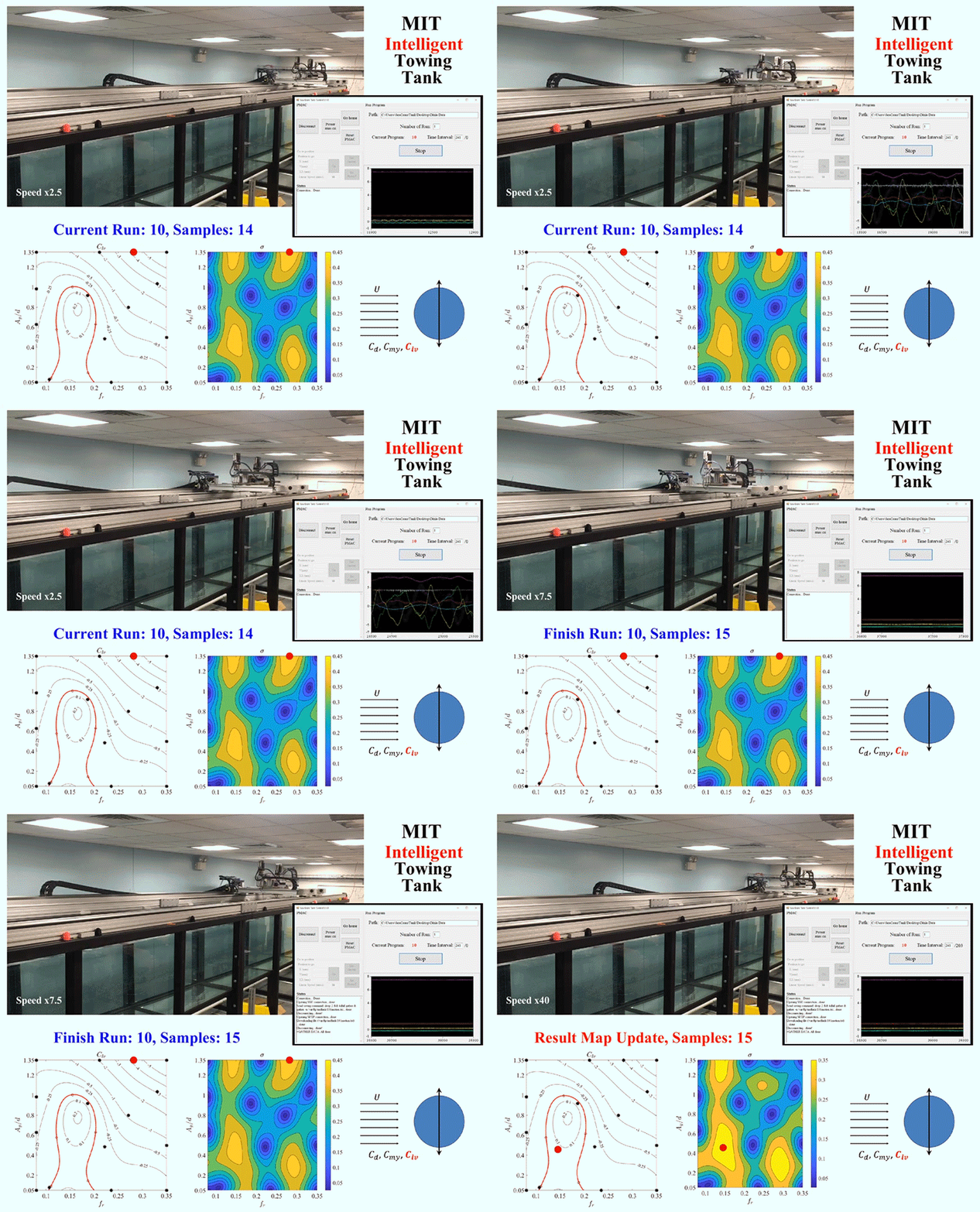
    One of the major challenges in fluid dynamics is the size of the parameter spaces we have to explore. Because many problems in fluid dynamics are non-linear, making small changes in the initial set-up can result in large differences in the results. Consider, for example, a simple cylinder towed through a water tank. As the cylinder moves, vortices will form around it and shed off the back, causing the cylinder to vibrate. The details of what will happen will depend on variables like the cylinder’s size and flexibility, the speed it’s being towed at, and which directions it’s allowed to vibrate in. Mapping out the parameter space, even sparsely, could take a graduate student hundreds of experiments.

    To speed up this process, engineers are now building robotic facilities like the Intelligent Towing Tank (ITT) shown above. Like graduate students, the ITT can work into the wee hours of the night, but, unlike graduate students, it never needs to eat, sleep, or stop experimenting. Now, one could use a facility like this to brute-force the answers by testing every possible combination of parameters, but even working 24 hours a day, that would take a long time. Instead, researchers use machine learning to guide the robotic facility into choosing test parameters in a way that optimizes the factors the researchers define as important.

    Essentially, the system starts with experiments chosen at random within the parameter space, and then uses those results to select areas of interest until it’s gathered enough data to satisfy the limits specified by human researchers. In theory, a well-designed algorithm can dramatically reduce the number of experiments needed to explore a parameter space. (Image and research credit: D. Fan et al.; submitted by Kam-Yung Soh)

  • Symmetric Wakes

    Symmetric Wakes

    Nature is full of remarkable patterns and moments of symmetry. This image shows the wake behind two rotating cylinders. Half of the cylinders are visible at the far left. The flow moves left to right. The cylinders are rotating at the same rate but in opposite directions, clockwise for the cylinder on top and counter-clockwise for the bottom one. At this speed relative to the freestream, there is a beautiful symmetry to the vortices in the wake, but the researchers found that even a slight deviation from this condition quickly destroyed the pattern. The flow is visualized here by introducing tiny hydrogen bubbles via electrolysis. The bubbles are small enough that their buoyancy has no appreciable effect. (Image credit: S. Kumar and B. Gonzalez)

  • Soap Film Visualization

    Soap Film Visualization

    Soap films provide a simple and convenient method for flow visualization. Here an allen wrench swept upward through a soap film leaves a distinctive wake. This trail of counter-rotating vortices is known as a von Karman vortex street. Their spacing depends on the wrench’s size and speed. Although the von Karman vortex street is usually associated with the wake of cylinders, it shows up often in nature as well, especially in the clouds trailing rocky islands. (Photo credit: P. Nathan)

  • Von Karman Vortex Streets

    Von Karman Vortex Streets

    The wake of a cylinder is a series of alternating vortices shed as the flow moves past. This distinctive pattern is known as a von Karman vortex street. The speed of the flow and the size of the cylinder determine how often vortices are shed. Incredibly, this pattern appears at scales ranging from the laboratory demo all the way to the wakes of islands. Von Karman vortex streets can even be seen from space. (Image credit: R. Gontijo and W. Cerqueira, source video)

  • Cylinder Wakes

    Cylinder Wakes

    A simple cylinder in a steady flow creates a beautiful wake pattern known as a von Karman vortex street. The image above shows several examples of this pattern. Flow is from bottom to top, and the Reynolds number is increasing from left to right. In the experiment, this increasing Reynolds number corresponds to increasing the flow velocity because the cylinder size, fluid, and temperature were all fixed. As the Reynolds number first increases, the cylinder begins to shed vortices. The vortices alternate the side of the cylinder from which they are shed as well as alternating in their sense of rotation (clockwise or counterclockwise). Further increasing the Reynolds number increases the complexity of the wake, with more and more vortices being shed. The vortex street is a beautiful example of how fluid behavior is similar across a range of scales from the laboratory to our planet’s atmosphere.  (Image credit: Z. Trávníček et. al)

  • Flow Behind a Cylinder

    Flow Behind a Cylinder

    Flow over blunt bodies produces a series of alternating vortices that are shed behind an object. The image above shows the turbulent wake of a cylinder, with flow from right to left. Red and blue dyes are used to visualize the flow. This flow structure is known as a von Karman vortex street, named for aerodynamicist Theodore von Karman. The meander of the wake is caused by the shed vortices, each of which has a rotational sense opposite its predecessor. The rapid mixing of the two dyes is a result of the flow’s turbulence. In low Reynolds number laminar cases of this flow the structure of individual vortices is more visible. Similar flow structures are seen behind islands and in the wakes of flapping objects. (Photo credit: K. Manhart et al.)

  • Shedding Vortices

    Shedding Vortices

    The von Karman vortex street of shed vortices that form the wake of a stationary cylinder are a classic image of fluid dynamics. Here we see a very different wake structure, also made up of vortices shed from a cylindrical body.  This wake is formed by two identical cylinders, each rotating at the same rotational rate. Their directions of rotation are such that the cylinder surfaces in between the two cylinders move opposite the flow direction (i.e. top cylinder clockwise, bottom anti-clockwise). This results in a symmetric wake, but the symmetry can easily be broken by shifting the rotation rates out of phase. (Photo credit: S. Kumar and B. Gonzalez)

  • Reader Question: Creeping Flow

    [original media no longer available]

    David asks:

    I’m taking an undergraduate fluid dynamics course, and I’m having trouble understanding what a Creeping Flow exactly is. The only thing I understand about that is that the Re should be 0 or close to 0 for the flow… Could you post an example of a creeping flow please? Thank you!

    Absolutely! Creeping flow, also called Stokes flow, is, like you said, a very low Reynolds number flow. It would be hard to say that the Reynolds number is zero because that would seem to imply no flow at all. Think of it instead as a Reynolds number much, much less than one. When the Reynolds number is very low, it means that viscous forces are dominating the flow. The video above shows creeping flow around a cylinder; notice how the streamlines stay attached all the way around the surface of the cylinder.  There’s no separation, no turbulent wake, no von Karman vortex street. Viscosity is so dominant here that it’s damped out all of that inertial diffusion of momentum.

    We’ve posted some other great examples of creeping flow, as well, though not by that name. There are the reversible laminar flow demos and various experiments in Hele-Shaw cells, all of which qualify as creeping flow because of their highly viscous nature. If you have the time, there’s also a great instructional video from the 1960s called “Low Reynolds Number Flow” (Parts 1, 2, 3, 4) starring G. I. Taylor (a famous fluid dynamicist) that is full of one demo after another.

  • Featured Video Play Icon

    Supersonic Flow Around a Cylinder

    This numerical simulation shows unsteady supersonic flow (Mach 2) around a circular cylinder. On the right are contours of density, and on the left is entropy viscosity, used for stability in the computations. After the flow starts, the bow shock in front of the cylinder and its reflections off the walls and the shock waves in the cylinder’s wake relax into a steady-state condition. About halfway through the video, you will notice the von Karman vortex street of alternating vortices shed from the cylinder, much like one sees at low speeds. The simulation is inviscid to simplify the equations, which are solved using tools from the FEniCS project. (Video credit: M. Nazarov)