Vortices are one of the most common structures in fluid dynamics. In this video, Dianna from Physics Girl explores an unusual variety of vortex you can create in a pool. Dragging a plate through the water at the surface creates a half vortex ring, which can be tracked either by the surface depressions created or by using food dye for visualization. Vortex rings are quite common, but a half vortex ring is not. The reason is that, ignoring viscous effects, a vortex filament cannot end in a fluid. The vortex must close back on itself in a loop, or, like the half vortex ring, the ends of the vortex must lie on the fluid boundary. It is possible to break vortex lines like those in smoke rings, but the lines will reattach, creating new vortex rings–just as they do in these vortex knots. (Video credit: Physics Girl; submitted by Tom)
Search results for: “viscous”

Beverage Bubbles Bursting
Fizzy drinks like soda and champagne have many bubbles which rise to the surface before bursting. When the film separating the bubble and the air drains and bursts, it leaves a millimeter-sized cavity that collapses on itself. That collapse creates an upward jet of fluid which can break into tiny aerosol droplets that disperse the aroma and flavor of the drink. Similar bubble-bursting events occur in sea spray and industrial applications, too. Researchers find that droplet ejection depends on bubble geometry and fluid properties such as viscosity. More viscous liquids, for example, generate smaller and faster droplets. Learn more and see videos of bubble-bursts at Newswise. (Image credit: E. Ghabache et al.)

Jet Impact

Viscoelasticity can generate some bizarre fluid behaviors. Viscoelastic fluids are special class of non-Newtonian fluid in which the response to deformation is both viscous, like a fluid, and elastic, like rubber. Above, a jet of viscoelastic fluid impacts a plate as viewed from the side (top image) and beneath (bottom image). When the jet impacts the plate, elastic stresses in the fluid destabilize the cylindrical symmetry of the jet. The jet instead becomes webbed, with an odd, asymmetric number of webs. The number of webs depends on the viscoelastic properties of the fluid as well as the jet’s speed and distance from the plate. (Image credit: B. Néel et al.)

The Kaye Effect
Those who have poured viscous liquids like syrup or honey are familiar with how they stack up in a rope-like coil, as shown in the top row of images above. What is less familiar, thanks to the high speed at which it occurs, is the Kaye effect, which happens in fluids like shampoo when drizzled. Shampoo is a shear-thinning liquid, meaning that it becomes less viscous when deformed. Like a normal Newtonian fluid, shampoo first forms a heap (bottom row, far left). But instead of coiling neatly, the heap ejects a secondary outgoing jet. This occurs when a dimple forms in the heap due to the impact of the inbound jet. The deformation causes the local viscosity to drop at the point of impact and the jet slips off the heap. The formation is unstable, causing the heap and jet to collapse in just a few hundred milliseconds, at which point the process begins again. (Image credit: L. Courbin et al.)

Beading Fluids
Adding just a few polymers to a liquid can substantially change its behavior. The presence of polymers turns otherwise Newtonian fluids like water into viscoelastic fluids. When deformed, viscoelastic fluids have a response that is part viscous–like other fluids–and part elastic–like a rubber band that regains its initial shape. The collage above shows what happens to a thinning column of a viscoelastic fluid. Instead of breaking into a stream of droplets, the liquid forms drop connected with a thin filament, like beads on a string. In a Newtonian fluid, surface tension would tend to break off the drops at their narrowest point, but stretching the polymers in the viscoelastic fluid provides just enough normal stress to keep the filament intact. If the effect looks familiar, it may be because you’ve seen it in the mirror. Human saliva is a viscoelastic liquid! (Image credit: A. Wagner et al.)
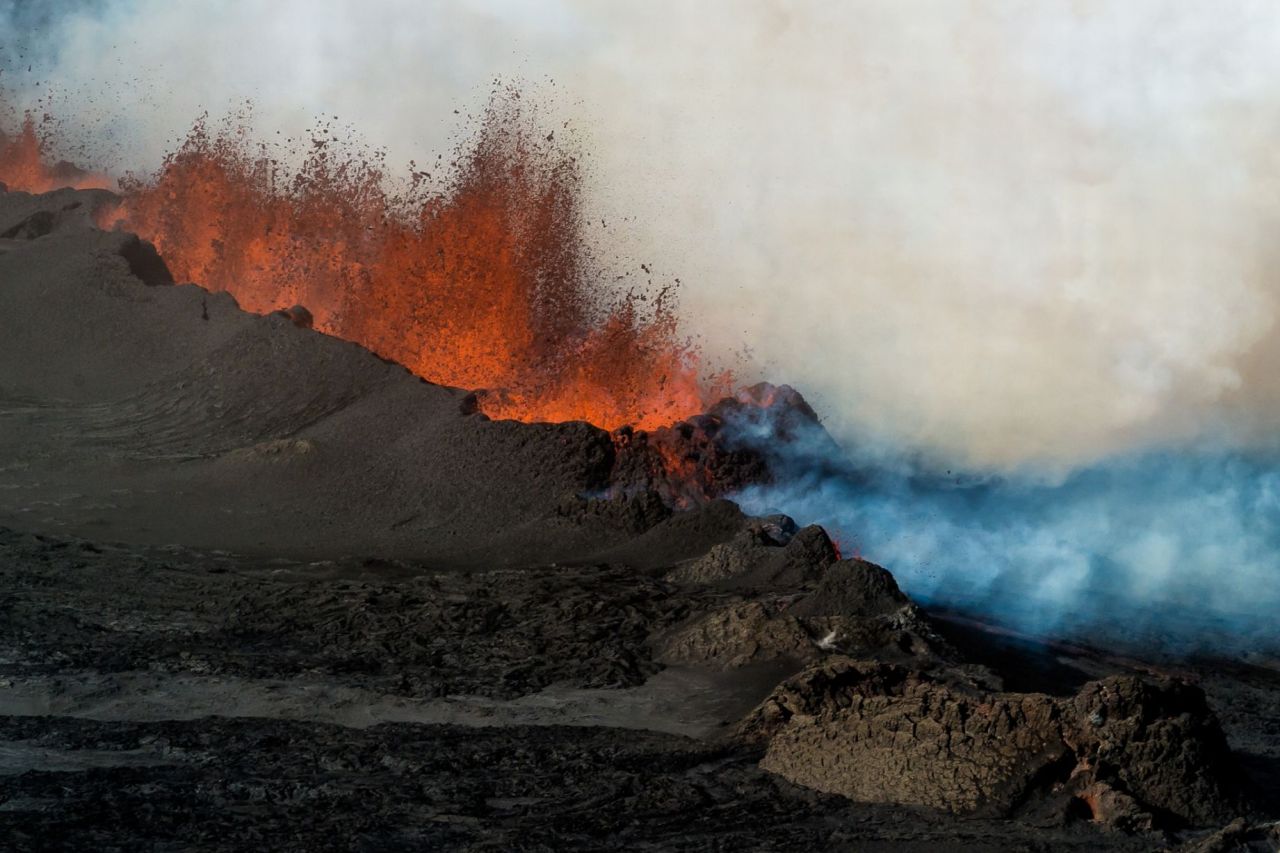
Lava Physics
Lava is rather fascinating as a fluid. Lava flow regimes range from extremely viscous creeping flows all the way to moderately turbulent channel flow. Lava itself also has a widely varying rheology, with its bulk properties like viscosity and its response to deformation changing strongly with temperature and composition. As lava cools, instabilities form in the fluid, causing the folding, coiling, branching, swirling, and fracturing associated with different types and classes of lava. (Image credit: E. Guddman, via Mirror)
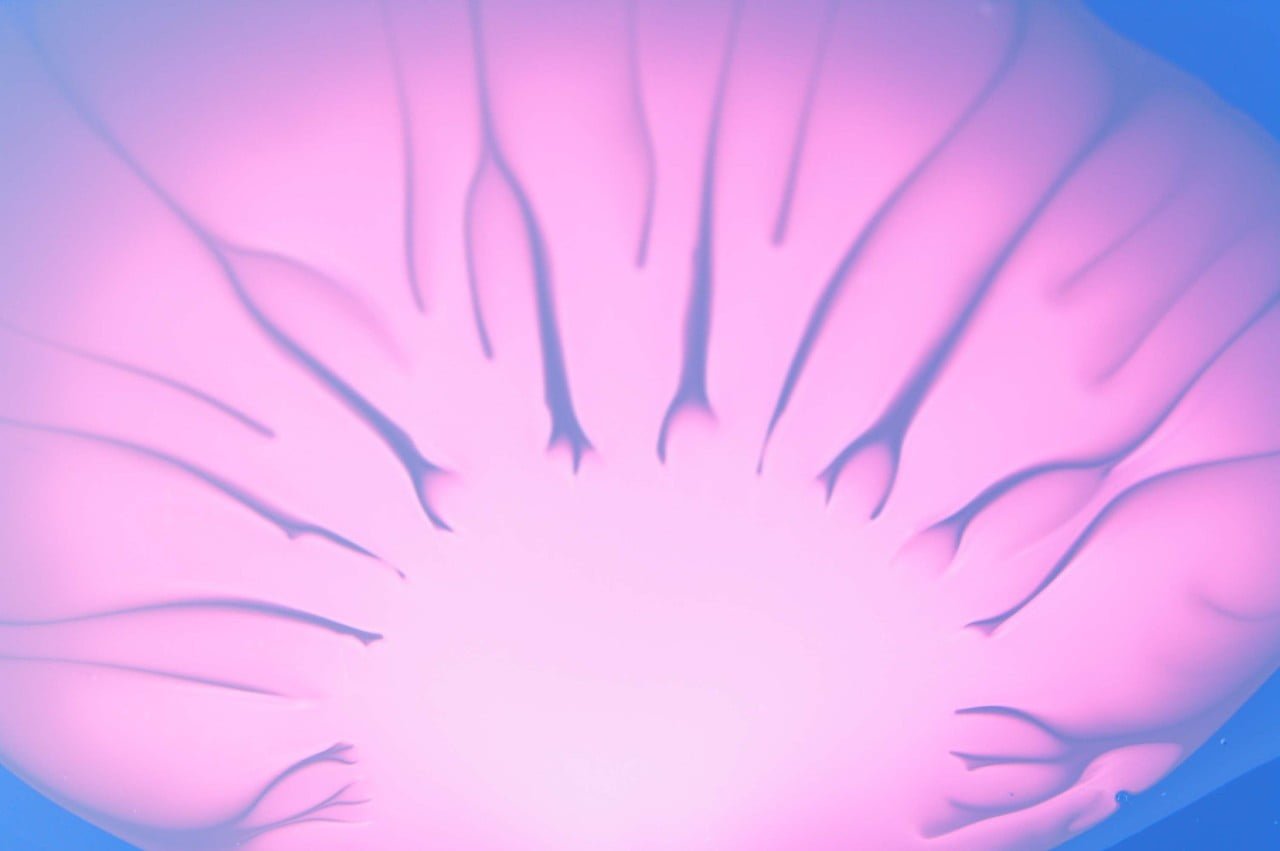
Fluid Fingers
Differences in viscosity or surface tension between two fluids can lead to finger-like instabilities. Here food dye placed on corn syrup forms narrow tendrils driven by the differing surface tensions of the two liquids. Similar dendritic shapes can be generated by injecting a low viscosity fluid into a high viscosity one (Saffmann-Taylor instability) or by pulling apart glass plates sandwiched around a high viscosity fluid. (Photo credit: T. Gaskill et al.)

4th Birthday: The Kaye Effect
Today’s post continues my retrospective on mind-boggling fluid dynamics in honor of FYFD’s birthday. This video on the Kaye effect was one of the earliest submissions I ever received–if you’re reading this, thanks, Belisle!–and it completely amazed me. Judging from the frequency with which it appears in my inbox, it’s delighted a lot of you guys as well. The Kaye effect is observed in shear-thinning, non-Newtonian fluids, like shampoo or dish soap, where viscosity decreases as the fluid is deformed. Like many viscous liquids, a falling stream of these fluids creates a heap. But, when a dimple forms on the heap, a drop in the local viscosity can cause the incoming fluid jet to slip off the heap and rebound upward. As demonstrated in the video, it’s even possible to create a stable Kaye effect cascade down an incline. (Video credit: D. Lohse et al.)
Stirring Up
When a viscoelastic non-Newtonian fluid is stirred, it climbs up the stirring rod. This behavior is known as the Weissenberg effect and results from the polymers in the fluid getting tangled and bunched due to the stirring. You may have noticed this effect in the kitchen when beating egg whites. In this video, researchers explore the effect using rodless stirring. The first example in the video shows a viscous Newtonian fluid being stirred. The stirring action creates a concave shape in the glycerin-air interface, and dye injection shows a toroidal vortex formed over the stirrer. Fluid near the center of the vortex is pulled downward and circulates out to the sides. In contrast, the viscoelastic fluid bulges outward when stirred. Dye visualization reveals fluid being pulled up the center into the bulge. It then travels outward, forming a mushroom-cap-like shape before sinking down the outside. This is also a toroidal vortex, but it rotates opposite the direction of the Newtonian one. Exactly how the polymers create this change in flow behavior is a matter of active research. (Video credit: E. Soto et al.)
Why Ketchup is Hard to Pour
Oobleck gets a lot of attention for its non-intuitive viscous behaviors, but there are actually many non-Newtonian fluids we experience on a daily basis. Ketchup is an excellent example. Unlike oobleck, ketchup is a shear-thinning fluid, meaning that its viscosity decreases once it’s deformed. This is why it pours everywhere when you finally get it moving. Check out this great TED-Ed video for why exactly that’s the case. In the end, like many non-Newtonian fluids, the oddness of ketchup’s behavior comes down to the fact that it is a colloidal fluid, meaning that it consists of microscopic bits of a substance dispersed throughout another substance. This is also how blood, egg whites, and other non-Newtonian fluids get their properties. (Video credit: G. Zaidan/TED-Ed; via io9)