
Vortex rings are endlessly fascinating, and they appear throughout nature from dolphins to volcanoes and from splashes to falling drops. One way to form them is to inject a jet into a stationary fluid. Viscosity between the fast-moving jet and the quiescent surrounding fluid slows down fluid at the jet’s edge. That slower fluid slips to the rear, only to get sucked into the faster -moving flow and pushed forward again. The result is a spinning toroid, or ring. A similar method generates vortex rings by pushing a fluid out a round orifice. In this case, interaction between the fluid and the wall provides some of the force necessary to form the vortex ring. (Image credit: Irvine Lab, source)
Search results for: “viscous”
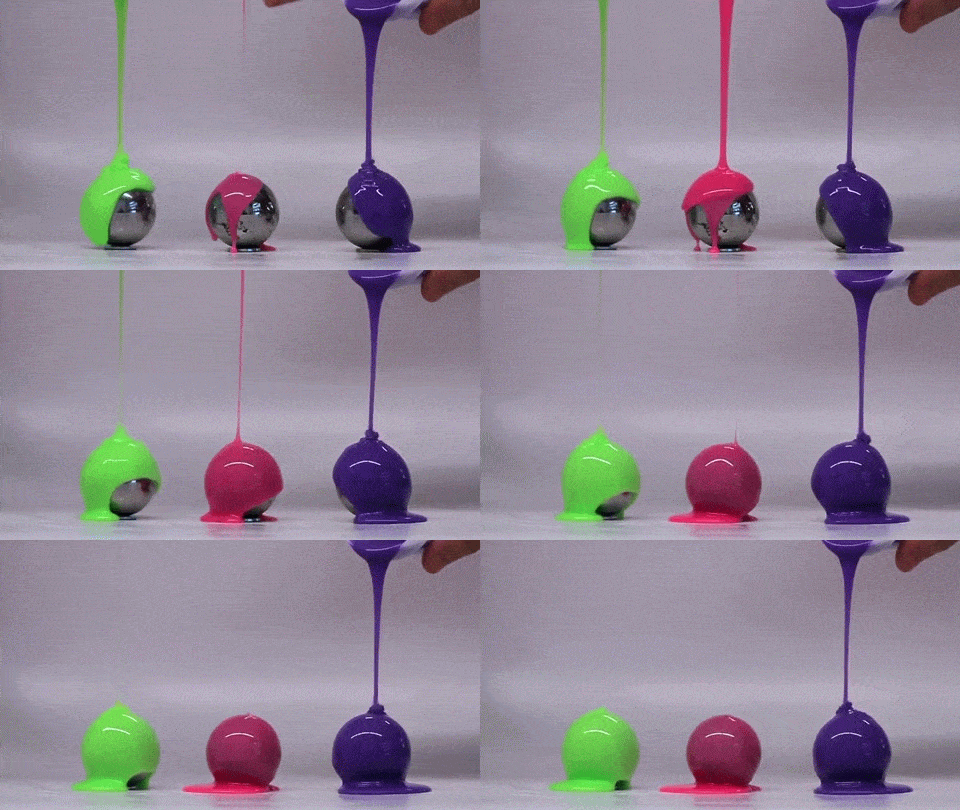
Bonbon Coatings

If you’ve ever bitten into a chocolate-covered bonbon, you may have noticed that the candy’s chocolate coating is remarkably uniform. Inspired by this observation, a group of engineers have investigated how viscous fluids poured over a curved surface flow and solidify; their findings were published this week.
Rather than heated chocolate, the group used polymer-filled fluids that cure and harden over time. Interestingly, they found that the final shell is quite uniform and that its thickness does not depend on the pouring technique. Instead, they can predict the final shell thickness based on the radius of the mold and the rheological properties of the fluid–specifically its density, viscosity, and curing time. The reason for this is that the time it takes for the fluid to drain and coat the mold is much shorter than the time it takes for the polymer to cure. As a result, the amount of fluid that sticks to the mold depends on geometry and fluid properties – not how the fluid was poured.
Amateur confectioners rejoice: pouring uniform chocolate coatings may be easier than you thought! (Image credit: MIT News, video; research credit: A. Lee et al.)

Wrinkling Fluids
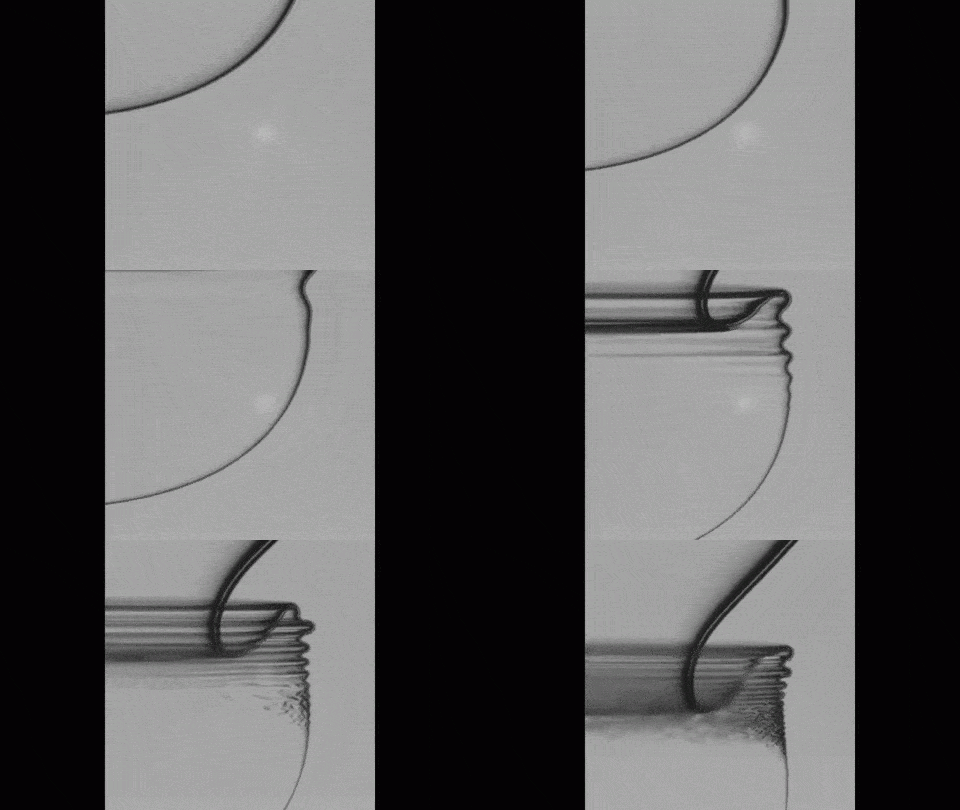
What you see here is a viscous drop falling into a less viscous fluid. Shear forces between the drop and the surrounding fluid cause the drop to quickly deform into a shape like an upside-down mushroom as it descends. The cap forms a vortex ring that curls the viscous fluid back on itself. As it does, that motion compresses the viscous sheet, causing it to wrinkle, as seen in the close-up in the bottom animation. Check out the full video here. (Image credit: E. Q. Li et al., source)

Jumping Off Water

Many insects and arachnids can walk on water by virtue of their hydrophobicity and small size. With their light weight and skinny legs, these invertebrates curve the air-water interface like a trampoline, with surface tension providing the elasticity that keeps them afloat. What’s truly incredible, though, is that many of these creatures, like water striders, can actually jump off the water surface.
The top animation shows high-speed video footage of a water strider leaping off the water. Notice how it distorts the air-water interface but doesn’t break the surface – it makes no splash.
The key is not to push too hard. If the insect exerts a force exceeding the limits of what surface tension can withstand, then its legs will break the water surface and it will lose energy to drag and viscous forces. The insect must generate its jumping force without exceeding a hard limit.
The water strider achieves this feat not by pushing downward but by rotating its middle and hind legs. Rotating its legs allows the insect to maintain contact with the water surface longer and continue deforming the interface as it jumps. This maximizes the momentum it transfers to the water, which, in turn, increases the insect’s take-off velocity. By studying and then emulating this mechanism, scientists were able to successfully create a tiny 68-mg water-jumping robot. (Image credits: J. Koh et al., sources, PDF)
This week FYFD is exploring the physics of walking on water, all leading up to a special webcast March 5th with guests from The Splash Lab.
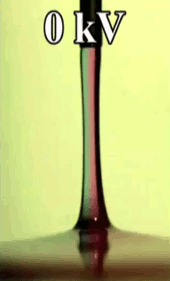
Electric Coiling
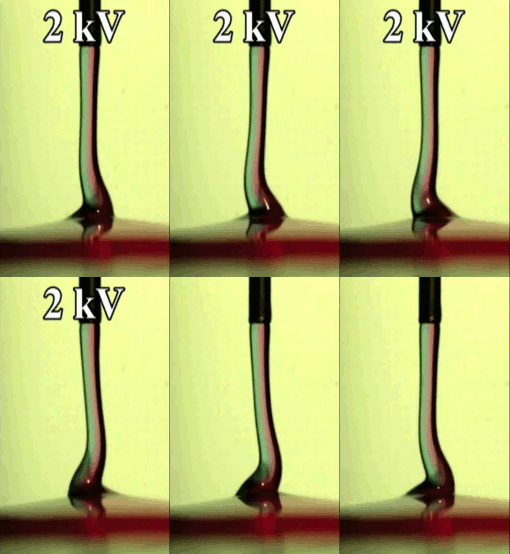


A falling jet of viscous fluid–like honey or syrup–will often coil. This happens when the jet falls quickly enough that it gets skinnier and buckles near the impact point. Triggering this coiling typically requires a jet to drop many centimeters before it will buckle. In many manufacturing situations, though, one might want a fluid to coil after a shorter drop, and that’s possible if one applies an electric field! Charging the fluid and applying an electric field accelerates the falling jet and induces coiling in a controllable manner.
An especially neat application for this technique is mixing two viscous fluids. If you’ve ever tried to mix, say, food coloring into corn syrup, you’ve probably discovered how tough it is to mix viscous substances. But by feeding two viscous fluids through a nozzle and coiling the resulting jet, researchers found that they could create a pool with concentric rings of the two liquids (see Figure C above). If you make the jet coil a lot, the space between rings becomes very small, meaning that very little molecular motion is necessary to finish mixing the fluids. (Image credits: T. Kong et al., source; via KeSimpulan)

Fluids Round-up
Here’s to another fluids round-up, our look at some of the interesting fluids-related stories around the web:
– Above is a music video by Roman Hill that relies on mixing and merging different fluids and perturbing ferrofluids for its visuals as it re-imagines the genesis of life.
– GoPro takes viewers inside a Category 5 typhoon with 112 mph (180 kph; 50 m/s) winds.
– Astronaut Scott Kelly demonstrates playing ping pong with a ball of water in space. (via Gizmodo)
– See fluid dynamics on a global scale with Glittering Blue. (via The Atlantic)
– To make a taller siphon, you have to find a way to avoid cavitation.
– Speaking of siphons, Randall Munroe tackles the question of siphoning water from Europa over at What If? (submitted by jshoer)
– The Mythbusters make a giant tanker implode using air pressure.
– Sixty Symbols explores how tiny things swim.
– What happens when you bathe in 500 pounds of putty? Let’s just say that bathing in an extremely viscous non-Newtonian fluid is not recommended. (via Gizmodo)
(Video credit and submission: R. Hill et al.)
Don’t forget to check out our Patreon page. Please help support FYFD by becoming a patron.
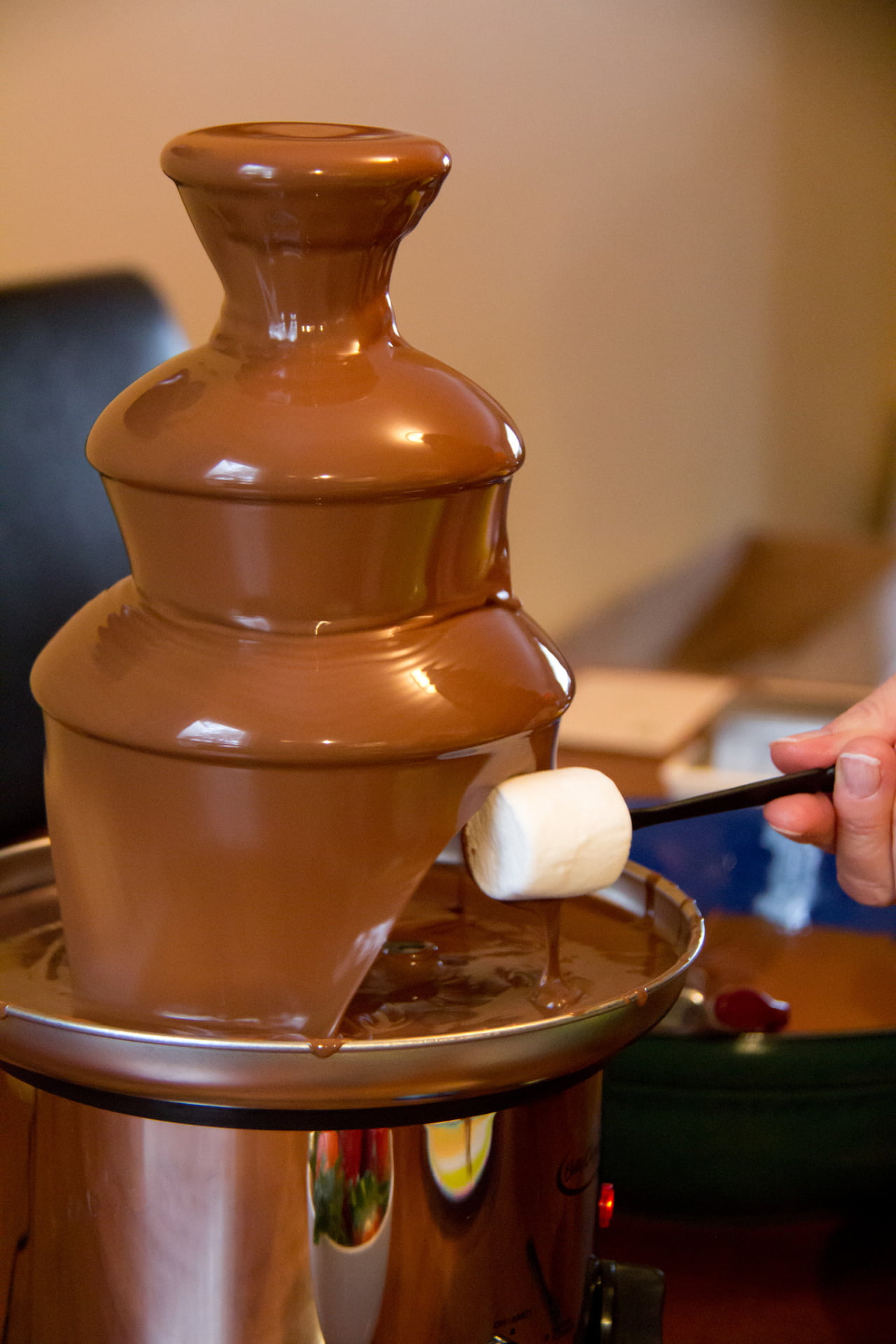
Chocolate Fountain
Amidst your holiday celebrations, you may have encountered a chocolate fountain. In a recent paper, applied mathematicians have laid out the physics behind these delicious decorations, and it turns out they are an excellent introduction to many fluids concepts. Molten chocolate is a mildly shear-thinning, non-Newtonian fluid, meaning that it becomes less viscous when deformed. This adds a wrinkle to the mathematics describing the flow, but only a little one. The researchers divide the flow into three regimes: pipe flow driving the chocolate up the inside of the fountain, thin-film flow over the fountain’s domes, and, finally, the curtain of falling chocolate where foodstuffs are dipped. The final regime is the most mathematically challenging and may be the most fascinating. The authors found that the free-falling curtain of liquid pulls inward as it falls due to surface tension. Their paper is quite approachable, and I recommend those of you with mathematical inclinations check it out. (Image credit: P. Gorbould; research credit: A. Townsend and H. Wilson)

Nectar-Eating Bats


Nectar-eating bats have evolved to use several methods to drink. Some bats, like the Pallas’ long-tongued bat (top), use a lapping method. Hair-like papillae on the bat’s tongue increase the contact area with the nectar, helping to draw the fluid up in viscous globs as the bat repeatedly dips its tongue into the nectar. The orange nectar bat (middle and bottom), in contrast, has a tongue with a long central groove. This bat’s tongue stays submerged as it drinks. Researchers hypothesize that muscle action along the tongue, combined with capillary action in the narrow groove, allow the bat to actively pump nectar up to its mouth. It’s worth noting that the edges of the bat’s tongue do not curl around to touch, so the bat is definitely not using suction as one would with a straw. (Image credit: M. Tschapka et al., source)
Pollock-Style Physics
Here on FYFD, we like to show off the artistic side of fluid dynamics. But some researchers are actively studying how artists use fluid dynamics in their art. In this video, they examine one of Jackson Pollock’s painting techniques, in which filaments of paint were applied by flinging paint off a paintbrush. Getting the technique to work requires a fine balance of forces and effects. Firstly, the paint must be viscous enough to hold together in a filament when flung. Secondly, the centripetal acceleration of the rotation must be high to both form the catenary filament and throw it off the brush. And, finally, the Reynolds number needs to be high enough to add some waviness and instability to the filament so that it looks interesting once it hits the canvas. Also be sure to check out the group’s previous work exploring Siqueiros’s painting techniques. (Video credit: B. Palacios et al.)
Un-Mixing a Flow
This video demonstrates one of my favorite effects: the reversibility of laminar flow. Intuition tells us that un-mixing two fluids is impossible, and, under most circumstances, that is true. But for very low Reynolds numbers, viscosity dominates the flow, and fluid particles will move due to only two effects: molecular diffusion and momentum diffusion. Molecular diffusion is an entirely random process, but it is also very slow. Momentum diffusion is the motion caused by the spinning inner cylinder dragging fluid with it. That motion, unlike most fluid motion, is exactly reversible, meaning that spinning the cylinder in reverse returns the dye to its original location (plus or minus the fuzziness caused by molecular diffusion).
Aside from being a neat demo, this illustrates one of the challenges faced by microscopic swimmers. In order to move through a viscous fluid, they must swim asymmetrically because exactly reversing their stroke will only move the fluid around them back to is original position. (Video credit: Univ. of New Mexico Physic and Astronomy)