A group at MIT have created a new 3D printer that builds with molten glass. This allows them to manufacture items that would difficult, if not impossible, to create with traditional glassblowing or other modern techniques. One of the coolest aspects of this technique is that it can use viscous fluid instabilities like the fluid dynamical sewing machine to create different effects with the glass. You can see this around 1:56 in the video. Varying the height of the head and the speed at which it moves will cause the molten glass to fall and form into different but consistent coiling patterns. All in all, it’s a very cool application for using some nonlinear dynamics! (Video credit: MIT; via James H. and Gizmodo)
Search results for: “viscous”
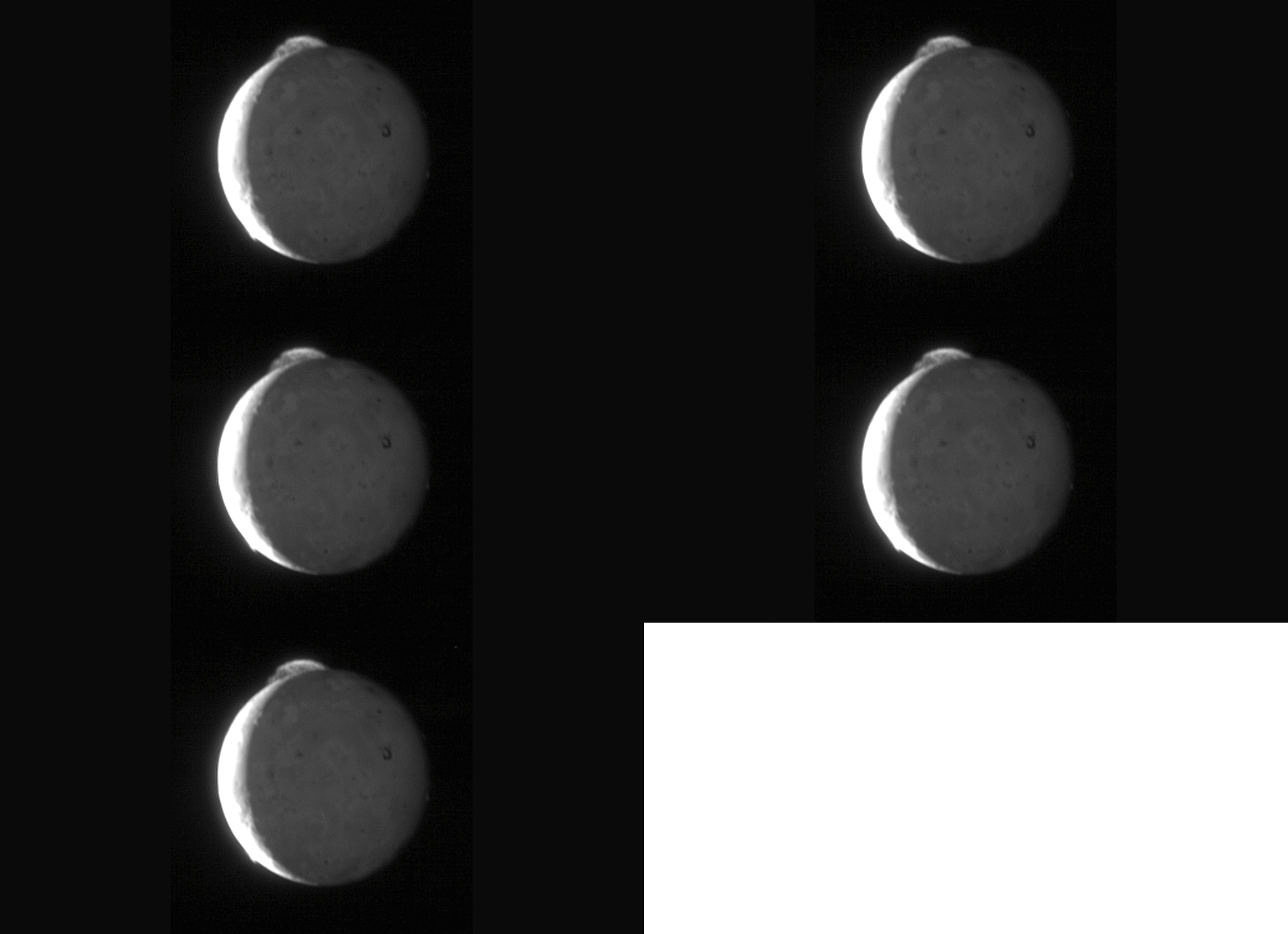
Io’s Magma Ocean
Jupiter’s moon Io is the most volcanically active world in our solar system. The energy that drives its geological activity comes from tidal forces the moon experiences from Jupiter and from other Jovian moons. These forces flex the moon and heat its interior via friction. Previous models of Io’s tidal heating assumed a solid body, but their results predicted volcanoes in locations that did not match observations of the moon. A new study suggests that the missing piece of the puzzle is a subsurface ocean of magma. Highly viscous liquids like magma also generate heat when deformed by tidal forces, and applying this model to Io allowed scientists to better match the volcano distribution actually seen on the world. For more, check out NASA’s article. (Image credit: NASA; via Gizmodo; submitted by jshoer)
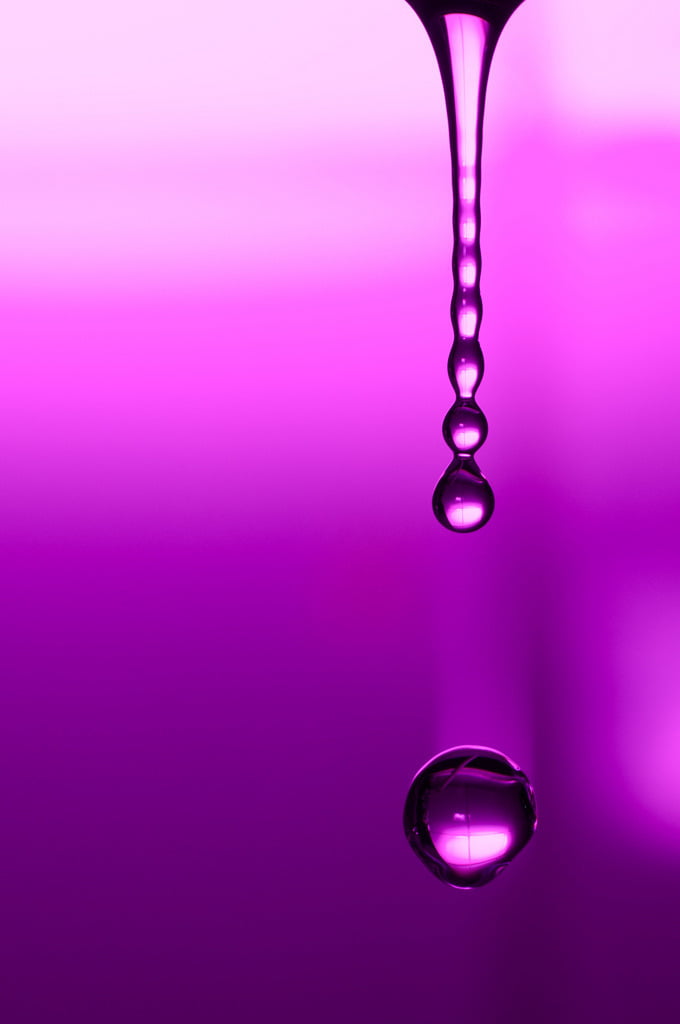
Breaking Jets Into Drops
A falling stream of water will break into droplets due to the Plateau-Rayleigh instability. Small disturbances can create a wavy perturbation in the falling jet. Under the right conditions, the pressure caused by surface tension will be larger in the narrower regions and smaller in the wider ones. This imbalance will drive flow toward the wider regions and away from the narrower ones, thereby increasing the waviness in the jet. Eventually, the wavy jet breaks into droplets, which enclose the same volume of water with less surface area than the perturbed jet did. The instability is named for Joseph Plateau and Lord Rayleigh, who studied it in the late 19th century and showed that a falling jet of a non-viscous fluid would break into droplets if the wavelength of its disturbance was larger than the jet’s circumference. (Image credit: N. Morberg)

Kitchen Fluid Dynamics


The kitchen is a fantastic place to witness the everyday beauty of fluid dynamics. Daria Khoroshavina and Olga Kolesnikova capture these delectable cooking-related GIFs on their Buttery Planet Tumblr. From pouring cream to drizzling syrup, there are countless examples of fluids in daily life. Check out their site for more awesome images and be sure to keep your eyes open for great examples of fluid behavior in your day-to-day life. (Image credits: Buttery Planet; via Colossal)

Why Joints Pop
Joints like our knuckles are lubricated with liquid called the synovial fluid. When manipulated, these joints can pop or crack audibly. For half a century, researchers have thought the cracking sound joints under tension make was the result of bubbles in the synovial fluid collapsing. But a new cine magnetic resonance imaging (MRI) study shows that the sound is generated during bubble inception and that the cavity persists after the sound. When the bones of the joint are pulled, viscous forces resist their separation. With enough force, the joints separate suddenly, causing a pressure drop in the synovial fluid that forms a vapor-filled cavity in the joint. According to the real-time MRI observations, this is when the sound is generated. The cavity does eventually dissipate, they found, but only well after the pop. The whole joint-cracking process is consistent with the tribonucleation mechanism seen in machinery. (Image credit: G. Kawchuk et al.; GIF via skunkbear, source video)

Newtonian and Non-Newtonian Vortices
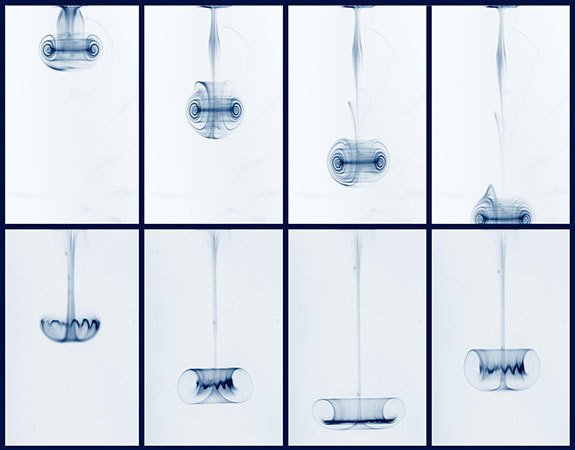
Not all vortex rings are created equal. Despite identical generation mechanisms and Reynolds numbers, the two vortex rings shown above behave very differently. The donut-shaped one, on the top left in green and in the middle row in blue, was formed in a Newtonian fluid, where viscous stress is linearly proportional to deformation. As one would expect, the vortex travels downward and diffuses some as time passes. The mushroom-like vortex ring, on the other hand, is in a viscoelastic fluid, which reacts nonlinearly to deformation. This vortex ring first furls and expands as it travels downward, then stops, contracts, and travels backward! (Image credit: J. Albagnac et al.; via Gallery of Fluid Motion)

When Lava Meets Ice
What happens when lava meets ice or water? Artists and geologists are working together to explore these interactions by melting crushed basalt and pouring it onto different substrates. Ice is their classic example; instead of melting instantly through the ice, the lava is so hot that it creates a layer of steam between it and the ice. This steam helps the lava flow due to lower friction while also insulating the ice from the lava. It’s an example of the Leidenfrost effect. The end result is a very bubbly lava flow thanks to the steam trying to escape through the viscous lava. (Video credit: Science Channel; submitted by @jchawner)

Melt Fracture in Plastics
Liquid plastics are often extruded–or pressure-driven through a die–during manufacturing. Early on manufacturers discovered that they could only extrude plastic at low flow rates, otherwise the plastic’s surface begins undulating in what became known as melt fracture. These corrugations result from the viscoelasticity of the plastic. Viscoelastic fluids have a response to deformation that is part viscous–like any fluid–and part elastic. At low flow rates, viscous forces dominate in the plastic, but at higher speeds, elasticity increases and the polymers in the plastic get stretched along the direction of flow. In response to this stretching, the polymers exert normal stresses, much like a rubber band that’s being stretched. Because this force acts only along the flow direction, different parts of the fluid are experiencing different forces, and these internal stresses cause the plastic to change shape. (Image credit: D. Bonn et al.)
Lava Coiling
It’s tough to get much closer to flowing lava than this video of freshly forming coastline in Hawaii. Lava is complex fluid, with viscous properties that vary significantly with chemical composition, temperature and deformation. Here, despite being very viscous, the lava flows quickly–perhaps even turbulently. Several times it forms a heap and even shows signs of the rope-coiling instability familiar from viscous fluids like honey. All in all, it’s quite mesmerizing. (Video credit: K. Singson; submitted by Stuart B.)

Stepping on Lava
What happens when you step on lava? (First off, don’t try this yourself.) Lava is both very dense and very viscous, so, as illustrated in the animation above, it does not give all that much under pressure. If you were to fall on it, you’d land, sink a little bit, and then get burned. It’s also interesting to note that the lava springs back after being indented. Basaltic lava like that found in Hawaii, where this clip originates, does have viscoelastic properties, which might explain the elasticity of the deformed fluid. (Image credit: A. Rivest, source video; via Gizmodo)