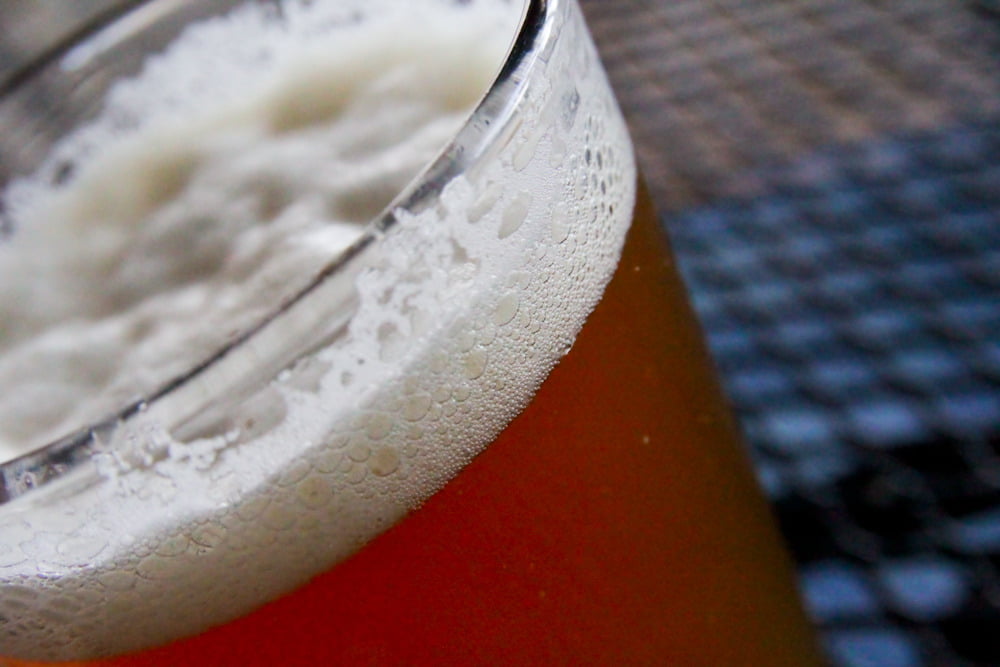
To round out our series on fluid dynamics in the Ig Nobel Prizes (which are not the same thing as the actual Nobel Prizes), here are some of the other winners. Last year Mayer and Krechetnikov won for a study on coffee sloshing when people walk. We’ve mentioned the pitch-drop experiment measuring the viscosity of an extremely viscous fluid a couple times; Mainstone and Parnell won a 2005 Ig Nobel for that (on-going) work. Another 2005 prize went to Meyer-Rochow and Gal for calculating the pressures involved in penguin defecation. (Yes, seriously.) A avian-related award was also handed out to B. Vonnegut for estimating tornado wind speeds by their ability to strip a chicken of its feathers. And, finally, for those looking to interest undergraduate lab students in mathematics and fluid dynamics, I suggest following the lead of 2002 winner A. Leike who demonstrates laws of exponential decay with beer head. (Photo credit: S. Depolo)
Search results for: “viscous”

Ig Nobel Fluids: Swimming in Syrup
Does a person swim faster in water or syrup? One expects the more viscous syrup would offer a swimmer greater resistance, but, at the same time, it could also provide more to push against. Gettelfinger and Cussler put this to a test experimentally with competitive and recreational swimmers in a pool of water and in one with a fluid measuring roughly twice the viscosity of water. Their results showed no significant change in swimming speed. When you consider that human swimming is highly turbulent, however, the result makes sense. In fluid dynamics, the dimensionless Reynolds number represents a ratio between inertial forces and viscous forces in a flow. The researchers estimate a Reynolds number of a typical human in water at 600,000, meaning that inertial effects far outweigh viscous effects. In this case, doubling the viscosity only reduces the Reynolds number by half, leaving it still well inside the turbulent range. Thus, swimming in syrup has little effect on humans. The Mythbusters also tackled this problem, with similar conclusions. This is a continuation of a series on fluids-related Ig Nobel Prizes. (Photo credit: Mythbusters/Discovery Channel; research credit: B. Gettelfinger and E. L. Cussler, winners of the 2005 Ig Nobel Prize in Chemistry)
Selective Suction
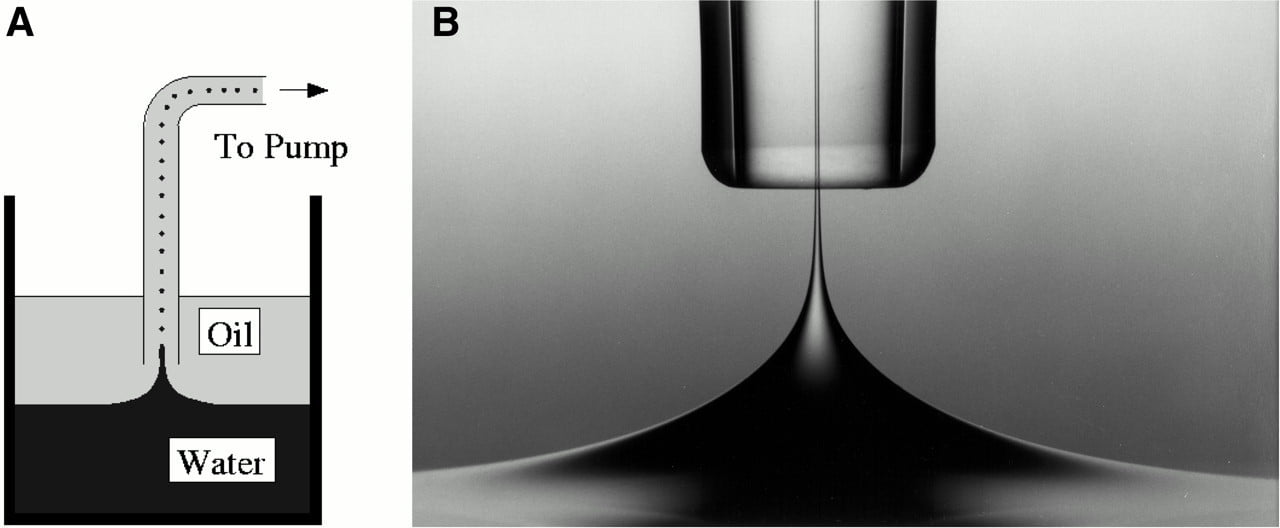
A thin spout of water is drawn up through a layer of oil in the photo on the right. This simple version of the selective withdrawal experiment is illustrated in Figure A, in which a layer of viscous oil floats above a layer of water. A tube introduced in the oil sucks fluid upward. At low flow rates, only the oil will be drawn into the tube, but as the flow rate increases (or the tube’s height above the water decreases), a tiny thread of water will be pulled upward as well. The viscous outer fluid helps suppress instabilities that might break up the inner fluid, and their relative viscosities determine the thickness of the initial spout. In this example, the oil is 195 times more viscous than the water. (Photo credit: I. Cohen et al.)

Liquids Pinching Off
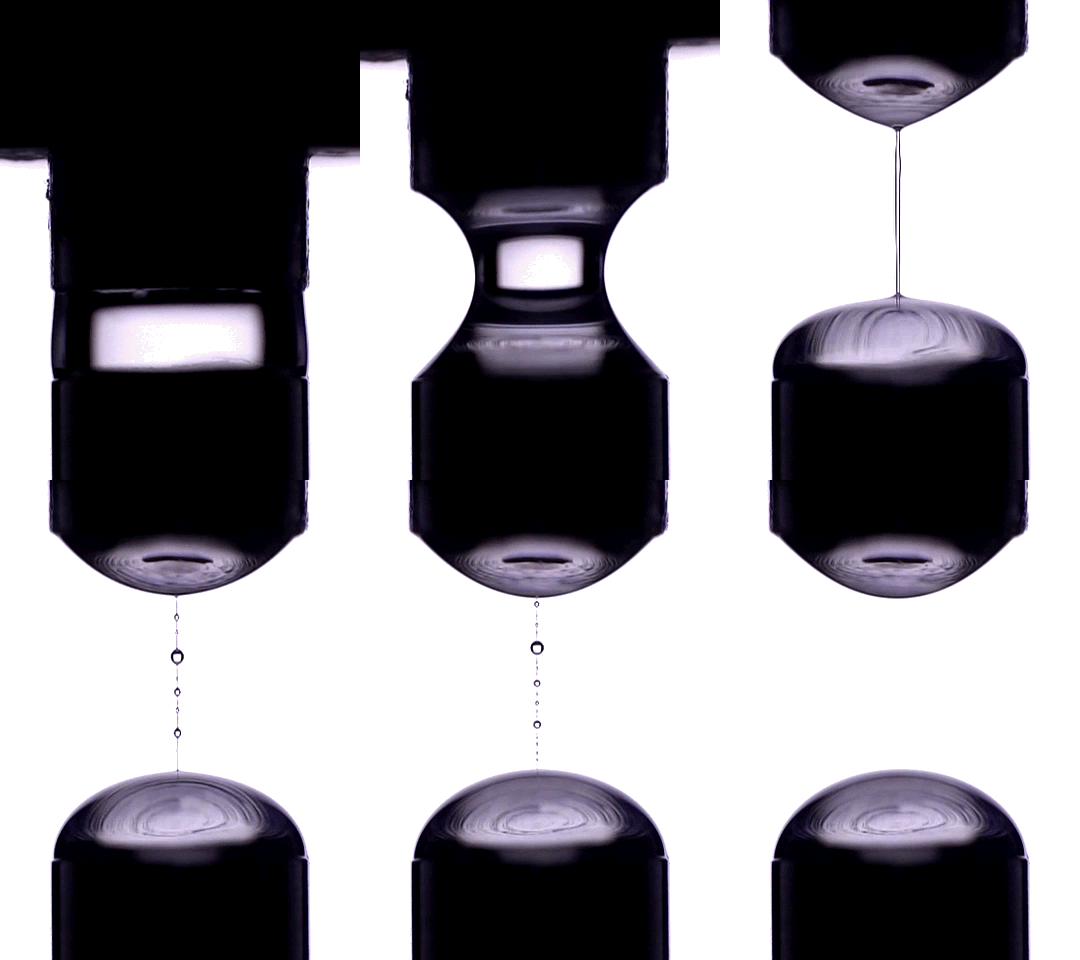
There is a surprising variety of forms in the pinch-off of a liquid drop. This short video shows three examples, and you’ll probably find yourself replaying it a few times to catch the details of each. On the left, a drop of water pinches off in air. As the neck between the nozzle and the drop elongates, the drop end of the neck thins to a point around which the drop’s surface dimples. This is called overturning. When the drop snaps off, the neck disconnects and rebounds into a smaller satellite droplet. The middle video shows a drop of glycerol, which is about 1000 times more viscous than water. This droplet stretches to hang by a thin neck that remains nearly symmetric on the nozzle end and the drop end. There is no satellite drop when it breaks. The rightmost video shows a polymer-infused viscoelastic liquid pinching off. This liquid forms a very long, thin thread with a fat satellite drop still attached. When gravity eventually becomes too great a force for the stresses generated by the polymers in the liquid, the drops break off. (Video credit: M. Roche)

Spiraling Break-up
Instabilities in fluids are sometimes remarkable in their uniformity. Here we see a hollow spinning cup with a thin film of fluid flowing down the interior. The rim of fluid at the cup’s lip stretches into long, evenly spaced, spiraling threads. These filaments stretch until centrifugal forces overcome surface tension and viscous forces and break the liquid into a multitude of tiny droplets. This process is called atomization and is vital to everyday applications like internal combustion and inkjet printing. (Photo credit: R. P. Fraser et al.)

101 Signals
Welcome, Wired readers! I’m stunned, honored, and very grateful to see FYFD featured on this year’s 101 Signals science recommendations, especially given how much I admire many of the others on that list! The premise of FYFD is simple: every weekday I post a new photo or video and a brief explanation of the fluid dynamics and physics therein. Topics include everything from chip-sized microfluidics to astrophysics, from super-slow-moving flows to hypersonic planetary re-entry, from the aerodynamics of cycling to the bizarre behavior of cyrogenic superfluids. You can find a little bit of just about anything here. Jump into the visual archive and take a look around. I’m also always happy to answer reader questions on Tumblr or by email. Happy reading! – Nicole

Fluids Round-up – 11 August 2013
Time for another fluids round-up! Here are your links:
- Back in January 1919, a five-story-high metal tank full of molasses broke and released a wave of viscous non-Newtonian fluid through Boston’s North End. Scientific American examines the physics of the Great Molasses Flood, including how to swim in molasses. If you can imagine what it’s like to swim in molasses, you’ll know something of the struggle microbes experience to move through any fluid. They also discusses some of the strange ways tiny creatures swim.
- In sandy desert environments, helicopter blades can light up the night with so-called helicopter halos. The effect is similar to what causes sparks from a grinding wheel. Learn more about this Kopp-Etchells effect.
- Check out this ominous footage of a tornadic cell passing through Colorado last week.
- If you want more of a science-y look to your drinkware, you should check out the Periodic TableWare collection over on Kickstarter.
- Finally, wingsuits really take the idea of gliding flight to some crazy extremes. Check out this video of in-flight footage. Watch for the guy’s wingtip vortices at 3:16 (screencap above)! (submitted by Jason C)
(Photo credit: Squirrel)
The Fluid Dynamical Sewing Machine
Originally posted: 3 Jan 2012 Nonlinearity and chaos are important topics for many aspects of fluid dynamics but can be difficult to wrap one’s head around. But this video provides an awesome, direct example of one of the key concepts of nonlinear systems–namely, bifurcation. What you see is a thread of very viscous fluid, like honey, falling on a moving belt. Initially, the belt is moving quickly and the thread falls in a straight line. When the belt slows down, the thread begins to meander sinusoidally. With additional changes in the belt’s speed, the thread begins to coil. A multitude of other patterns are possible, too, just by varying the height of the thread and the speed of the belt. Each of these shifts in behavior is a bifurcation. Understanding how and why systems display these behaviors helps unravel the mysteries of chaos. (Video credit: S. Morris et al.)
Reminder: There’s still time left to take the reader survey! Please take a couple minutes to help improve FYFD and science outreach. Thank you!

Foam Array
Soap foams represent an interplay of gravitational, capillary, interfacial, and viscous forces, none of which is easily isolated in a laboratory experiment. This makes it difficult to sort out the various effects governing the foam since individual variables cannot be controlled independently. The image above is of a special foam, one in which the liquid phase has been replaced with a ferrofluid. This adds an additional parameter–external magnetic fields–to the problem, but, unlike the others, this is an independent variable. By manipulating the external magnetic field, researchers can control the foam’s drainage rate and even the structure it takes on. (Photo credit: E. Janiaud)

Beads on a String

Adding just a small amount of polymers to a liquid can drastically change its behavior. The polymers make the liquid viscoelastic, meaning that, under deformation, the liquid shows behaviors that are both viscous (like all fluids) and elastic (i.e. able to resume its original shape, like a rubber band). These properties are particularly identifiable under extensional loading, like in the animation above. Under these loads, the polymers in the fluid stretch and rearrange, creating an internal compressive stress that acts opposite the imposed tensile stress. It’s this balance of forces, along with ever-present surface tension that creates the beads-on-a-string effect seen above. (Image credit: B. Keshavarz)
ETA: As usual, Tumblr gave me issues with an animated GIF. It should be fixed now. Sorry!