Search results for: “microgravity”

  • Cleaning Up Combustion

    Cleaning Up Combustion

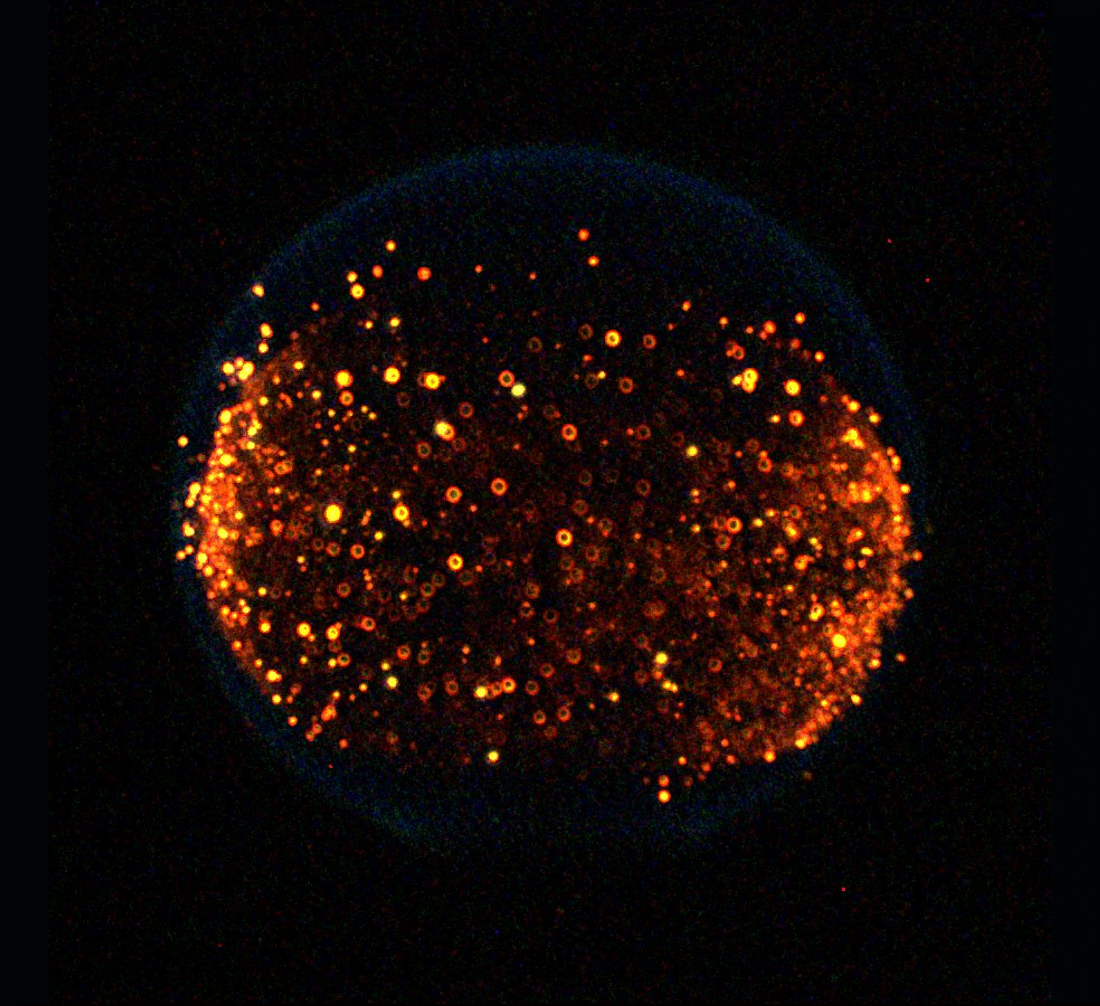
    In space, flames behave quite differently than we’re used to on Earth. Without gravity, flames are spherical; there are no hot gases rising to create a teardrop-shaped, flickering flame. In many ways, removing gravity makes combustion simpler to study and allows scientists to focus on fundamental behaviors. It’s no surprise, then, that combustion experiments are a long-standing feature on the International Space Station.

    In the photo above, we see a flame in microgravity studded with bright yellow spots of soot. Soot is a by-product of incomplete combustion; it’s essentially unburned leftovers from the chemical reaction between fuel and oxygen. In this experiment, researchers were studying how much soot is produced under different burning conditions, work that will help design flames that burn more cleanly in the future. (Image and video credit: NASA; submitted by @LordDewi)

  • Testing Granular Gas Theory

    Testing Granular Gas Theory

    When excited, a group of particles can behave much like a gas. These granular gases exhibit many similarities to molecular gases but contain one vital difference: without a constant input of energy, granular gases lose kinetic energy to collisions.

    Over the years, scientists have developed a special theory to describe the behaviors of granular gases, but most of its predictions could only be tested numerically. A new study used a microgravity experiment aboard a sounding rocket to physically test the theory.

    The experiment, shown above, consists of nearly 2800 magnetic particles, which the researchers could stir up using pairs of magnets. Once they shut off the magnets (which occurs at t=0 in the image above), the granular gas begins to “cool” as collisions sap away its energy. With this set-up, the researchers were able to confirm several key predictions of the granular gas theory. (Image and research credit: P. Yu et al.; via APS Physics)

  • Featured Video Play Icon

    “The Other Side”

    “The Other Side” is a short film imagining fluids on the other side of people’s eyes. The fast-paced editing makes this one feel rather different from Thomas Blanchard’s other films, which often take the time to linger on the mixing of soaps, inks, and paints that form the bulk of the imagery. There are hints of ferrofluids here, too, but like much of the action, if you blink you’ll miss it.

    Strange as it may sound, there’s actually a strong connection between eyes and fluid dynamics, whether you’re considering the optimal length for eyelashes, the way a tear film coats the eye, or how vision changes in microgravity. (Image and video credit: T. Blanchard)

  • Featured Video Play Icon

    Drinking Coffee in Space

    You probably don’t give much thought to the forces involved in drinking here on Earth. That’s because gravity’s effects dominate over everything else. Our cups are designed to hold a liquid until we use gravity to pour it into our mouths. But that technique doesn’t work in microgravity. There other forces govern how liquids flow: specifically surface tension and capillary action.

    Both of these forces are the result of intermolecular attractions. In the case of surface tension, it’s the attraction that the molecules of a liquid feel for one another that keeps them in a cohesive bunch. Capillary action is similar, but it’s an attraction between the liquid molecules and those of the solid they’re wetting. When you combine them both, you get the ability for liquids to climb up a narrow gap and pull more liquid up behind them. That’s the key science behind every version of the “space cup” developed by astronaut Don Pettit and his collaborators. 

    To hear more about the development and engineering of the cup (and exactly why it makes drinking coffee so much more enjoyable in space than it would be otherwise) check out the full video. And, in case you’re wondering, there’s a special microgravity champagne flute, too! (Image and video credit: It’s Okay to Be Smart)

  • Making Champagne for Space

    Making Champagne for Space

    Humanity’s ongoing quest to enjoy beloved beverages in space has a new entry: champagne. French champagne maker Mumm has announced a new line with specially designed bottles to dispense champagne in microgravity. The bottles feature an internal piston that allows users to release the contents from the bottle in a controlled manner. Rather than pouring the champagne, one dispenses a blob which can then be caught in the special cups that go with it. They’re shaped somewhat like a miniature coupe. 

    It certainly looks like a fun way to celebrate in microgravity, although it’s unclear to me that they’ve tested the after effects of consumption. Historically, astronauts have avoided carbonated beverages in orbit because the lack of gravity can cause unpleasant side effects with all those bubbles. (Image credits: Mumm Champagne, source; via Wired)

  • Twisting to Pack

    Twisting to Pack

    One conventional method for packing granular materials is to tap them repeatedly, but a new study suggests that twisting is a faster method. Researchers poured thousands of dice into a cylinder, then twisted the container back and forth. When the acceleration caused by the change in direction exceeded a threshold value, the dice worked their way into ordered layers of concentric rings over ~10,000 cycles. Reaching this maximum packing density through tapping requires a specially designed method where the tapping characteristics change over time. With twisting, shear forces transmitted from the walls of the container tend to align the flat surfaces of the dice, providing an efficient method of ordering if the acceleration is large enough. The researchers hope methods like this may be useful where tapping works poorly, such as in microgravity. (Image and research credit: K. Asencio et al.; via APS Physics; submitted by Kam-Yung Soh)

  • Blowing Bubbles in Space

    Blowing Bubbles in Space

    Blowing bubbles in your fruit juice is a bad idea when you’re in space, as astronaut Jack Fischer demonstrates. On Earth, gravity dominates water’s behavior, except when things are very small. But in microgravity, a liquid’s other characteristics become more obvious. Adhesion between the straw and juice guides it up and onto Fischer’s face. Surface tension is strong enough to hold the expanding juice bubble together. Capillary action, the ability of fluids to climb up narrow spaces, is far more apparent in microgravity as well, although it’s not important for this demo. We sometimes forget how powerful these forces can be, but microgravity is a good reminder that fluids are more complicated than we think. (Image credit: J. Fischer, source)

  • Featured Video Play Icon

    Flames in Freefall

    Gravity is such an omnipresent force in our lives that we frequently forget how strongly it affects our daily experiences and how differently nature behaves without it. A wonderful example of this is the simple flame of a candle. On Earth, a candle flame is tear-drop-shaped and elongated, burning hotter near the bottom and glowing yellow from soot at the top. But, as Dianna demonstrates with her free-fall experiment, this shape is due entirely to the effects of gravity. Buoyant forces make the hot air near the candle rise, pulling in cooler air and fresh oxygen at the base while stretching out the flame. In microgravity – or free-fall – flames are instead spherical, their shape driven by molecular and chemical diffusion. Check out the full video to see more effects of acceleration on flames. (Video credit: Physics Girl)

  • Featured Video Play Icon

    Sloshing in Space

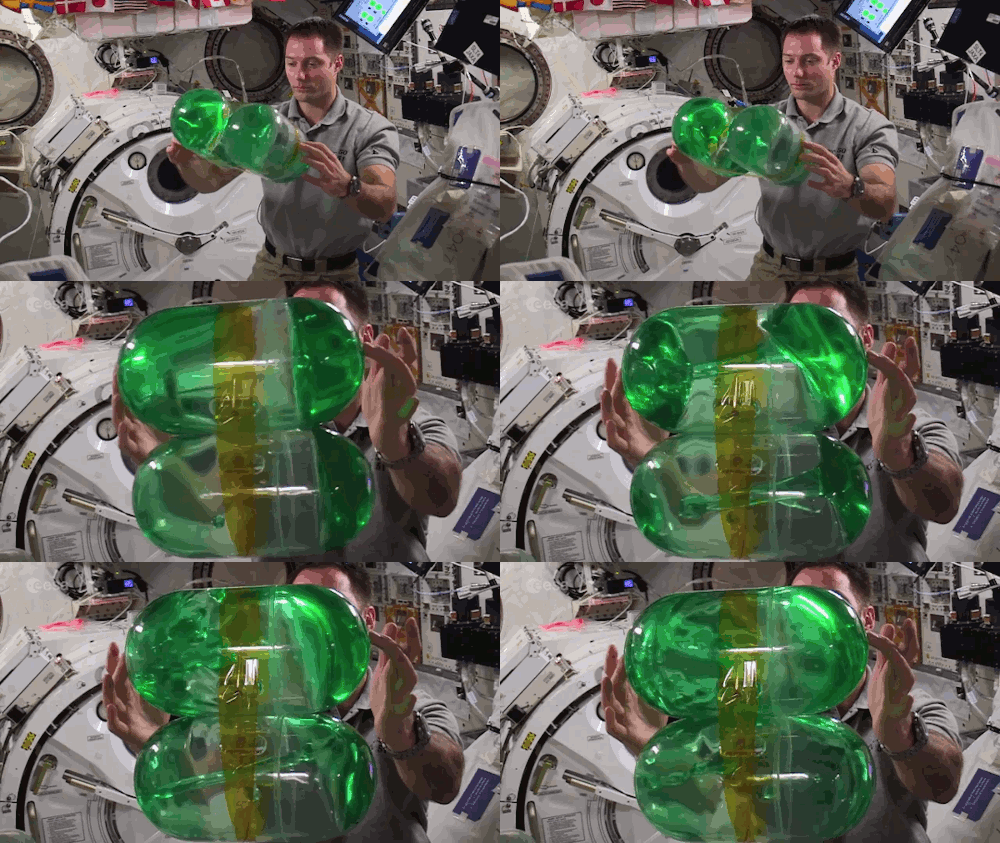
    Last month, French astronaut Thomas Pesquet posted a video of some experiments he did on the International Space Station exploring the movement of fluids in microgravity. He filmed the experiments as part of the SPHERES Slosh project. Sloshing is the technical term for how liquids respond to the motion of their container, and it’s a tough problem whether you’re carrying a full coffee mug on Earth or dealing with a partially-emptied fuel canister in orbit.

    Here on Earth, gravitational forces dominate how fluids respond, but in microgravity, surface tension is a more powerful player. Pesquet’s demonstrations help scientists here on Earth better understand and model how liquids respond to movement in space. One major application for this is in spacecraft fuel tanks, which engineers must be able to design so that they empty themselves consistently with or without the added complications of spinning, maneuvering, or impulsive kicks of acceleration. (Video and image credit: ESA; submitted by gdurey)

  • Featured Video Play Icon

    Avoiding Coalescence

    If you watch closely as you go about your day, you may notice drops of water sometimes bounce off a pool of water instead of coalescing. Fluid dynamicists have been fascinated by this behavior since the 1800s, but it was Couder et al. who explained that these droplets can bounce indefinitely as long as the thin air layer separating the drop and pool is refreshed by vibrating the pool. In this video, Destin teams up with astronaut Don Pettit to film the phenomenon in beautiful high-speed. My favorite part of the video starts around 8:18, where Destin shows Don’s experiments with this effect in microgravity. It turns out that the cello produces just the right frequencies to create a cascade of bouncing water droplets, much like a Tibetan singing bowl turned back on itself! (Video credit: Smarter Every Day; submitted by Destin and effyeahjoebiden)