Search results for: “jet”

  • Forming a Jet

    Forming a Jet

    Many situations can generate high-speed liquid jets, including droplet impacts, vibrated fluids, and surface charges. In each of these cases, a concave liquid surface is impulsively accelerated, which causes the flow to focus into a jet. The image above shows snapshots of a microjet generated from a 50 micron capillary tube visible at the right. This jet formed when the meniscus inside the capillary tube was disturbed by a laser pulse that vaporized fluid behind the interface. Incredibly, the microjets generated with this method can reach speeds of 850 m/s, nearly 3 times the speed of sound in air. Researchers have found the method produces consistent results and suggest that it could one day form the basis for needle-free drug injection. You can read more in their freely available paper. (Photo credit: K. Tagawa et al.)

  • Featured Video Play Icon

    Granular Jet

    Sometimes the similarity between fluid flow and granular flows is quite striking. This video shows a stream of sand falling down a tube and impacting a rod. (Note: the view is rotated 90 degrees counter-clockwise, so down points to the right.) As the sand strikes the rod, it’s deflected into a conical sheet, very much like a water bell. There are even ripple-like instabilities that form in the granular sheet, though they move differently than in a liquid due to the sand’s lack of surface tension. (Video credit: S. Nagel et al.)

  • Featured Video Play Icon

    When Jets Collide

    When two jets of a viscous liquid collide, they can form a chain-like stream or even a fishbone pattern, depending on the flow rate. This video demonstrates the menagerie of shapes that form not only with changing flow rates but by changing how the jets collide – from a glancing impingement to direct collision. When just touching, the viscous jets generate long threads of fluid that tear off and form tiny satellite droplets. At low flow rates, continuing to bring the jets closer causes them to twist around one another, releasing a series of pinched-off droplets. At higher flow rates, bringing the jets closer to each other creates a thin webbing of fluid between the jets that ultimately becomes a full fishbone pattern when the jets fully collide. The surface-tension-driven Plateau-Rayleigh instability helps drive the pinch-off and break-up into droplets. (Video credit: B. Keshavarz and G. McKinley)

  • Protostellar Jets

    Protostellar Jets

    As young stars form, they often produce narrow high-speed jets from their poles. By astronomical standards, these fountains are dense, narrowly collimated, and quickly changing. The jets have been measured at velocities greater than 200 km/s and Mach numbers as high as 20. The animation above (which you should watch in its full and glorious resolution here) is a numerical simulation of a protostellar jet. Every few decades the source star releases a new pulse, which expands, cools, and becomes unstable as it travels away from the star. Models like these, combined with observations from telescopes like Hubble, help astronomers unravel how and why these jets form. (Image credit: J. Stone and M. Norman)

    ETA: As it happens, the APOD today is also about protostellar jets, so check that out for an image of the real thing. Thanks, jshoer!

  • Rebounding Jets

    Rebounding Jets

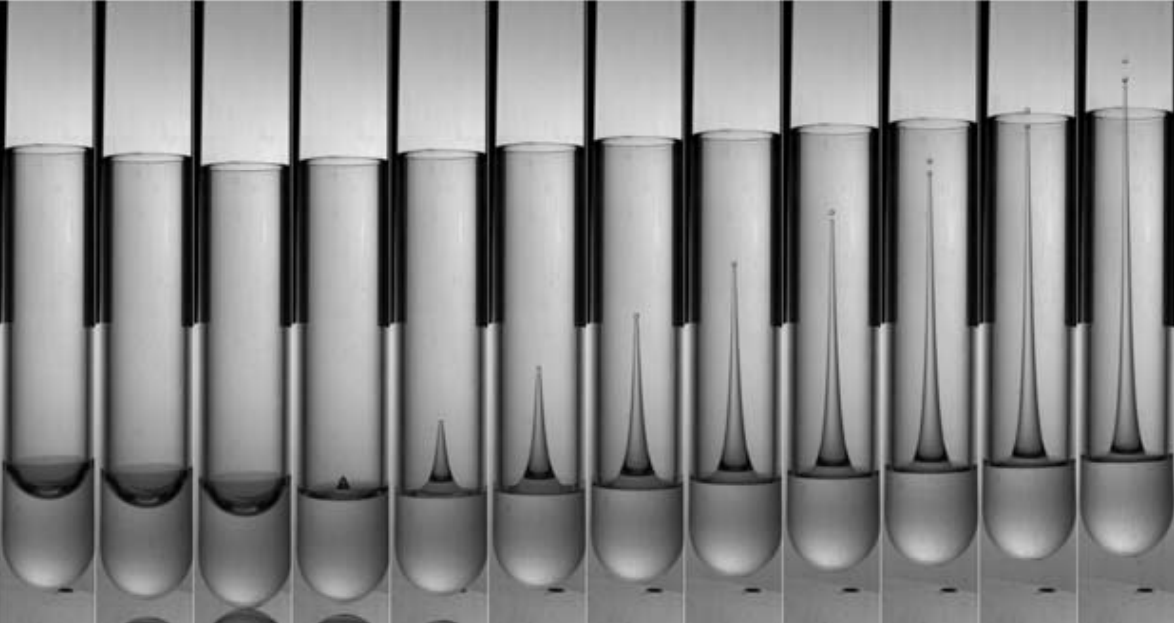
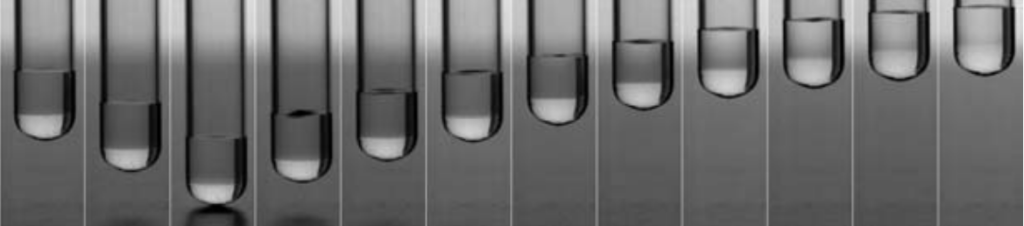
    The photo sequence in the upper image shows, left to right, a fluid-filled tube falling under gravity, impacting a rigid surface, and rebounding upward. During free-fall, the fluid wets the sides of the tube, creating a hemispherical meniscus. After impact, the surface curvature reverses dramatically to form an intense jet. If, on the other hand, the tube is treated so that it is hydrophobic, the contact angle between the liquid and the tube will be 90 degrees during free-fall, impact, and rebound, as shown in the lower image sequence. The liquid simply falls and rebounds alongside the tube, without any deformation of the air-liquid interface. (Photo credit: A. Antkowiak et al.)

  • Dancing Jets

    Dancing Jets

    Vibrating a gas-liquid interface produces some exciting instability behaviors. The photo above shows air and silicone oil vibrated vertically within a prism. For the right frequencies and amplitudes, the vibrations produce liquid jets that shoot up and eject droplets as well as gas cavities and bubble transport below the interface. To see a similar experiment in action, check out this post. (Photo credit: T. J. O’Hern et al./Sandia National Laboratories)

  • Stopping Jet Break-Up

    Stopping Jet Break-Up

    When a stream of liquid falls, a surface tension effect called the Plateau-Rayleigh instability causes small variations in the jet’s radius to grow until the liquid breaks into droplets. For a kitchen faucet, this instability acts quickly, breaking the stream into drops within a few centimeters. But for more viscous fluids, like honey, jets can reach as many as ten meters in length before breaking up. New research shows that, while viscosity does not play a role in stretching and shaping the jet as it falls–that’s primarily gravity’s doing–it plays a key role in the way perturbations to the jet grow. Viscosity can delay or inhibit those small variations in the jet’s diameter, preventing their growth due to the Plateau-Rayleigh instability. In this respect, viscosity is a stabilizing influence on the flow. (Photo credit: Harsha K R; via Flow Visualization)

  • Plasma Jets

    Plasma Jets

    Jets of high-energy plasma and sub-atomic particles explode outward from the Hercules A elliptical galaxy at the center of this photo. The jets are driven to speeds close to that of light due to the gravitation of the supermassive black hole at the center of the elliptical galaxy. Relativistic effects mask the innermost portions of the jets from our view, but, as the jets slow, they become unstable, billowing out into rings and wisps whose turbulent shapes suggest multiple outbursts originating from Hercules A. (Photo credit:NASA, ESA, S. Baum and C. O’Dea (RIT), R. Perley and W. Cotton (NRAO/AUI/NSF), and the Hubble HeritageTeam (STScI/AURA); via Discovery)

  • Bouncing Jet

    Bouncing Jet

    For the right flow speeds and incidence angles, a jet of Newtonian fluid can bounce off the surface of a bath of the same fluid. This is shown in the photo above with a laser incorporated in the jet to show its integrity throughout the bounce. The walls of the jet direct the laser much the way an optical fiber does. The jet stays separated from the bath by a thin layer of air, which is constantly replenished by the air being entrained by the flowing jet. The rebound is a result of the surface tension of the bath providing force for the bounce. (Photo credit: T. Lockhart et al.)

  • Swirling Jets

    Swirling Jets

    In fluid dynamics, we like to classify flows as laminar–smooth and orderly–or turbulent–chaotic and seemingly random–but rarely is any given flow one or the other. Many flows start out laminar and then transition to turbulence. Often this is due to the introduction of a tiny perturbation which grows due to the flow’s instability and ultimately provokes transition. An instability can typically take more than one form in a given flow, based on the characteristic lengths, velocities, etc. of the flow, and we classify these as instability modes. In the case of the vertical rotating viscous liquid jet shown above, the rotation rate separates one mode (n) from another.  As the mode and rotation rate increase, the shape assumed by the rotating liquid becomes more complicated. Within each of these columns, though, we can also observe the transition process. Key features are labeled in the still photograph of the n=4 mode shown below. Initially, the column is smooth and uniform, then small vertical striations appear, developing into sheets that wrap around the jet. But this shape is also unstable and a secondary instability forms on the liquid rim, which causes the formation of droplets that stretch outward on ligaments. Ultimately, these droplets will overcome the surface tension holding them to the jet and the flow will atomize. (Video and photo credits: J. P. Kubitschek and P. D. Weidman)