


In the tiny realm of microfluidics, flows are, in general, completely laminar. That makes mixing a challenge. But it turns out that pumping water steadily into multiple inlets can spontaneously generate oscillations between the jets, allowing dramatic mixing even at low Reynolds numbers. Two inlets in a parallel channel (first image) oscillate steadily over a small range of conditions, but widening the channels (second image) allows the jets to switch back and forth over a larger range. And adding additional inlets (third image) can create even more complex fluid oscillators! (Image, video, and research credit: A. Bertsch et al.)


Peregrine falcons are built for speed. They’ve been clocked at more than 380 kilometers per hour when diving. This video from Deep Look examines some of the features that make these birds of prey so fast, from the shape of their eyes to the tubercles in their nostrils that help them breathe during high-pressure dives.
Part of the falcon’s speed comes from its signature stoop, where it pulls in its wings to form a tight, streamlined shape. This reduces drag forces on the falcon, letting gravity pull it toward a high terminal velocity. But even with its wings extended, the falcon exudes speed and agility. Its wings form a sharp leading edge to cut through the air, with stiff, overlapping feathers that slice the flow. Compare this to the feathers of an owl, which specializes in silence rather than speed for catching its prey. (Video and image credit: Deep Look)
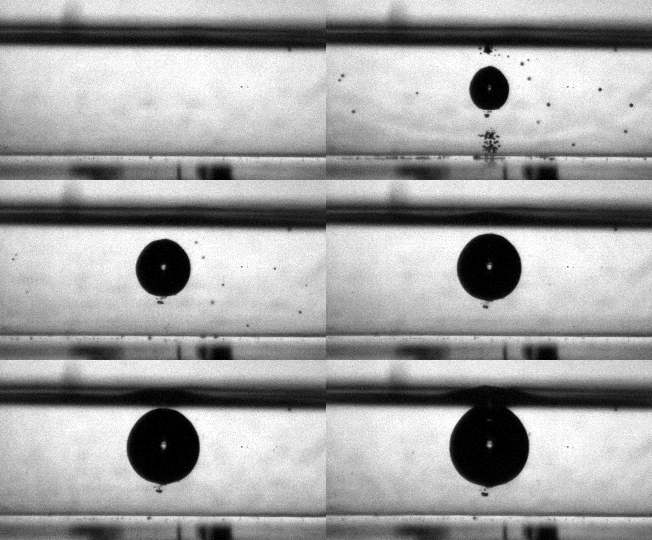
Laser-induced forward transfer (LIFT) is an industrial printing technique where a laser pulse aimed at a thin layer of ink creates a tiny jet that deposits the ink on a surface. In practice, the technique is plagued with reproducibility issues, in part because it’s difficult to produce only a single cavitation bubble when aiming a laser at the liquid layer. This is what we see above.
The laser pulse creates its initial bubble just above the middle of the liquid layer. Shock waves expand from that first bubble and quickly reflect off the liquid surface (top) and wall (bottom). When reflected, the shock waves become rarefaction waves, which reduce the pressure rather than increasing it. This helps trigger the clouds of tiny bubbles we see above and below the main bubble.
The effect is worst along the path of the laser pulse because that part of the liquid has been weakened by pre-heating, but impurities and dissolved gases in the liquid layer are also prone to bubble formation, as seen far from the bubble. The trouble with all these unintended bubbles is that they can easily rise to the surface, burst, and cause additional jets of ink that splatter where users don’t intend. (Image and research credit: M. Jalaal et al.; submitted by Maziyar J.)

Bartenders and citrus lovers the world over are familiar with the mist of oil that bursts from a bent citrus peel. These microjets are about the width of a human hair, but they can spray at nearly 30 m/s in some citrus species. That’s an acceleration g-force of more 5,100, comparable to a bullet fired from a gun!
The key to the jets is the structure of the fruit’s peel. Citrus fruits have a relatively thick, soft inner material, known as the albedo, which houses the oil reservoirs. The thin, stiff outer layer of the peel, called the flavedo or zest, covers that. When the peel is bent, the albedo compresses, increasing the pressure inside the oil reservoirs up to an additional atmosphere’s worth. Meanwhile, the flavedo is stretched. When that outer layer fails, it releases the oil pressure and a jet spurts out. For more on this work, including some awesome high-speed videos, check out my interview (starting at 2:59) with one of the authors in the video below. (Image and research credit: N. Smith et al.; video credit: N. Sharp and T. Crawford)
FYFD is celebrating Plant Week all this week. Check out our previous posts on how moisture lets horsetail plant spores walk and jump, the incredible aerodynamics of dandelion seeds, and the ultra-fast suction bladderworts use to hunt.
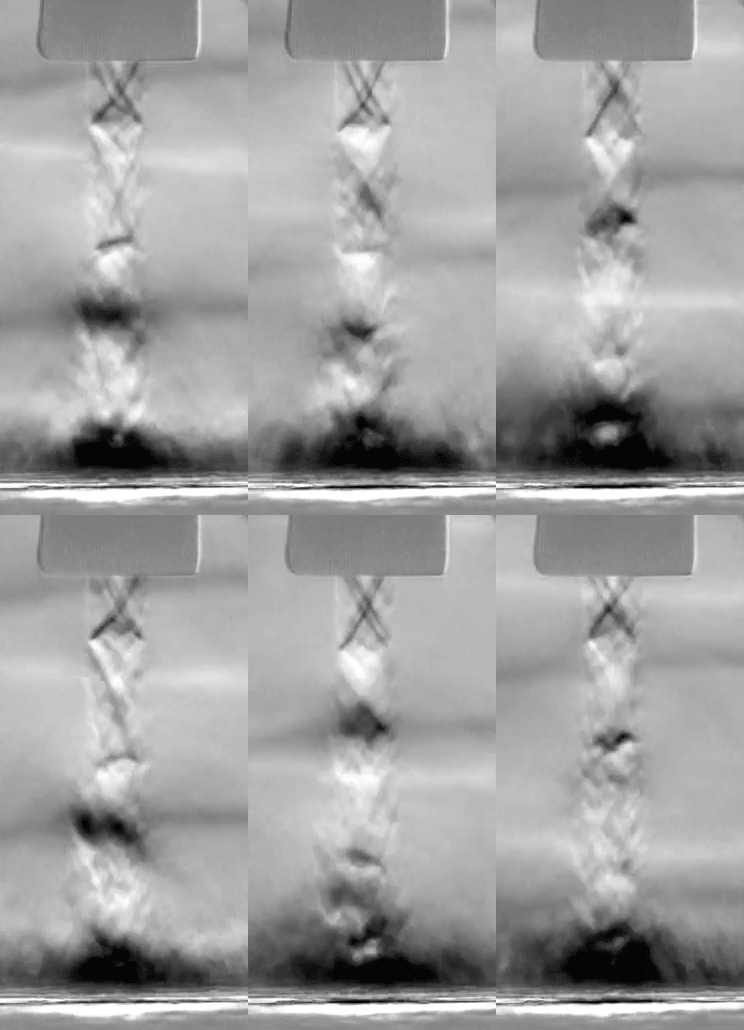
One major problem that has plagued supersonic aircraft is their noise. The Concorde – thus far the only supersonic commercial airliner – was plagued with noise complaints that ultimately restricted its usability. Noise reduction is a major area of inquiry in aerospace, and the video below shows one experiment trying to understand the connections between supersonic flow and noise.
Above you see a supersonic, Mach 1.5 microjet emanating from a nozzle at the top of the image. The jet is hitting a flat plate at the bottom of the image. Just beyond nozzle’s exit, you can see the X-shape of shock waves inside the jet. The position of that X is oscillating up and down.
In the background, you can see horizontal light and dark lines traveling up and down. Those horizontal lines in the background are acoustic waves. When they hit the bottom plate, they reflect and travel upward until they hit another surface (outside the picture) and reflect back down. As they travel, they interact with the jet, causing those X-shaped shock waves to move up and down. This coupling between flow and acoustic waves makes the jet much louder – up to 140 dB – than it would be otherwise.
Researchers hope that unraveling the physics of simpler systems like this one will help them quiet more complicated aircraft. (Image and video credit: F. Zigunov et al.)


The FloWave facility in Scotland is one of the coolest ocean simulators out there. Equipped with 168 individual wave makers and 28 submerged flow-drive units, it’s capable of recreating almost any ocean conditions imaginable. So naturally the Slow Mo Guys used it to create a giant spike wave.
Essentially, this is an oversized Worthington jet, the same as the ones you see after a droplet hits the surface. But with several thousand tonnes of crystalline clear water, the effect of that wave focusing is pretty spectacular. When you’re watching the high-speed footage, be sure to pay attention to the details, like the glassy surface of the collapsing jet, or the way holes open and expand as the splash curtain comes down around Dan’s head (above). Longtime readers will recognize many familiar features. (Image and video credit: The Slow Mo Guys)

