
Two jets of sugar syrup collide and interact to form very different patterns. On the left, the two jets have a low flow rate and create a chain-like wake. The jets on the right have a higher flow rate and produce a liquid sheet that breaks down into filaments and droplets. The result is often likened to fish bones. (Photo credit: Rebecca Ing)
Search results for: “jet”

Worthington Jet
A drop of sugar syrup falls into a pool of methylated spirits, producing a Worthington jet and several ejected droplets. Although surface tension holds the jet in a smooth shape, the refractive index of the spirits reveals the turbulent mixing within the jet. (Photo credit: Rebecca Ing)

Particle Jets
During explosions, solid particles and liquids packed around the explosive charges can form jets, making a blast wave appear more porcupine-like than spherical. The instability mechanisms that cause this behavior are not well-understood, but researchers suspect the jets are formed due to perturbations in the particle bed on the timescale of the initial shock propagation. The presence of these jets can affect the blast wave’s subsequent growth as well as the mixing in its wake. The number of jets produced depends on many factors, including particle type, the geometry of the charge, the ratio of explosive to particles, and even whether the particles are wet or dry. Note the very different natures of the explosions in the video when shown side by side. (Video credit: D. Frost et al)
Atomizing Jets
The breakup of impinging jets into droplets (also called atomization) and the subsequent dynamics of those droplets are important in applications like jet and rocket engines where the mixing of liquid fuel with oxygen is necessary for efficient combustion. This video showcases recent efforts in high fidelity numerical simulation and modeling of such flows. The complexity of the problem requires clever ways of reducing the computational efforts required. One such method uses adaptotive meshing to concentrate grid points in areas where variables are changing quickly while leaving the grid sparse in areas of less interest. Because the flow is constantly evolving, the mesh must be able to adapt as the simulation steps forward in time. Even so, such calculations typically require supercomputers to complete. (Video credit: X. Chen et al)
How Scramjets Work
The scramjet–supersonic combustion ramjet–engine has been a holy grail of aerospace engineering for 50 years. It is an air-breathing engine with no moving parts capable of propelling crafts at hypersonic speeds beyond Mach 5. As indicated in the name, combustion in the scramjet occurs at supersonic speeds, where the heating due to air compression is sufficient to ignite fuel when injected into the engine. At present the record for the highest speed attained in scramjet flight is held by the NASA X-43A, which reached Mach 9.8 in 2004 after about 10 seconds of scramjet free-flight. The longest scramjet flight belongs to the Boeing X-51 Waverider with 140 seconds of burn time in a 2010 test flight. Few tests of these experimental hypersonic crafts have been completely successful; they represent the frontier of aerospace technology.
Fishbone Jet Collision
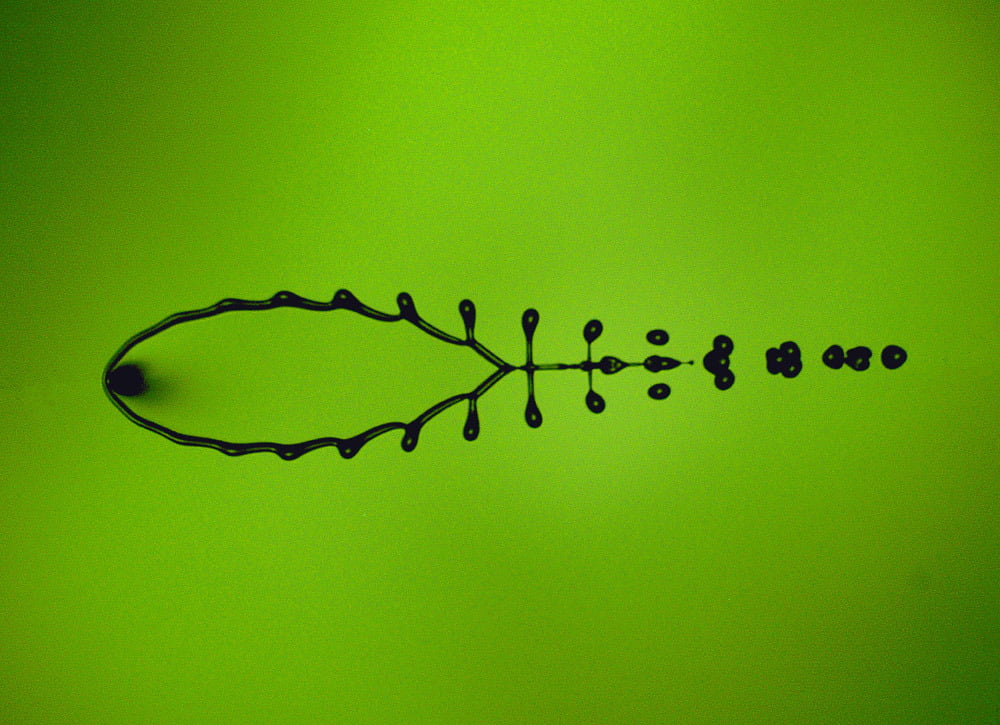
The collision of two jets of radius 420 μm results in a fishbone-like structure. The fluid contains a dilute polymer mixture whose viscoelastic effects resist the tendency of the droplets to detach from the ligaments. The breakup of the jets into droplets is important for applications in inkjet printing. The photo has been rotated 90-degrees for effect. (Photo credit: Sungjune Jung)
Jet Breakup
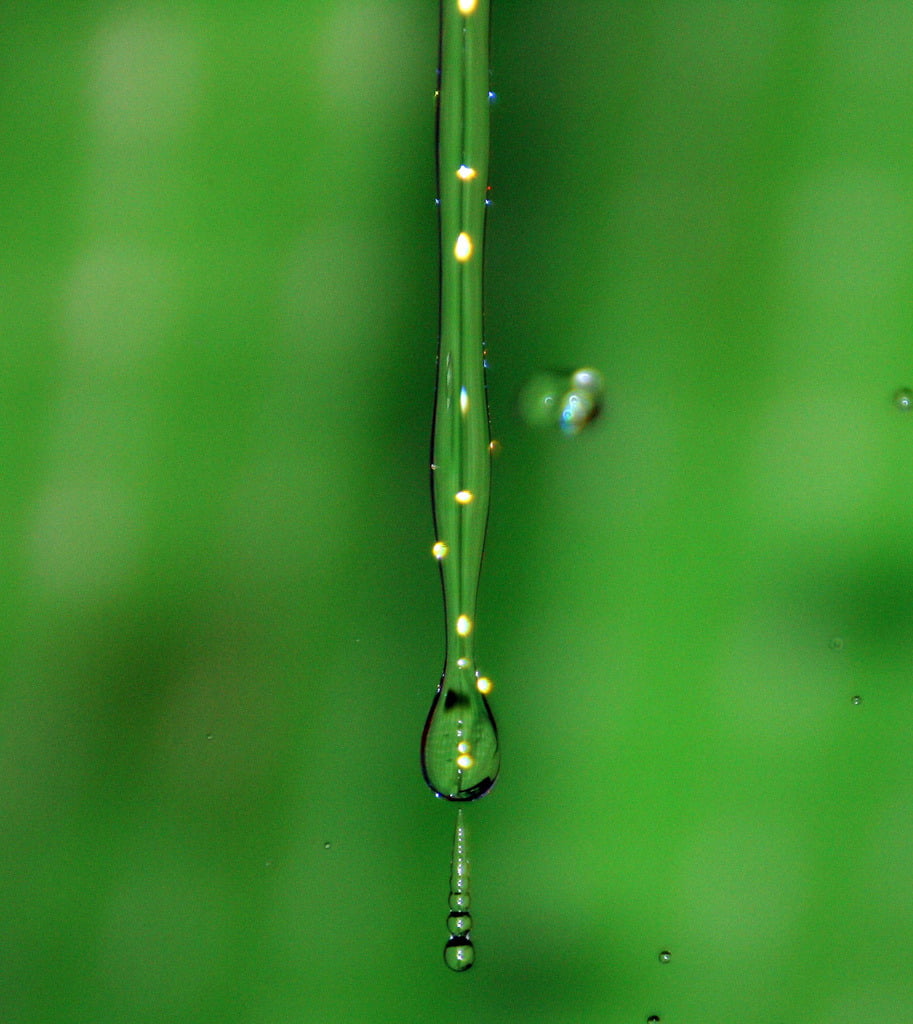
As a laminar column of water falls, slight perturbations cause waviness in the stream. Whenever the radius of the stream decreases, the pressure due to surface tension increases, causing fluid to flow away from the area of smaller radius. This outflow decreases the radius further and drives the stream to break into droplets. The mechanism is called the Plateau-Rayleigh instability. (Photo credit: Mahmoudreza Shirinsokhan)
Astronomical Jets
Researchers have pieced together Hubble images of jets from newborn stars into timelapse movies that reveal the interstellar fluid mechanics responsible for the formation of stars like our sun. These jets stream out clumps of matter that has fallen on the new star. When faster moving eddies impact slower ones, bow shocks can form, much like shockwaves running before an airplane. See more HD video of these jets and bow shocks here. #
The Dance of Jets and Droplets
Placing a prism upside down in a bath of silicone oil creates a trapped bubble of air inside the prism. When oscillated above a critical amplitude, the corners of the prism, the oil, and the air perform an intricate dance of bubbles, singularities, jets, and droplets. Read more in the research paper. #

Colliding Jets