If you’ve been around fluid mechanics for very long, you’ve probably noticed that we like to name things after people. (Mostly dead, white guys, but that’s another subject.) Whenever someone describes or explains a new phenomenon, it tends to get their name attached to it. Some of the common names in fluid dynamics – Reynolds, Rayleigh, Kelvin, Taylor, von Karman, Prandtl – read like a who’s-who of nineteenth and twentieth century physics. This video gives some historical insight into a couple of those figures – particularly Arthur Worthington, who is known for his contributions to the understanding of splashes. Be sure to check out some of his awesome illustrations and photos. Can you imagine being able to piece together splash physics like that without high-speed video?! (Video credit: Objectivity; submitted by Kam-Yung Soh)
Search results for: “jet”

Using Air to Break Up Jets


One method of breaking a liquid into droplets, or atomizing it, uses a slow liquid jet surrounded by an annulus of fast-moving gas. The gas along the outside of the liquid shears it, creating waves that the wind blowing past can amplify. This draws the liquid into thin ligaments that then break into droplets. This is a popular technique in rocket engines, where cryogenic liquid fuels often need to be atomized for efficient combustion. When things aren’t working exactly right, however, the liquid jet may start flapping instead of breaking up. In this case, the jet will swing back and forth, but only part of it will atomize. For a rocket engine, this would mean slower and less efficient combustion – never desirable outcomes! (Image credit: A. Delon et al.)
Plasma From a Jet of Water
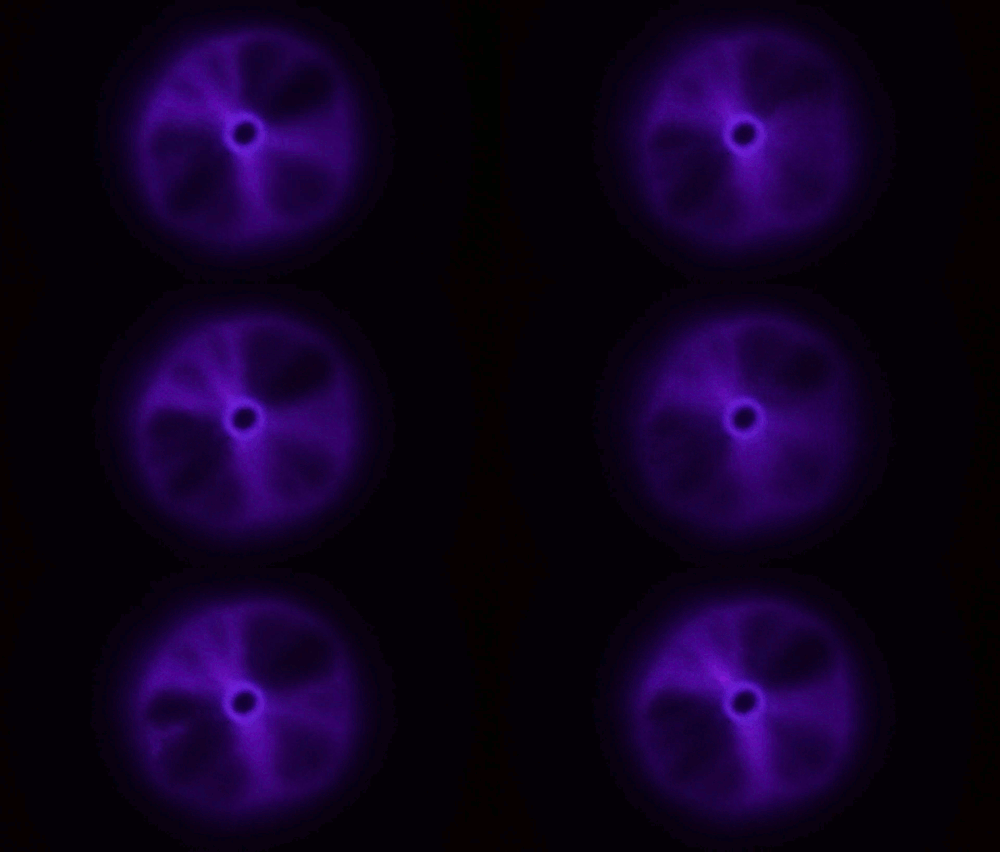
There aren’t many naturally occurring plasmas in our daily lives; by far the most common one is lightning. So it’s something of a surprise that a stream of water hitting a material like glass is able to produce a toroid of plasma like the one above. The key here, though, is that the jet has to be fast – to the tune of 200 meters per second or faster. When a jet of deionized water strikes a surface at that speed, the water has to take a very sharp, 90-degree turn, and, thanks to the polar nature of water, this causes a (negative) charge to build up at that turn. It’s akin to rubbing a balloon to build up a static charge, and it’s known as a triboelectric effect. At rest (and without high shear rates), water and glass in contact tend to create in a positive charge in the water. The plasma is created when an arc forms through air between those two charged areas.
Experiments in helium environments create a different color of plasma, confirming that the arc definitely travels through the gas. Similarly, if you use regular water instead of deionized water, the conductivity of the dissolved salts in the water is enough to prevent the necessary build up of charge. (Image and research credit: M. Gharib et al.; video credit: Applied Science; submitted by Kam-Yung Soh)

Bouncing, Floating, and Jetting


Get inside some of the latest fluid dynamics research with the newest FYFD/JFM video. Here researchers discuss oil jets from citrus fruits, balls that can bounce off water, and self-propelled levitating plates. This is our third entry in an ongoing series featuring interviews from researchers at the 2017 APS DFD conference. Missed one of the previous ones? Not to worry – we’ve got you covered. (Video and image credit: N. Sharp and T. Crawford)
Inside Ink Jet Printing
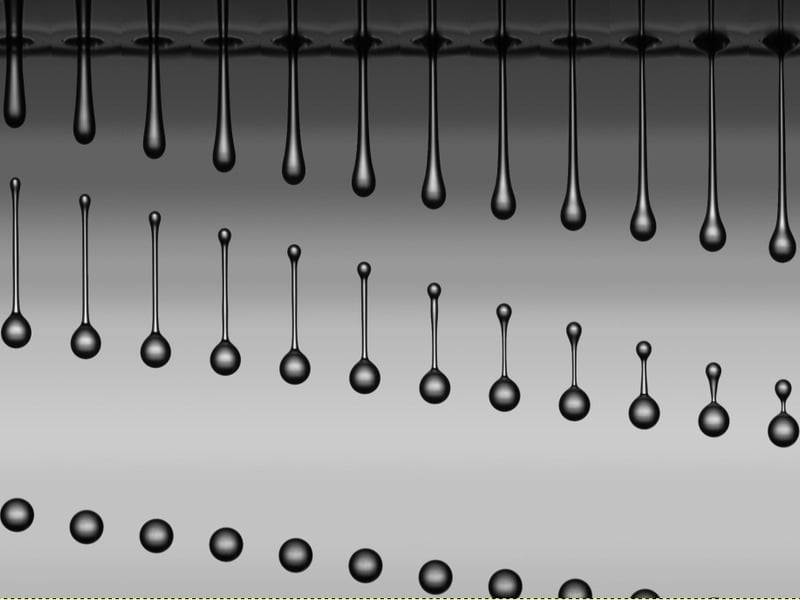
Inkjet printers produce droplets at an incredible rate. A typical printhead generates droplets that are about 10 picoliters in volume – that is, ten trillionths of a liter – moving at about 4 meters per second. Resolving the formation of those droplets would require ultra-high speed imaging at millions of frames per second. Instead researchers devised an alternative method to capture droplet formation, based on stroboscopic techniques. In this case the strobe is a 7 nanosecond laser pulse (7 billionths of a second) that illuminates a given droplet twice. By doing this for many droplets, the researchers can create a highly detailed time series like the one above, which shows the inkjet breakup and droplet formation. Here each droplet is 23 micrometers wide – about one-third the width of a human hair. (Image credit: A. van der Bos et al., source)

Using Jets to Find Food
Archer fish are well-known for their ability to hit aerial targets with perfectly aimed jets of water, as we’ve discussed previously. But a new study shows they use a similar technique to form underwater jets that help them uncover food. The researchers found that the fish altered the timing of their jet formation based on the type of substrate – fine sand, course sand, or mud – that the food pellet was hidden in. A great next step in this research would be using a technique like particle image velociometry (PIV) to measure the flow field directly and see to what extent the fish’s actions are altering the jet they produce. (Image and research credit: J. Dewenter et al.; GIF source: freshphotons)
How Jet Engines Work
Jet engines are a major part of aviation today, and this great video from the new LIB LAB project breaks down how jet engines operate. It focuses especially on the subject of combustion, in which fuel-air mixtures are burned to generate power and thrust. By breaking fuels down into simpler compounds, jet engines are able to accelerate exhaust gases, which creates thrust. They even provide instructions for an effervescence-driven bubble rocket so that kids can (safely!) experiment with propulsion at home. (Video credit: LIB LAB/Corvallis-Benton County Public Library)

When Jets Collide
Two liquids that collide don’t always coalesce. The image above shows two jets of silicone oil colliding. On the left, the jets collide and bounce off one another. On the right, at a slightly higher flow rate, the two jets coalesce. This bouncing, or noncoalescence, observed at lower speeds is due to an incredibly thin layer of air separating the two jets. This air layer is constantly being replenished by air that gets dragged along by the flowing oil. But if the oil flows too quickly, that air layer becomes unstable–in the same way that a droplet that falls too quickly will splash on impact. When the separating air layer becomes unstable and breaks down, the jets collide and merge. (Image credit: N. Wadhwa et al., pdf)
Reader Question: Blood Jets
Reader shoebill-san asks:
are blood jets realistic? when someone gets shot in the movies?
This one’s a bit tough to boil down to a yes or a no, honestly. While piercing an artery can cause jetting (more on that below), movies tend to exaggerate the effect. And even among Hollywood movies, there’s a broad variation in how wounds are represented. I’m pretty sure no one thinks that blood actually behaves like it does in Monty Python or a Tarantino film!
That said, depending on the wound, there can be a jetting effect thanks to the pulsing of our hearts. Scientists have even worked to numerically simulate human blood flow after a wound. I’ve included a video example above. Be warned – some viewers may find it gross. That said, there’s nothing all that graphic on display.
As you can see, wounds to arteries have an apparent jetting motion thanks to our pulses. Bleeding from veins tends to look more uniform because the pressure pulse caused by each heartbeat has been smoothed out by the viscous effects of all the blood vessels in between. (Video credit: K. Chong et al.)

Rotating Jet
This photo, one of the winners of the Engineering and Physical Sciences Research Council’s (EPSRC) annual photography contest, shows a rotating viscoelastic jet. Rotating liquid jets are common to many manufacturing processes, and their sometimes-wild appearance comes from a balance of gravitational forces and centrifugal force against surface tension. But because this fluid contains a small amount of polymer additive, surface tension has the additional aid of some elasticity to help hold the jet together and keep the globules and ligaments you see from flying off. As centrifugal forces fling the fluid outward, it stretches the polymer chains within the fluid, and they pull back against that tension like a stretched rubber band. To see some of the other contest winners–including other fluids entries!–check out the Guardian’s run-down. (Image credit and submission: O. Matar et al., ICL press release)