
When a stream of liquid falls, a surface tension effect called the Plateau-Rayleigh instability causes small variations in the jet’s radius to grow until the liquid breaks into droplets. For a kitchen faucet, this instability acts quickly, breaking the stream into drops within a few centimeters. But for more viscous fluids, like honey, jets can reach as many as ten meters in length before breaking up. New research shows that, while viscosity does not play a role in stretching and shaping the jet as it falls–that’s primarily gravity’s doing–it plays a key role in the way perturbations to the jet grow. Viscosity can delay or inhibit those small variations in the jet’s diameter, preventing their growth due to the Plateau-Rayleigh instability. In this respect, viscosity is a stabilizing influence on the flow. (Photo credit: Harsha K R; via Flow Visualization)
Search results for: “jet”
Plasma Jets
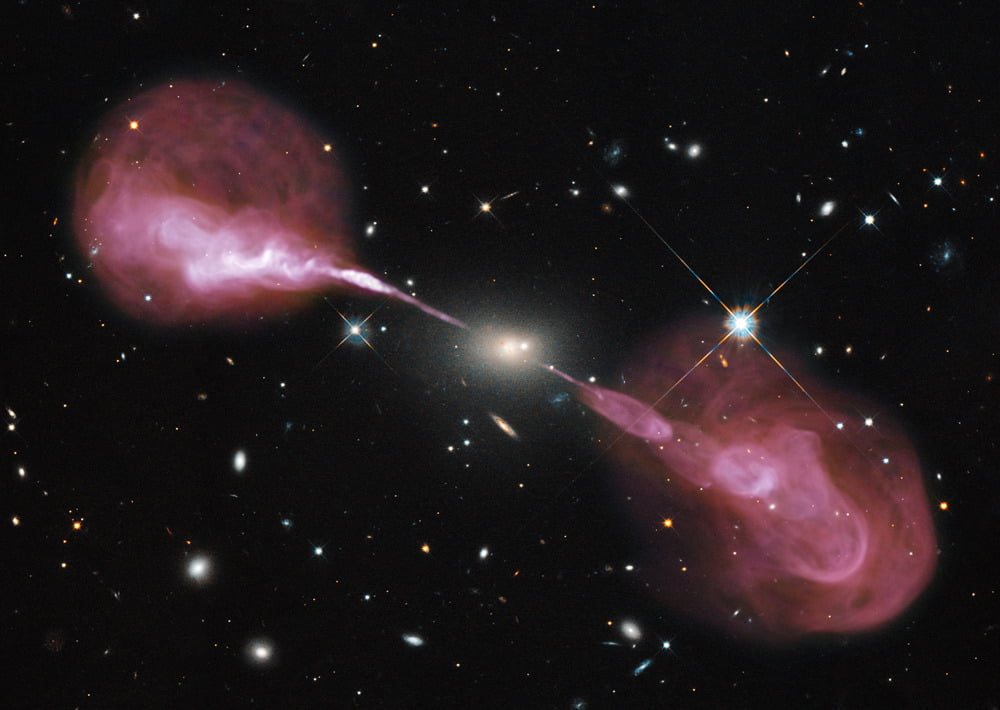
Jets of high-energy plasma and sub-atomic particles explode outward from the Hercules A elliptical galaxy at the center of this photo. The jets are driven to speeds close to that of light due to the gravitation of the supermassive black hole at the center of the elliptical galaxy. Relativistic effects mask the innermost portions of the jets from our view, but, as the jets slow, they become unstable, billowing out into rings and wisps whose turbulent shapes suggest multiple outbursts originating from Hercules A. (Photo credit:NASA, ESA, S. Baum and C. O’Dea (RIT), R. Perley and W. Cotton (NRAO/AUI/NSF), and the Hubble HeritageTeam (STScI/AURA); via Discovery)

Bouncing Jet
For the right flow speeds and incidence angles, a jet of Newtonian fluid can bounce off the surface of a bath of the same fluid. This is shown in the photo above with a laser incorporated in the jet to show its integrity throughout the bounce. The walls of the jet direct the laser much the way an optical fiber does. The jet stays separated from the bath by a thin layer of air, which is constantly replenished by the air being entrained by the flowing jet. The rebound is a result of the surface tension of the bath providing force for the bounce. (Photo credit: T. Lockhart et al.)
Swirling Jets
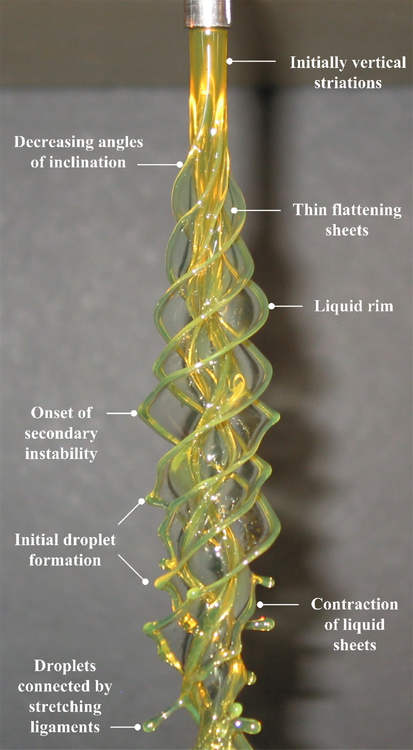
In fluid dynamics, we like to classify flows as laminar–smooth and orderly–or turbulent–chaotic and seemingly random–but rarely is any given flow one or the other. Many flows start out laminar and then transition to turbulence. Often this is due to the introduction of a tiny perturbation which grows due to the flow’s instability and ultimately provokes transition. An instability can typically take more than one form in a given flow, based on the characteristic lengths, velocities, etc. of the flow, and we classify these as instability modes. In the case of the vertical rotating viscous liquid jet shown above, the rotation rate separates one mode (n) from another. As the mode and rotation rate increase, the shape assumed by the rotating liquid becomes more complicated. Within each of these columns, though, we can also observe the transition process. Key features are labeled in the still photograph of the n=4 mode shown below. Initially, the column is smooth and uniform, then small vertical striations appear, developing into sheets that wrap around the jet. But this shape is also unstable and a secondary instability forms on the liquid rim, which causes the formation of droplets that stretch outward on ligaments. Ultimately, these droplets will overcome the surface tension holding them to the jet and the flow will atomize. (Video and photo credits: J. P. Kubitschek and P. D. Weidman)

Sandy Jets
When a fluid is vibrated, instabilities can form along its surface. With a sufficient amplitude, voids form inside the fluid and their collapse leads to a jet that shoots out from the fluid. A very different process leads to air cavities forming in a vibrated granular medium, but the jets produced are remarkably similar, as seen in this video. (Video credit: M. Sandtke et al.)
Jets from Hollows
Bubbles rising through a viscous fluid deform and interact. As they collapse into one another, the lower bubble induces a gravity-driven jet that projects upward into the higher bubble. The more elongated the bubble, the faster the jet. The same behavior is seen in the rebound of a cavity at the free surface of a liquid. The authors suggest a universal scaling law for this behavior. (Video credit: T. Seon et al.)
Viscoelastic Jets
Unlike Newtonian fluids, such as air and water, viscoelastic fluids exhibit non-uniform reactions to deformation. In this video, researchers explore the effects of this behavior when a liquid jet falls into another fluid. When fluids move past one another at different speeds in this manner, there is a shearing force which often leads to the wave-like Kelvin-Helmholtz instability between the fluids. Here we see for a variety of wavelengths how the breakdown of a Newtonian and viscoelastic jet differ. The Newtonian jets form clean lines and complicated tulip-like shapes, but the viscoelasticity of the non-Newtonian jets inhibits the growth of these instabilities, surrounding the central jet with wisps of escaping fluid. For more, see Keshavarz and McKinley. (Video credit: B. Keshavarz and G. McKinley)
Bubbles and Jets
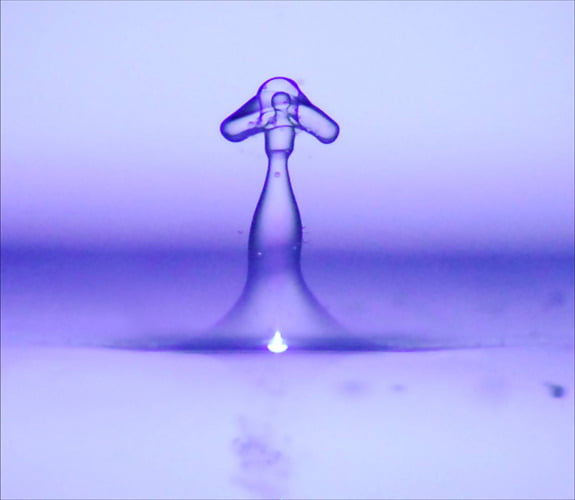
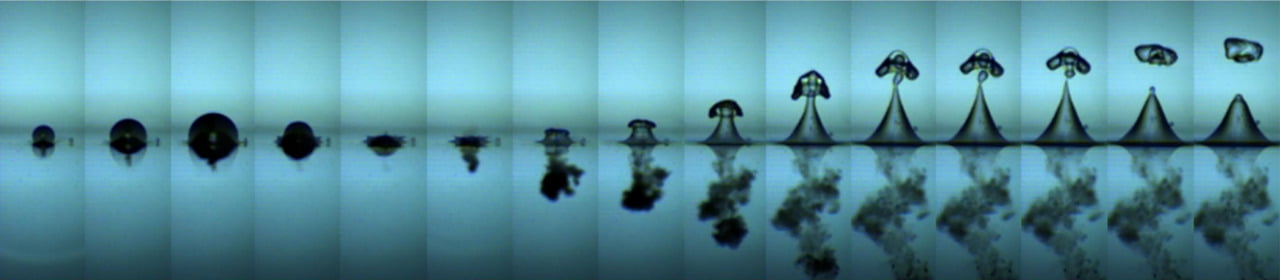
In the photo sequence above, a bubble is created at the interface between two immiscible liquids–water on top and denser hydrofluroether (HFE) below. Initially, the bubble expands explosively due to the vaporization of water generated by a short laser pulse. As the bubble collapses, a jet forms and accelerates into the HFE. After collapse, the bubble remnants injected in the HFE cause the formation of a jet that shoots back into the water above. Surface instabilities make the jet assume a mushroom or crown-like structure that detaches from the jet. Eventually gravity will return the system to its initial undisturbed fluid-fluid interface. (Photo credit: S. Avila et al. 1,2)
Jet Collisions
When two jets of liquid collide, they form a sheet of fluid. As the speeds of the jets change, the sheet can become unstable, forming a set of liquid ligaments and droplets that look like a fish’s bones. This is shown in the video above. For purposes of orienting yourself, flow in the video is moving right to left and the video has been rotated 90-degrees clockwise (i.e. the two out-of-frame jets forming the flow seen are falling due to gravity). (Video credit: Sungjune Jung, University of Cambridge)

Colliding Jets


Two jets colliding can form a chain-like fluid structure. With increasing flow rate, the rim of the chains becomes wavy and unstable, forming a fishbone structure where droplets extend outward from the fluid sheet via tiny ligaments. Eventually, the droplets break off in a pattern as beautiful as it is consistent. (Photo credits: A. Hasha and J. Bush)