
A ping pong ball bounces off a puddle, drawing a liquid column upward behind it. This photo shows the instant after the fluid has disconnected from the ball, allowing it to rebound without further loss of momentum to the fluid. The fluid column begins to fall under gravity, the tiny undulations in its radius growing via the Rayleigh-Plateau instability and eventually causing the column to separate from the puddle. You can see the whole process in action in this high-speed video. (Photo credit: BYU Splash Lab)
Search results for: “droplet”

Leidenfrost Dynamics
When a liquid impacts a solid heated well above the liquid’s boiling point, droplets can form, levitating on a thin film of vapor that helps insulate them from the heat of the solid. This is known as the Leidenfrost effect. Here a very large Leidenfrost droplet is shown from the side in high-speed. A vapor chimney forms beneath the drop, causing the dome in the liquid. When the dome bursts, the droplet momentarily forms a torus before closing. The resulting oscillatory waves in the droplet are spectacular. The same behavior can be viewed from above in this video. (Video credit: D. Soto and R. Thevenin; from an upcoming review by D. Quere)

Liquid Lenses
Here astronaut Andre Kuipers demonstrates fluid dynamics in microgravity. A roughly spherical droplet of water acts as a lens, refracting the image of his face so that it appears upside down. The air bubble inside the droplet refracts the image back to our normal perspective again. (Photo credit: Andre Kuipers, ESA; via Bad Astronomy)
Atomizing
High-speed video reveals the complexity of fluid instabilities leading to atomization–the breakup of a liquid sheet into droplets. A thin annular liquid sheet is sandwiched between concentric air streams. As the velocity of the air on either side of the liquid sheet varies, shear forces cause the sheet to develop waves that result in mushroom-like shapes that break down into ligaments and droplets. Quick breakup into droplets is important in many applications, most notably combustion, where the size and dispersal of fuel droplets affects the efficiency of an engine. (Video credit: D. Duke, D. Honnery, and J. Soria)
Acoustic Levitation
Researchers at Argonne National Laboratory are using acoustic levitation of droplets to further pharmaceuticals. By placing two precisely aligned speakers opposite one another, a standing wave can be created. At nodes along the standing wave, there is no net transfer of energy, but the acoustic pressure is sufficient to cancel the effect of gravity, allowing light objects like droplets to levitate. This is why, in the video, you see the droplets are placed at equally spaced distances and if one is slightly off the node, it vibrates noticeably. The benefit of this levitation to pharmaceutical research comes at the molecular level; drugs formed from solutions kept in a solid container are likely to be crystalline in structure and thus less efficiently absorbed by the body. If the drug can instead be kept in an amorphous state by evaporating the solution without a container, then the resulting drug may be effective at a lower dosage than its crystalline counterpart. (Video credit: Argonne National Laboratory, via Laughing Squid, submitted by @__pj)

Ferrofluid Drop
A drop of ferrofluid is shaped by seven small circular magnets sitting beneath the glass and paper. Ferrofluids are made up of nanoscale ferromagnetic particles suspended in a carrier liquid. Under the influence of magnetic fields, they can take on fantastic shapes, including sharp-tipped droplets and labyrinthine mazes. This image is taken from the National Academy of Science’s book Convergence, focused on the intersection between science and art. (Photo credit: Felice Frankel)
Boiling Without Bubbles
Water droplets sprinkled on a sufficiently hot frying pan will skitter and skate across the surface on a thin layer of vapor due to the Leidenfrost effect. When a solid object is much warmer than a liquid’s boiling temperature, the surface is surrounded by a vapor cloud until the solid cools to the point that the vapor can no longer be sustained. Then the vapor breaks down in an explosive boiling full of bubbles. Unless, as researchers have just published in Nature, the solid is treated with a superhydrophobic coating. The water-repellent surface prevents the bubbling, even as the sphere cools. The technique could be used to reduce drag in applications like the channels of a microfluidic device. (Video credit: I. Vakarelski et al.; see also Nature News; submitted by Bobby E)
Liquid Logic Gates
Researchers have built logic gates–a physical implementation of Boolean logic–using droplets on a superhydrophobic surface. The video above demonstrates their flip-flop memory gate. Incoming droplets travel on a single track, striking a stationary “memory droplet” which then goes into one of the two output tracks according to its memory state. The memory state of the droplet relies on its position; the droplet sits on an infinity-shaped depression. When the incoming droplet strikes the sitting one, the droplet will exit via the track closest to its depression. The droplet that struck it will, as a result of the momentum transfer of the collision, rebound the opposite direction into the other depression, thereby storing the opposite memory state. See here for videos demonstrating other logic gates. (Video credit: H. Mertaniemi et al.; submitted by L. Buss)
Bouncing Off
A water droplet falling onto a superhydrophobic surface will rebound and bounce without wetting the surface. Capillary and internal waves reflect in the drop until it comes to rest at a high contact angle, formed at the boundary where the liquid, solid, and air meet. Such surfaces can have interesting interactions with water, as when two droplets coalesce on a surface and then begin bouncing or when superhydrophobic objects are dropped into a bath. (Video credit: Gangopadhyay Group, University of Missouri)
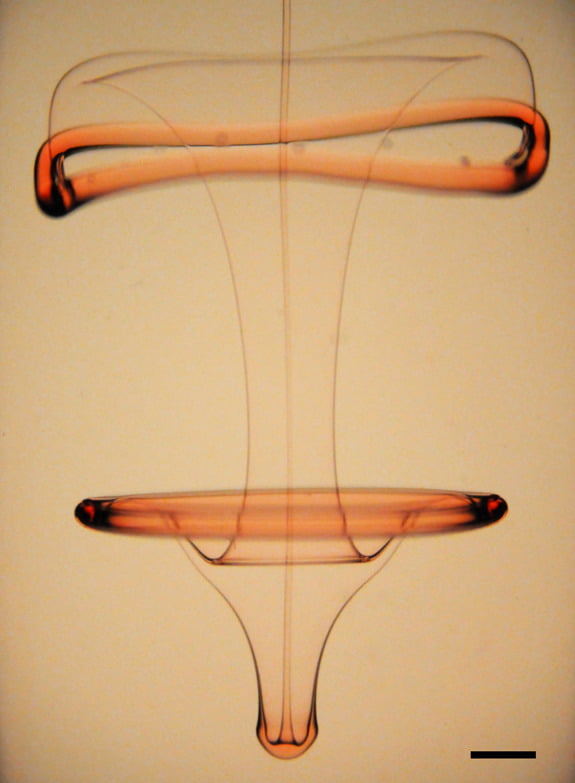
Falling Oil
A drop of silicone oil falling through a liquid with lower surface tension distorts into multiple vortex rings connected by thin films. This behavior is caused by the interaction between viscous and capillary forces and is observable for only a narrow range of oil viscosities. (Photo credit: A. Felce and T. Cubaud)