
Physicist Richard Feynman once famously ended a lecture by describing how the whole universe can be found in a glass of wine. And there is certainly plenty of fluid dynamics in one. In the photo above, we see in the shadows how a film of wine drips down into the main pool below. This effect is known by many names, including tears of wine and wine legs; it can also be found in other high alcohol content beverages. Several effects are at play. Capillary action, the same effect that allows plants to draw water up from their roots, helps the wine flow up the wall of the glass. At the same time, the alcohol in this wine film evaporates faster than the water, raising the surface tension of the wine film relative to the main pool of wine below. Because of this gradient in surface tension, the wine will tend to flow up the walls of the glass away from the area of lower surface tension. This Marangoni effect also helps draw the wine upward. When the weight of the wine film is too great for capillary action and surface tension to hold it in place, droplets of wine–the legs themselves–flow back downward. (Photo credit: Greg Emel)
Search results for: “droplet”
Swirling Jets
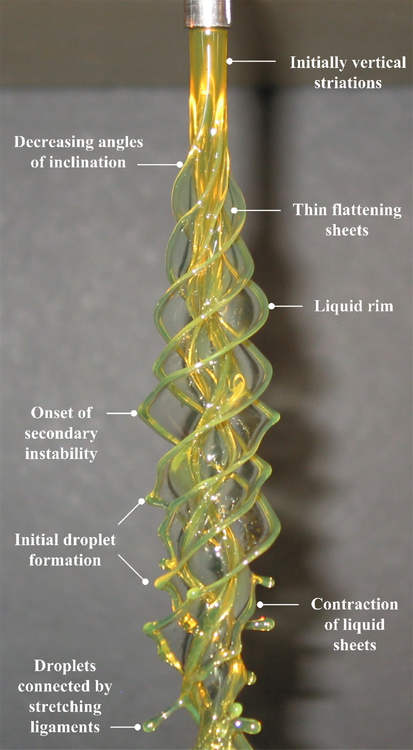
In fluid dynamics, we like to classify flows as laminar–smooth and orderly–or turbulent–chaotic and seemingly random–but rarely is any given flow one or the other. Many flows start out laminar and then transition to turbulence. Often this is due to the introduction of a tiny perturbation which grows due to the flow’s instability and ultimately provokes transition. An instability can typically take more than one form in a given flow, based on the characteristic lengths, velocities, etc. of the flow, and we classify these as instability modes. In the case of the vertical rotating viscous liquid jet shown above, the rotation rate separates one mode (n) from another. As the mode and rotation rate increase, the shape assumed by the rotating liquid becomes more complicated. Within each of these columns, though, we can also observe the transition process. Key features are labeled in the still photograph of the n=4 mode shown below. Initially, the column is smooth and uniform, then small vertical striations appear, developing into sheets that wrap around the jet. But this shape is also unstable and a secondary instability forms on the liquid rim, which causes the formation of droplets that stretch outward on ligaments. Ultimately, these droplets will overcome the surface tension holding them to the jet and the flow will atomize. (Video and photo credits: J. P. Kubitschek and P. D. Weidman)

Frozen Powder Drops
Droplet impacts on granular surfaces and water interactions with superhydrophobic surfaces are not unfamiliar topics for FYFD. But this behavior of water droplets falling on a superhydrophobic powder is unusual, to say the least. When the droplets impact in powder, they rebound with a partial coating of powder. In the case of the superhydrophobic powder, the shape of the droplet is “frozen” by the powder. A satellite droplet is ejected from the region not coated in powder and the resultant main drop falls back to the surface and comes to rest with little to no deformation. The researchers report a critical velocity at which the behavior is observed. (Video credit: J. Marston et al.; via Physics Buzz)

“Kusho”


Artist Shinichi Maruyama uses photography to freeze the transient motion of fluids into water sculptures. Inertia, gravity, and surface tension are at war in each piece. Plateau-Rayleigh instabilities break long filaments of liquid into droplets that splash, collide, and reform. To see how he makes this art, check out his videos. (Photo credits: Shinichi Maruyama)

Microbubble Necklace
When a drop impacts a pool at very low velocity, a thin layer of air can be trapped between the drop and the pool. When this air film ruptures, a ring of microbubbles forms and expands. Multiple “bubble necklaces” can form if the film ruptures at several points. These rings travel outward until the film is completely destroyed, leaving a chandelier-like shape of microbubbles. See the phenomenon in action with one of the videos linked here. (Photo credit: S. T. Thoroddson et al.; see video at arXiv)
Leidenfrost Explosions
When a drop of water touches a very hot pan, it will skitter across the surface on a thin layer of water vapor due to the Leidenfrost effect. But what happens when another chemical is added to the droplet? Researchers find that adding a surfactant to the water droplets creates some spectacular results. As the water evaporates, the concentration of the surfactant in the droplet increases causing the surfactant to form a shell around the droplet. The pressure inside the droplet increases until the shell breaks in a miniature explosion much like the popping of popcorn. (Video credit: F. Moreau et al.)
Donut-Shaped Bubbles
Here researchers simulate rain-like droplet impacts with large drops of water falling into a tank from several meters. The momentum of such an impact is significantly higher than many other droplet impact examples we’ve featured. In this case, the coronet, or crown-like splash, caused by the collision collapses quickly, closing the fluid canopy around a trapped bubble of air. The remains of the coronet fall inward, preventing the development of the usual Worthington jet associated with droplet impacts. Instead, the air bubble takes on an unstable donut-like shape. (Video credit: M. Buckley et al.)
Spray Starch
High speed video of of spray starch from a can. Once the initial transients die down, a cone-shaped annular sheet forms. Disturbances propagate in the sheet, tearing it into filaments that break down into droplets. Beautiful complexity hidden in a simple everyday device. (Video credit: John Savage)
Dynamic Leidenfrost Impact
The Leidenfrost effect occurs when a liquid encounters a solid object much hotter than the liquid’s boiling point, like when water skitters on a hot griddle or someone plunges a hand in liquid nitrogen. A thin layer of vapor forms between the liquid and the solid, thereby (briefly) insulating the remaining liquid. The Leidenfrost effect can be static–like a droplet sitting on a pan–or dynamic, like the video above in which a droplet impacts the hot object. The video shows both a top and a side view of a droplet striking a plate that is over five times hotter than the liquid’s boiling point. On impact, the droplet spreads and flattens, and a spray of even tinier droplets is ejected before rebound. (Video credit: T. Tran and D. Lohse, from a review by D. Quere)

The Archer Fish’s Arrows

The archer fish hunts by shooting a jet of water at insects in the leaves above and knocking them into the water. How the fish achieve this feat has been a matter of contention. A study of high-speed video of the archer’s shot shows that fluid dynamics are key. The fish releases a pulsed liquid jet, imparting greater velocity to the tail of the jet than the head. As a result, the tail tends to catch up to the head and increase the jet’s mass on impact while decreasing the duration of impact. Simultaneously, the jet tends to break down into droplets via the Rayleigh-Plateau instability caused by surface tension. Surface tension’s power to hold the water in droplets combined with the inertial effects of the pulsed jet create a ball of fluid that strikes the archer’s prey with more than five times the power than vertebrate muscles alone can impart. For more on archer fish, check out this video and the original research paper by A. Vailati et a. (Photo credits: Scott Linstead and BBC; submitted by Stuart R)