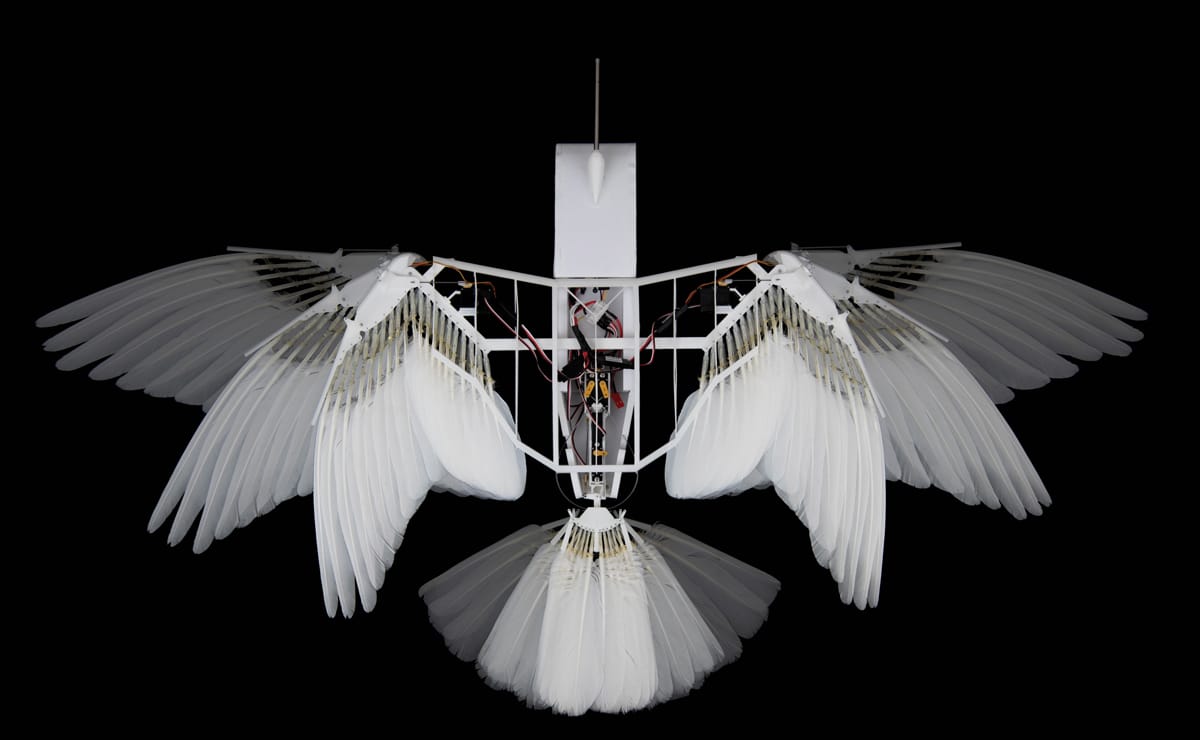
Aircraft typically use a vertical tail to keep the craft from rolling or yawing. Birds, on the other hand, maneuver their wings and tail feathers to counter unwanted motions. Researchers found that the list of necessary adjustments is quite small: just 4 for the tail and 2 for the wings. Implementing those 6 controllable degrees of freedom on their bird-inspired PigeonBot II allowed the biorobot to fly steadily, even in turbulent conditions, without a rudder. Adapting such flight control to the less flexible surfaces of a typical aircraft will take time and creativity, but the savings in mass and drag could be worth it. (Image credit: E. Chang/Lentink Lab; research credit: E. Chang et al.; via Physics Today)
Search results for: “drag”
Disappearing Sea Ice Ridges
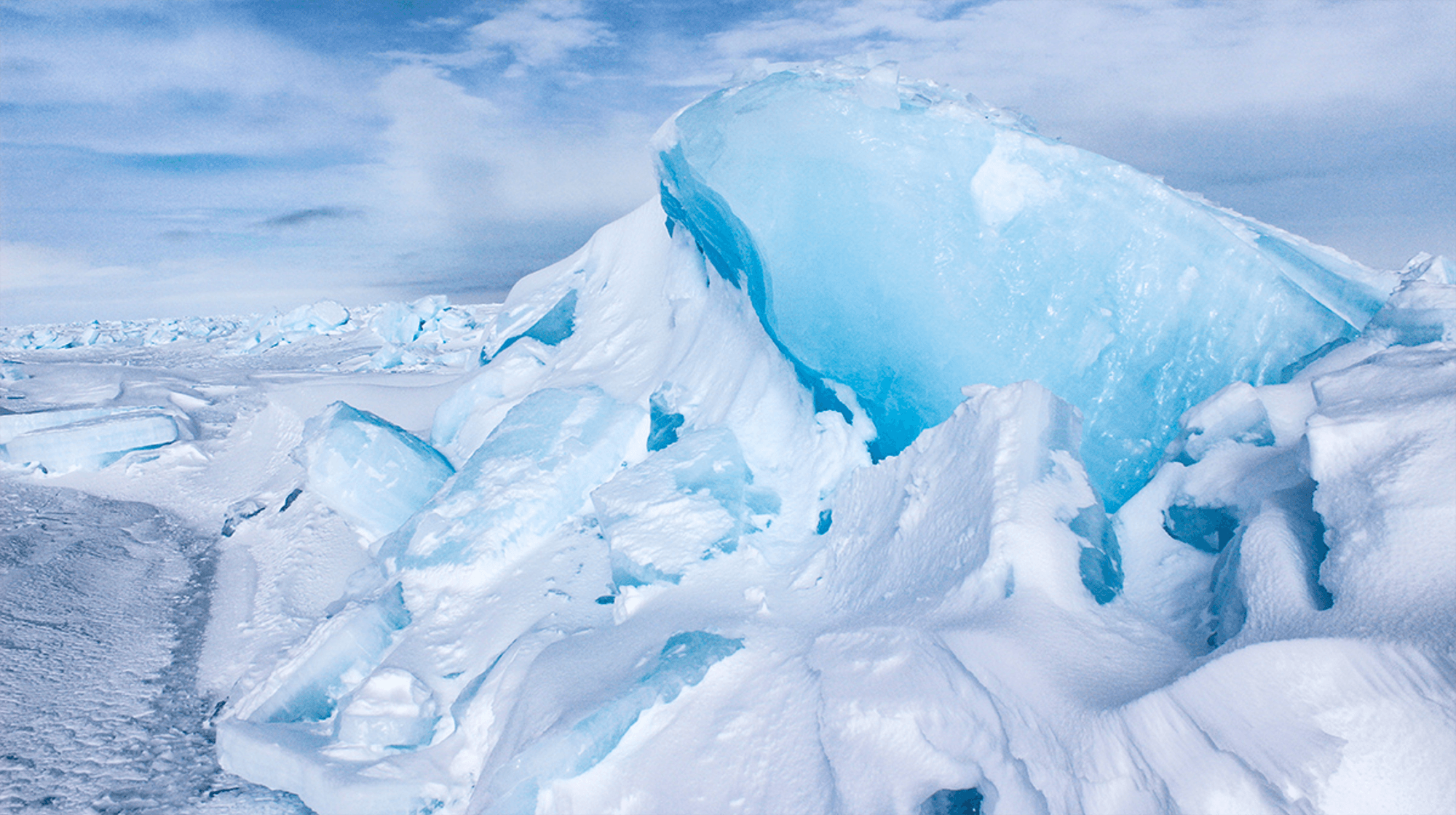
As blocks of sea ice shift and float, they can press together, forming ridges spaced every few hundred meters or so. A new study uses aerial observations from recent decades to show that these sea ridges are getting smaller in both size and number, a smoothing of Arctic topography that has many consequences.
The team showed that the overall changes in the sea ridges correspond to a loss of older sea ice. The current smoother sea ice presents less drag to winds and currents, which might suggest that the ice is slower-moving, but instead the opposite seems true. Scientists are not sure why the ice is moving faster, though faster ocean currents may play a role.
Another consequence of smoother sea ice is wider, shallower melt ponds each summer. These wider ponds increase the amount of sunlight the ice absorbs, hastening melting even further. (Image credit: USGS; research credit: T. Krumpen et al.; via Eos)

Bubbly Tornadoes Aspin
Rotating flows are full of delightful surprises. Here, the folks at the UCLA SpinLab demonstrate the power a little buoyancy has to liven up a flow. Their backdrop is a spinning tank of water; it’s been spinning long enough that it’s in what’s known as solid body rotation, meaning that the water in the tank moves as if it’s one big spinning object. To demonstrate this, they drop some plastic tracers into the water. These just drop to the floor of the tank without fluttering, showing that there’s no swirling going on in the tank. Then they add Alka-Seltzer tablets.
As the tablets dissolve, they release a stream of bubbles, which, thank to buoyancy, rise. As the bubbles rise, they drag the surrounding water with them. That motion, in turn, pulls water in from the surroundings to replace what’s moving upward. That incoming water has trace amounts of vorticity (largely due to the influence of friction near the tank’s bottom). As that vorticity moves inward, it speeds up to conserve angular momentum. This is, as the video notes, the same as a figure skater’s spin speeding up when she pulls in her arms. The result: a beautiful, spiraling bubble-filled vortex. (Video and image credit: UCLA SpinLab)

Fediverse Reactions
-

Where to Follow FYFD Online
Hi, folks! As the social media landscape fractured, I’ve been dragging my feet about making some needed changes. But no longer. As of November 2024, I am no longer updating FYFD’s X/Twitter account. Here are the places you can currently follow FYFD online:
- Bluesky
- Mastodon/Fediverse: @[email protected]
- Tumblr
- YouTube
Most of those services get autoposts rather than regular check-ups, so I rarely see messages on Instagram/Tumblr/YouTube. Fediverse replies autopost as comments to the blog, so I do see those, and I will probably hang around on Bluesky some, but email is your best bet these days if you want me to see your message.
And, if you just want FYFD in your inbox every other week, you can subscribe to the newsletter!
(Image credit: P. Czerwinski)
Fediverse Reactions
Paris 2024: Tennis Racket Physics
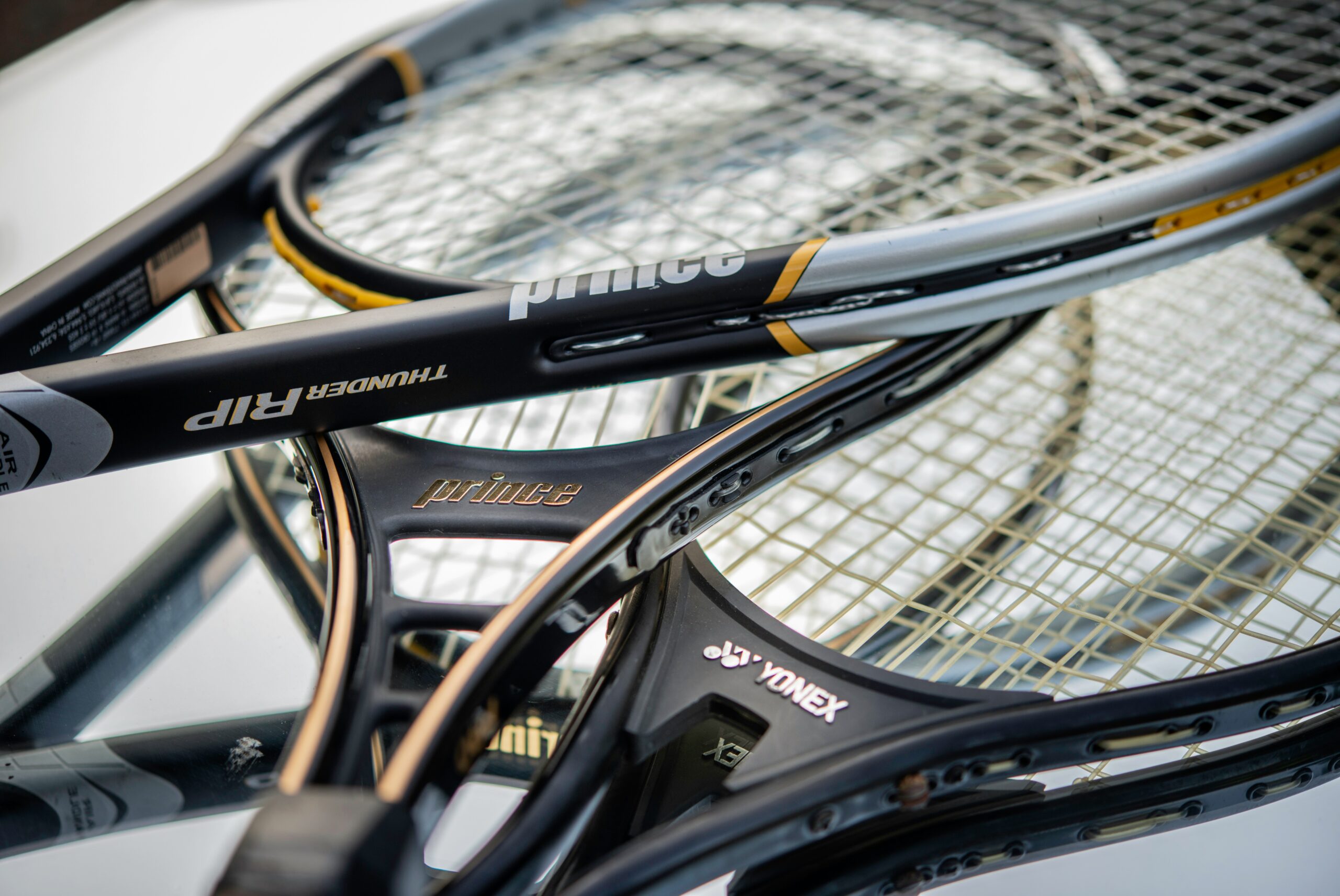
Like many sports that feature balls, spin plays a big role in tennis. By imparting a topspin or backspin to a tennis ball, players can alter the ball’s trajectory after a bounce and, using the Magnus effect to alter lift around the ball, change how it travels through the air. For example, a ball hit with backspin can dive just after the net, forcing an opponent to scramble after it. How much spin a player can impart depends on the speed of the racket’s head. Competitive rackets are carefully engineered — in terms of weight, string tension, and frame stiffness — to translate the kinetic energy of a player’s swing into the ball. But aerodynamics also play a role: new rackets designed to minimize drag hit the market 15-20 years ago, promising drag reductions up to 24% compared to previous rackets. That gives a player more swing speed and higher spins at a lower energy cost. (Image credit: C. Costello)
Related topics: The Magnus effect in table tennis and in golf; the reverse Magnus effect
Check out more of our ongoing and past Olympic coverage here.

Paris 2024: Cycling in Crosswinds
Wind plays a major role in cycling, since aerodynamic drag is the greatest force hampering a cyclist. In road racing, both individual cyclists and teams use tactics that vary based on the wind speed and direction. Crosswinds — when the apparent wind comes from the side in the cyclist’s point of view — are some of the toughest conditions to deal with. In races, groups will often form echelons to minimize the group’s overall effort in a crosswind. Alternatively, racers looking to tire their competitors out will position themselves on the road so that the rider behind them gets little to no shelter from the wind; this is known as guttering an opponent.
In this study, researchers put a lone cyclist in a wind tunnel and measured the effects of crosswind from a pure headwind to a pure tailwind and every possible angle in between. From that variation, they were able to mathematically model the aerodynamic effects of crosswind on a cyclist from every angle. With rolling resistance (a cyclist’s second largest opposing force) included, they found relatively few conditions where a crosswind actually helped a cyclist. Most of the time — as any cyclist can tell you — hiding from the wind is beneficial. (Image credit: J. Dylag; research credit: C. Clanet et al.)
Related topics: The physics of the Tour de France, how the peloton protects riders aerodynamically, track cycling physics, and a look inside wind tunnel testing bikes and cyclists

Paris 2024: Bouncing and Spinning
Spin, or the lack thereof, plays a major role in many sports — including tennis, golf, football, baseball, volleyball, and table tennis — because it affects whether flow stays attached around a ball, as well as how much lift or side force a ball gets. A ball’s spin doesn’t stay constant, however. During flight, a ball’s spin decays at a rate proportional to its initial spin and velocity. Researchers have found that a ball’s moment of inertia, flow regime, and surface roughness all affect that decay, but which factor is the most significant varies by ball and by sport.
Whether a ball bounces while spinning also matters. For compliant balls on a non-compliant surface — think tennis balls on a court — a bounce can actually change how much a ball spins. During impact, a tennis ball can: slide, decreasing its tangential velocity while increasing its topspin; roll, where the ball’s tangential velocity matches the tangential velocity of the surface; or over-spin, where the ball spins faster than it rolls. For a given impact angle and velocity, researchers found that stiffer and/or lighter balls were more likely to over-spin. Within tennis’s allowable range of ball stiffness and mass, manufacturers could create tennis balls that over-spin far more than conventional ones, creating another opportunity for deceptive tactics in the sport. (Image credit: J. Calabrese; research credit: T. Allen et al.)
Related topics: How flow separates from a surface, and why turbulence is sometimes preferable
Find all of our Olympics coverage — past and ongoing — here and every sports post here.

Paris 2024: Triathlon Swimming
Unlike the swimming competition, Olympic triathletes complete their swim legs in open waters. There are no lane dividers and no rules against drafting off a fellow athlete. Curious to see how draft positioning could affect swimmers, researchers experimented with swimmer-shaped models in a water channel and a numerical simulation. They found that the most advantageous position is directly behind a lead swimmer, where the follower could enjoy a 40% reduction in drag. Another good position is near the leader’s hip, where waves off the leader provide a 30% reduction in drag.
The worst place to swim, interestingly, is immediately side-by-side. With both swimmers neck-in-neck, drag is maximized, and each swimmer feels more drag than they would swimming by themselves! (Image credit: J. Romero; research credit: B. Bolan et al.)
Related topics: Drafting in each triathlon stage and drafting effects in nordic skiing
Join us all this week and next for more Olympics-themed stories.
Paris 2024: Swimsuit Tech
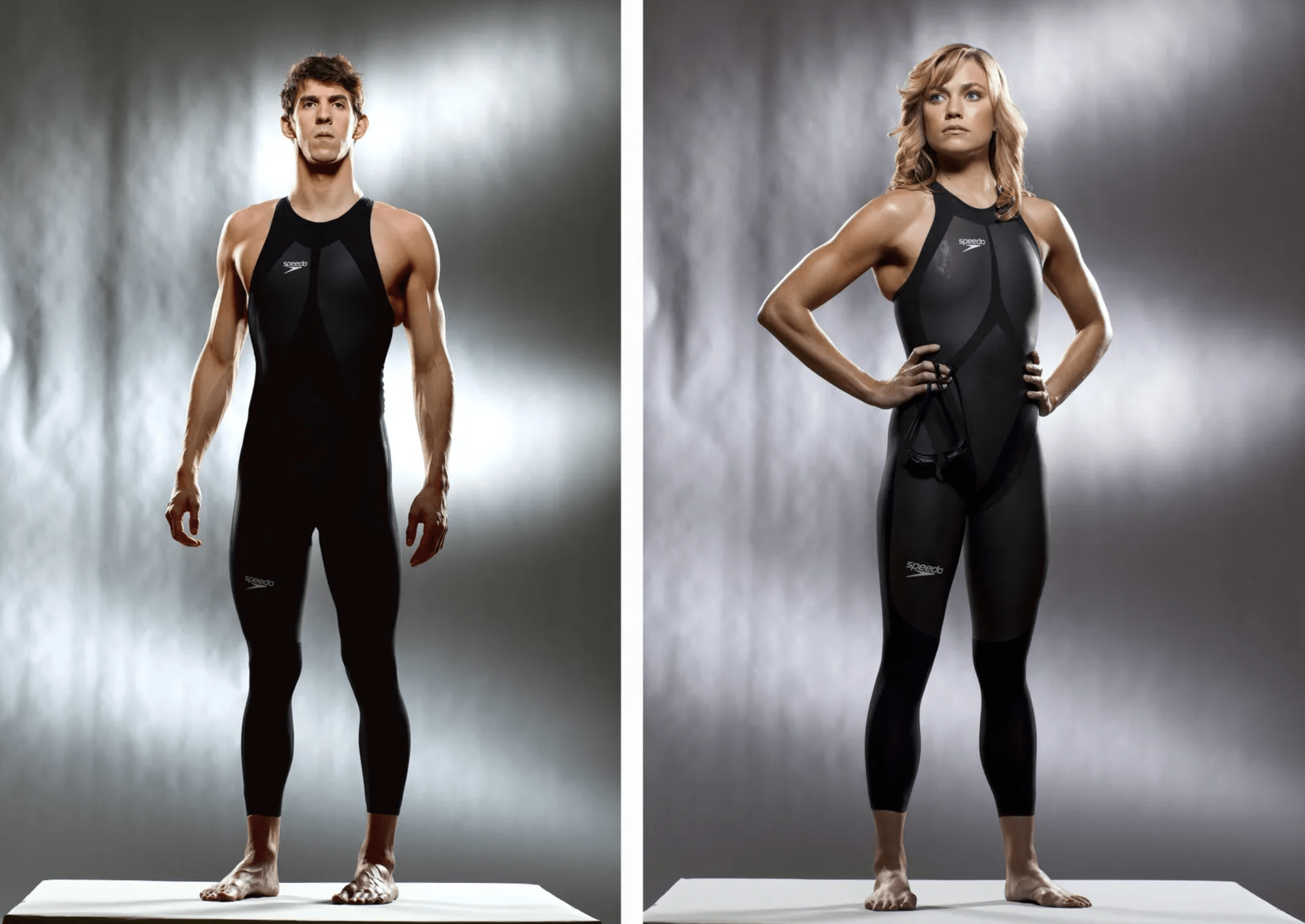
The aughts were an exciting time to watch competitive swimming. Records were falling left and right, especially in 2008 and 2009. The first wave of improvements came around 2000, with the introduction of full-body swimwear. According to one analysis, men’s freestyle swimming performances improved by about 1% with that change. The next big leap came in 2008 when companies introduced polyurethane panels into the suits (most famously the LZR Razer suits pictured above) causing an additional 1.5-3.5% performance improvement. The panels were stiff, reducing the swimmer’s cross-sectional area and thereby reducing drag. Their effect was greatest in sprint events; long-distance swimmers saw fewer improvements, possibly because turning in the stiffer suits was tiring.
The biggest leap came in 2009 with all polyurethane full-body swimsuits, which streamlined swimmers and gave them skin friction improvements that let them slip through the water more easily. Freestyle swimmers with those suits were showing a full 5.5% performance improvement on top of the 2000-era full-body suits.
With so many records falling in 2008 and 2009 — largely to swimmers wearing the expensive new suits that some teams could not afford — swimming’s federation chose to ban the new technology, causing an immediate drop in performances to pre-polyurethane levels. Although sprint performances will likely improve little by little each year, no one is likely to break the sprint records of 2008-2009 in the next decade — not unless the federation establishes a “new rules” record the way officials did with the javelin after a major rule change. (Image credit: Getty Images; research credit: L. Foster et al.)
Today kicks off our fluids-themed Olympics coverage. Stay tuned for more sports this week and next week. If that’s not enough sports physics for you, check out what we wrote in previous years.
Sensing Sound Like Spiderwebs
Most microphones — like our ears — work by sensing the tiny pressure changes caused by a sound wave‘s passing. But for microphones built this way, the smaller they get, the more sensitive they are to thermal noise. That’s one reason that the tiny microphones in a laptop or webcam just don’t sound as good as larger mics.
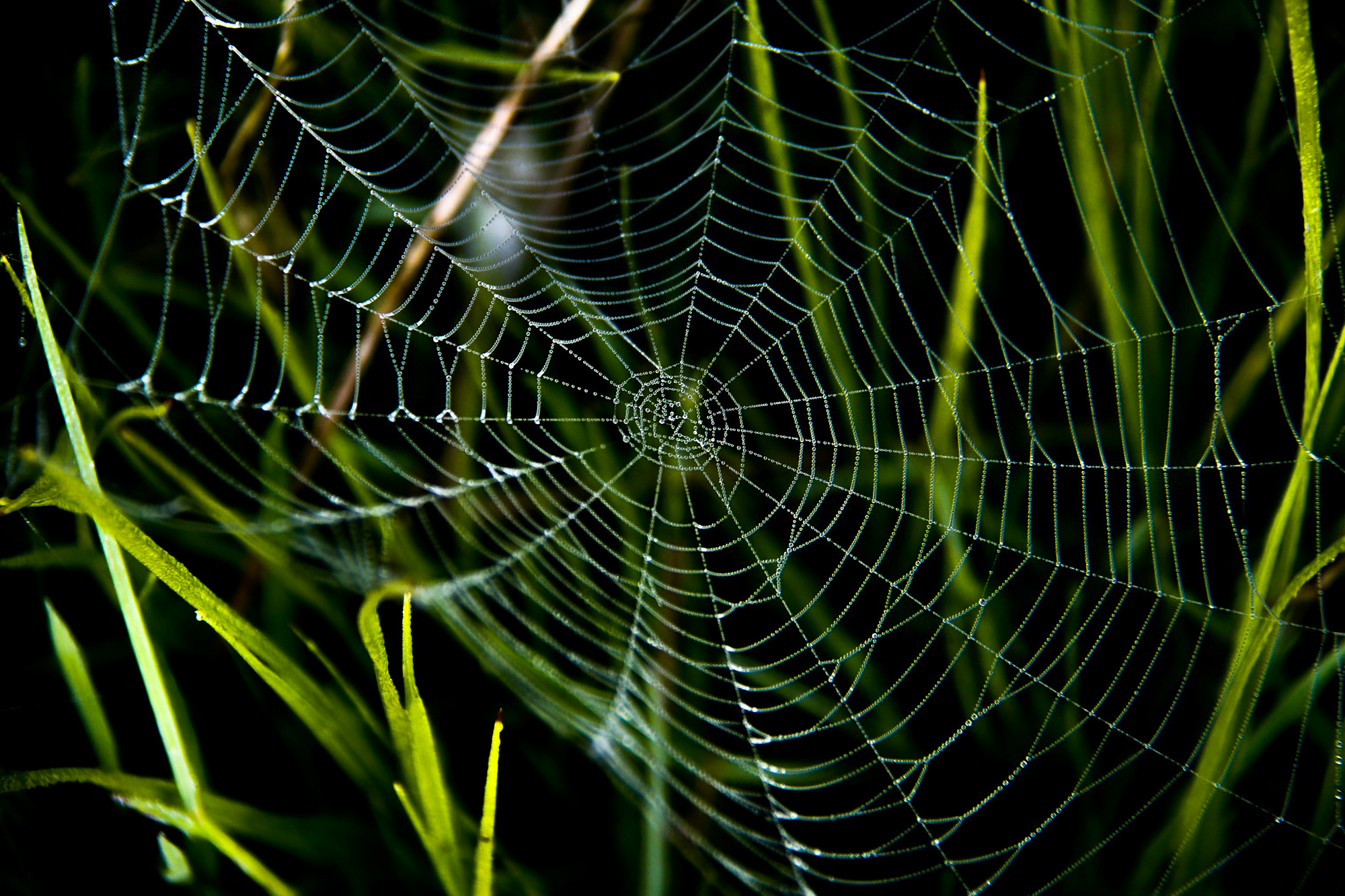
Researchers turned to nature to look for alternative ways to measure sound and zeroed in on the mechanism spiders use. Spiders “listen” to their web’s vibrations; the tiny strands of silk quiver as air flow from a sound moves past. Instead of being pressure-based, this mechanism uses viscous drag to register a sound.
The team fabricated an array of microbeams to test the concept of a viscosity-based microphone and found that tiny beams sensed sounds just as well as larger ones. That means these microphones can get smaller without sacrificing performance. For now, they’re not as sensitive as conventional microphones, but that’s not surprising, given that engineers have been improving pressure-based microphones for 150 years. It’s a promising start for a new technology, though. (Image credit: N. Fewings; research credit: J. Lai et al.; via APS Physics)