Search results for: “drag”

  • Ice Discs Surf on Herringbones

    Ice Discs Surf on Herringbones

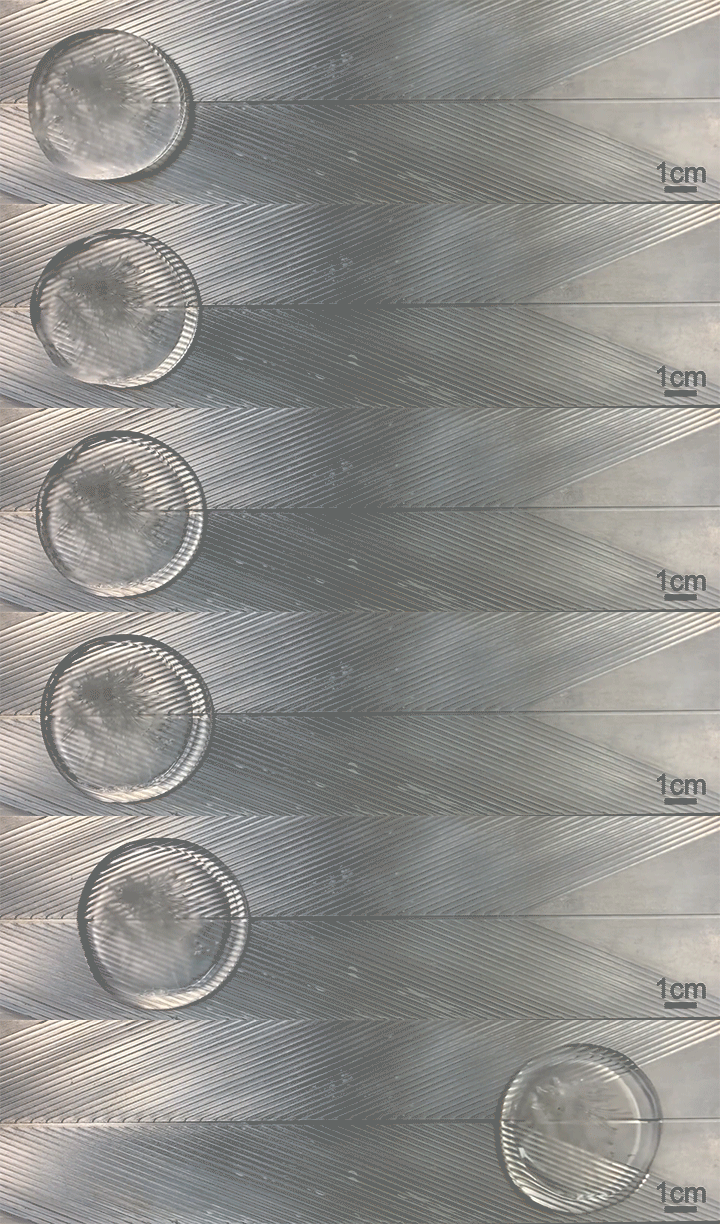
    Inspired by the roaming rocks of Death Valley, researchers went looking for ways to make ice discs self-propel. Leidenfrost droplets can self-propel on herringbone-etched surfaces, so the team used them here, as well. On hydrophilic herringbones, they found that meltwater from the ice disc would fill the channels and drag the ice along with it.

    But on hydrophobic herringbone surfaces, the ice disc instead attached to the crest of the ridges and stayed in place–until enough of the ice melted. Then the disc would detach and slingshot (as shown above) along the herringbones. This self-propulsion, they discovered, came from the asymmetry of the meltwater; because different parts of the puddle had different curvature, it changed the amount of force surface tension exerted on the ice. Thus, when freed, the ice disc tried to re-center itself on the puddle.

    The team is especially interested in how effects like this could make ice remove itself from a surface. After all, it requires much less energy to partially melt some ice than it does to completely melt it. (Image and research credit: J. Tapochik et al.; via Ars Technica)

    Fediverse Reactions
  • A Sandy Spine

    A Sandy Spine

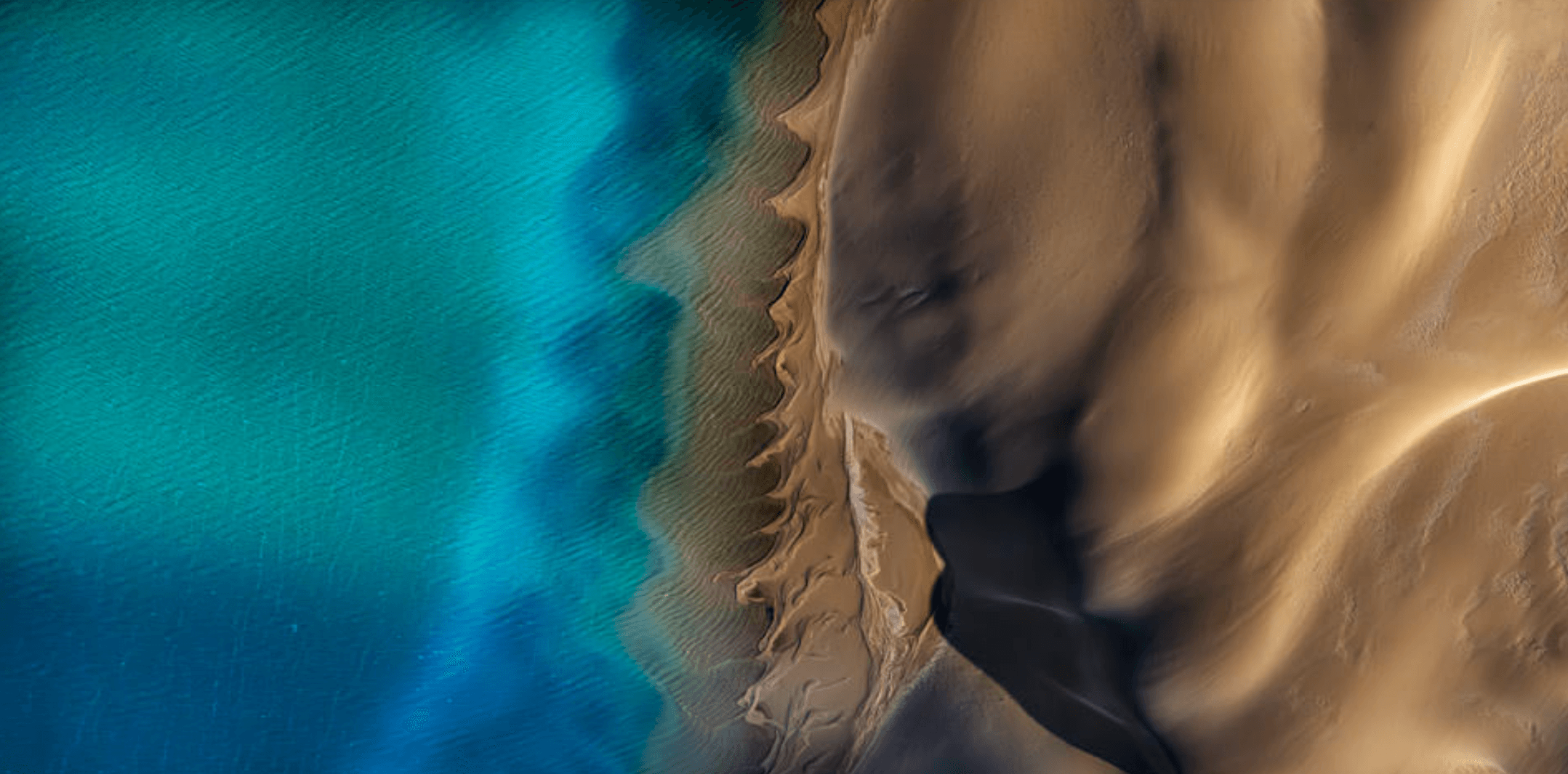
    Where sea and sand meet, Gaia’s spine rises. Photographer Satheesh Nair captured this striking image in western Australia, where wind and wave action have dragged a dune into vertebrae-like cusps. Notice how the size and shape of the curves differs between the under- and above-water sections. Those differences reflect the differing forces that shape them — just water for one set, water and air for the other. (Image credit: S. Nair/IAPOTY; via Colossal)

    Fediverse Reactions
  • Listening for Pollinators

    Listening for Pollinators

    Can plants recognize the sound of their pollinators? That’s the question behind this recently presented acoustic research. As bees and other pollinators hover, land, and take-off, their bodies buzz in distinctive ways. Researchers recorded these subtle sounds from a Rhodanthidium sticticum bee and played them back to snapdragons, which rely on that insect. They found that the snapdragons responded with an increase in sugar and nectar volume; the plants even altered their gene expression governing sugar transport and nectar production. The researchers suspect that the plants evolved this strategy to attract their most efficient pollinators and thereby increase their own reproductive success. (Image credit: E. Wilcox; research credit: F. Barbero et al.; via PopSci)

    Fediverse Reactions
  • Featured Video Play Icon

    Tracking Insects in Flight

    Insects are masters of a challenging flight regime; their agility, stability, and control far outstrip anything we’ve built at their size. But to even understand how they accomplish this, researchers must manage to capture those maneuvers in the first place. Insects don’t stay in one small area, which is what the typical fixed camera motion capture set-up requires. Instead, one group of researchers has designed a system with a moveable mirror that tracks an insect’s motion in real-time, ensuring that the camera stays fixed on the insect even as it traverses a room or — for the drone-mounted version — a field.

    Real-time motion tracking means that researchers can better capture detailed footage of the insect’s maneuvers in a lab environment, or they can head into the field to follow insects in the wild. Imagine tracking individual pollinators through a full day of gathering or watching how a bumblebee responds to getting hit by a raindrop mid-flight. (Video and image credit: Science; research credit: T. Vo-Doan et al.)

    Fediverse Reactions
  • Escape From Yavin 4

    Escape From Yavin 4

    In an ongoing tradition, let’s take another look at some Star Wars-inspired aerodynamics. This year it’s the TIE fighter’s turn. Here, researchers simulate the spacecraft trying to escape Yavin 4’s atmosphere at Mach 1.15. The research poster’s blue contours show pressure contours, with darker colors connoting higher pressures. The bright low pressure region immediately behind the craft suggests a difficult, high-drag ascent and a turbulent, subsonic wake despite the craft’s supersonic velocity. (Image credit: A. Martinez-Sanchez et al.)

    Fediverse Reactions
  • Hot Droplets Bounce

    Hot Droplets Bounce

    In the Leidenfrost effect, room-temperature droplets bounce and skitter off a surface much hotter than the drop’s boiling point. With those droplets, a layer of vapor cushions them and insulates them from the hot surface. In today’s study, researchers instead used hot or burning drops (above) and observed how they impact a room-temperature surface. While room-temperature droplets hit and stuck (below), hot and burning droplets bounced (above).

    In this case, the cushioning air layer doesn’t come from vaporization. Instead, the bottom of the falling drop cools faster than the rest of it, increasing the local surface tension. That increase in surface tension creates a Marangoni flow that pulls fluid down along the edges of the drop. That flow drags nearby air with it, creating the cushioning layer that lets the drop bounce. In this case, the authors called the phenomenon “self-lubricating bouncing.” (Image and research credit: Y. Liu et al.; via Ars Technica)
    A room temperature droplet strikes and sticks to a scratched glass surface.
  • Flying Without a Rudder

    Flying Without a Rudder

    Aircraft typically use a vertical tail to keep the craft from rolling or yawing. Birds, on the other hand, maneuver their wings and tail feathers to counter unwanted motions. Researchers found that the list of necessary adjustments is quite small: just 4 for the tail and 2 for the wings. Implementing those 6 controllable degrees of freedom on their bird-inspired PigeonBot II allowed the biorobot to fly steadily, even in turbulent conditions, without a rudder. Adapting such flight control to the less flexible surfaces of a typical aircraft will take time and creativity, but the savings in mass and drag could be worth it. (Image credit: E. Chang/Lentink Lab; research credit: E. Chang et al.; via Physics Today)

    Fediverse Reactions
  • Disappearing Sea Ice Ridges

    Disappearing Sea Ice Ridges

    As blocks of sea ice shift and float, they can press together, forming ridges spaced every few hundred meters or so. A new study uses aerial observations from recent decades to show that these sea ridges are getting smaller in both size and number, a smoothing of Arctic topography that has many consequences.

    The team showed that the overall changes in the sea ridges correspond to a loss of older sea ice. The current smoother sea ice presents less drag to winds and currents, which might suggest that the ice is slower-moving, but instead the opposite seems true. Scientists are not sure why the ice is moving faster, though faster ocean currents may play a role.

    Another consequence of smoother sea ice is wider, shallower melt ponds each summer. These wider ponds increase the amount of sunlight the ice absorbs, hastening melting even further. (Image credit: USGS; research credit: T. Krumpen et al.; via Eos)

  • Featured Video Play Icon

    Bubbly Tornadoes Aspin

    Rotating flows are full of delightful surprises. Here, the folks at the UCLA SpinLab demonstrate the power a little buoyancy has to liven up a flow. Their backdrop is a spinning tank of water; it’s been spinning long enough that it’s in what’s known as solid body rotation, meaning that the water in the tank moves as if it’s one big spinning object. To demonstrate this, they drop some plastic tracers into the water. These just drop to the floor of the tank without fluttering, showing that there’s no swirling going on in the tank. Then they add Alka-Seltzer tablets.

    As the tablets dissolve, they release a stream of bubbles, which, thank to buoyancy, rise. As the bubbles rise, they drag the surrounding water with them. That motion, in turn, pulls water in from the surroundings to replace what’s moving upward. That incoming water has trace amounts of vorticity (largely due to the influence of friction near the tank’s bottom). As that vorticity moves inward, it speeds up to conserve angular momentum. This is, as the video notes, the same as a figure skater’s spin speeding up when she pulls in her arms. The result: a beautiful, spiraling bubble-filled vortex. (Video and image credit: UCLA SpinLab)

    Composite image showing far (left) and close (right) views of a bubbly vortex in a rotating water tank.
    Fediverse Reactions
  • Where to Follow FYFD Online

    Where to Follow FYFD Online

    Hi, folks! As the social media landscape fractured, I’ve been dragging my feet about making some needed changes. But no longer. As of November 2024, I am no longer updating FYFD’s X/Twitter account. Here are the places you can currently follow FYFD online:

    Most of those services get autoposts rather than regular check-ups, so I rarely see messages on Instagram/Tumblr/YouTube. Fediverse replies autopost as comments to the blog, so I do see those, and I will probably hang around on Bluesky some, but email is your best bet these days if you want me to see your message.

    And, if you just want FYFD in your inbox every other week, you can subscribe to the newsletter!

    (Image credit: P. Czerwinski)

    Fediverse Reactions