
Many seabirds catch their prey through plunge diving, where they fly to a particular height, then fold their wings, and dive into the ocean. In busy waters, bubbles from all this diving can help obscure the birds from hapless fish. Some birds even use bubbles to escape from their own predators; some penguin species, for example, release trapped air from beneath their feathers as they surface, creating a flurry of bubbles that reduce the drag they have to overcome as they make their exit from the water. The fast exit and bubbly wake help them escape prowling seals. (Image credit: H. Spiers; via BWPA)
Search results for: “drag”

Black Holes in a Blender
Massive black holes drag and warp the spacetime around them in extreme ways. Observing these effects firsthand is practically impossible, so physicists look for laboratory-sized analogs that behave similarly. Fluids offer one such avenue, since fluid dynamics mimics gravity if the fluid viscosity is low enough. To chase that near-zero viscosity, experimentalists turned to superfluid helium, a version of liquid helium near absolute zero that flows with virtually no viscosity. At these temperatures, vorticity in the helium shows up as quantized vortices. Normally, these tiny individual vortices repel one another, but a spinning propeller — much like the blades of a blender — draws tens of thousands of these vortices together into a giant quantum vortex.

Here superfluid helium whirls in a quantum vortex. With that much concentrated vorticity, the team saw interactions between waves and the vortex surface that directly mirrored those seen in black holes. In particular, they detail bound states and black-hole-like ringdown phenomena. Now that the apparatus is up and running, they hope to delve deeper into the mechanics of their faux-black holes. (Image credit: L. Solidoro; research credit: P. Švančara et al.; via Physics World)

“Mason Bee at Work”
Mason bees like this one build landmarks to help them navigate as they construct a shelter for their eggs. Even hauling materials, these bees can easily stay aloft. This is in contrast to an old misconception that physics can’t explain how a bee flies. It’s true that bees don’t fly using the same mechanisms as a typical airplane — no fixed wings here! But they, like every other flyer aerodynamicists study, still produce lift and drag and thrust. The flapping of a bee’s wings generates much unsteadier quantities of these things, but at its small size, that is no hindrance to its ability to control its flight and even carry cargo. (Image credit: S. Zankl; via Wildlife POTY)

Lasers and Soap Films
Soap films are a great system for visualizing fluid flows. Researchers use them to look at flags, fish schooling and drafting, and even wind turbines. In this work, researchers explore the soap film’s reaction to lasers. When surfactant concentrations in the soap film are low, laser pulses create shock waves (above) in the film that resemble those seen in aerodynamics. The laser raises the temperature at its point of impact, lowering the local surface tension. That temperature difference triggers a Marangoni flow that draws the heated fluid outward. The low surfactant concentration gives the soap film relatively high elasticity, and that allows the shock waves to form.
In contrast, a soap film with a high concentration of surfactants has relatively little elasticity. In these films (below), the laser creates a mark that stays visible on the flowing soap film. This “engraving” technique could be used to visualize flow in the soap film without using tracer particles. (Image and research credit: Y. Zhao and H. Xu)

When surfactant concentrations are high, a laser pulse “engraves” spots onto a flowing soap film. Shown in terms of interference (left) and Schlieren (right) imaging. 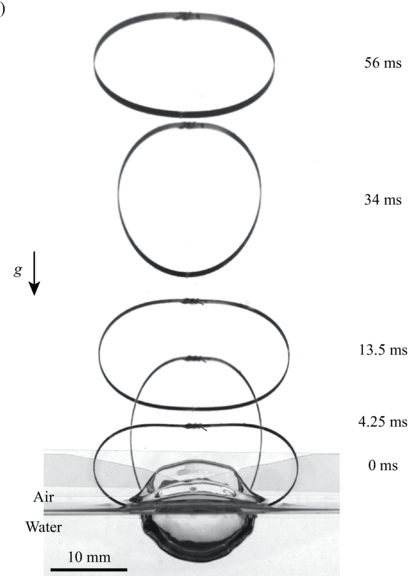
Water Jumping Hoops
Small creatures like springtails and spiders can jump off the air-water interface using surface tension. But larger creatures can water-jump, too, using drag. Here, researchers study drag-based water jumping with a simple elastic hoop. Initially, two sides of the hoop are pulled closer by a string, deforming the hoop. Then, with the hoop sitting upright on the air-water interface, a laser burns the string, releasing the energy stored in the hoop. The hoop’s bottom pushes into the water, generating drag. That resistance provides a reaction force strong enough to launch the hoop.
Compared to the hoop’s jumps off land, it’s slower to take-off from water, and it’s less efficient at jumping. Lighter hoops, however, jump better off water than heavier ones — a wrinkle that isn’t seen in ground jumpers. That suggests that weight reduction is more important for aquatic jumpers than for their terrestrial counterparts. (Image and research credit: H. Jeong et al.)
Swimming Through Mud
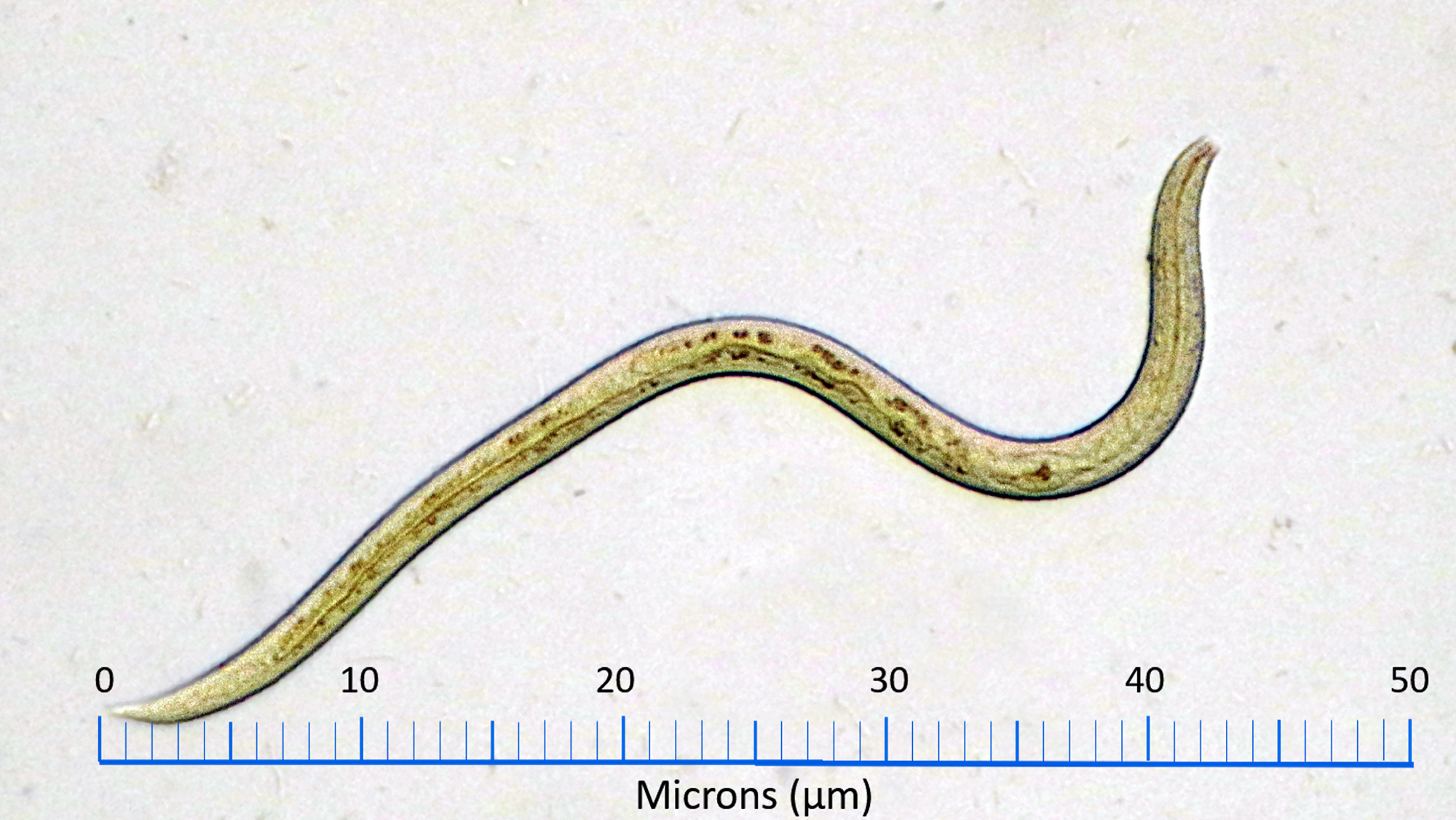
At the bottom of ponds, nematodes and other creatures swim in a world of mud. They squirm their way through a sediment of dirt particles suspended in water. Mud, of course, is notoriously impossible to see through, so to understand these creatures’ movements, scientists turn instead to biorobotics. Here, a team uses a magnetic head attached to an elastic tail to mimic these tiny creatures.
To drive the robot’s motion, they use an oscillating magnetic field, which forces the magnetic head to rotate. Combined with the elastic tail and the drag caused by surrounding materials, this causes the robot to swim in a fashion similar to its biological inspirations.

A biomimetic robot swims through immersed grains. The robot’s magnetic head is forced with an oscillating magnetic field. It swims through an underwater bed of hydrogel beads, with diameters smaller than that of the robot’s head. To mimic the muddy environment of a pond’s bottom, scientists used a bed of hydrogel beads immersed in water. Looking at the experimental video above, you’ll see no sign of the beads. That’s because the hydrogel beads have nearly the same index of refraction as water. Once you pour water in, they seem to disappear. That allows the researchers to focus instead on the robot’s motion. In other experiments, they added dye to the beads so that they could see how they moved around the robot.
They found that the robot’s motion fluidizes the grains around it. Effectively, the robot’s motion creates an area with fewer grains and more water for it to move through. Once it’s passed, however, more grains settle in, and the bed returns to a denser packing. (Image credit: nematode – P. Garcelon, experiment – A. Biswas et al.; research credit: A. Biswas et al.)

Butterfly Scales
Catch a butterfly, and you’ll notice a dust-like residue left behind on your fingers. These are tiny scales from the butterfly’s wing. Under a microscope, those scales overlap like shingles all over the wing. Their downstream edges tilt upward, leaving narrow gaps between one scale and the next. Experiments show that, although butterflies can fly without their scales, these tiny features make a big difference in their efficiency.

At the microscale, a butterfly’s scales overlap like roof shingles but are tilted upward, leaving cavities in the downstream direction. When air flows over the scales, tiny vortices form in the gaps between. These laminar vortices act like roller bearings, helping the flow overhead move along with less friction and, thus, less drag. Compared to a smooth surface, the scales reduce skin friction on the wing by 26-45%. (Image credit: butterfly – E. Minuskin, scales – N. Slegers et al., experiment – S. Gautam; research credit: N. Slegers et al. and S. Gautam; via Physics Today)

This lab-scale experiment shows how air moves over butterfly scales. As flow moves from left to right, small persistent vortices form in the gaps between scales. These act like roller bearings that reduce the skin friction from air moving past. 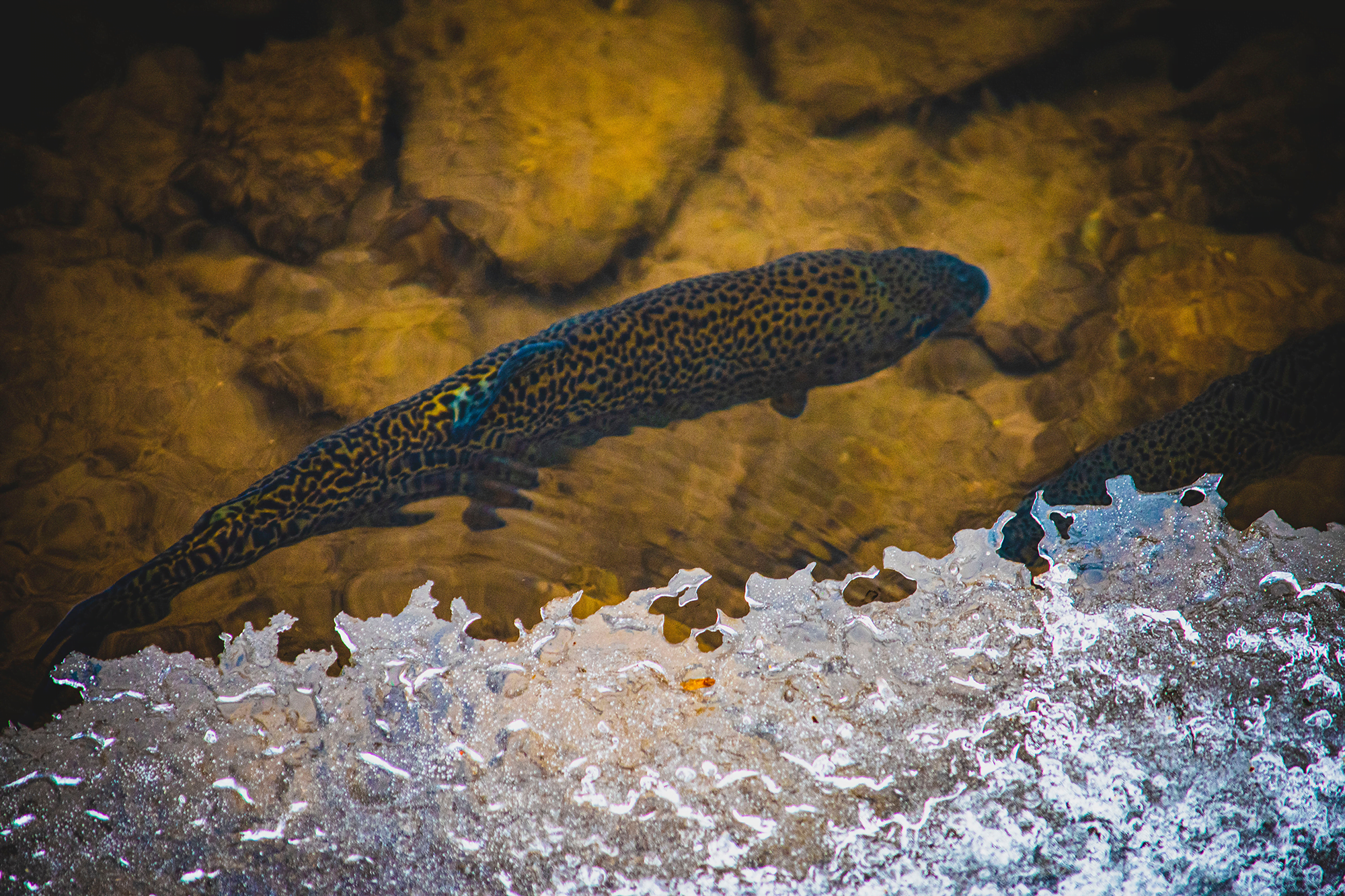
Fish Fins Work Together
Researchers studying how fish swim have long focused on their tail fins and the flows created there. But a fish’s other fins have important effects, too, as seen in this recent study. Researchers built a CFD simulation based on observations of a swimming rainbow trout, focusing on the flow from its back and tail fins. They found that the vortex created by the back fin stabilizes and strengthens the one generated by the tail. It also played a role in reducing drag on the fish by maintaining the pressure difference across the body. When they tried changing the size and geometry of the fins, the fish’s efficiency suffered, indicating that evolution has already optimized the trout’s fins for swimming efficiency. (Image credits: top – J. Sailer, simulation – J. Guo et al.; research credit: J. Guo et al.; via APS Physics)

Visualization of flow around a digitized rainbow trout. 
Anchoring Mussels


Mussels live in rough conditions, constantly pummeled by waves and turbulent currents. They hold themselves fast in the flow using dozens of byssel threads (commonly called a mussel’s beard) that anchor them to rocks and other mussels. The threads get built within the mussel’s foot, the tongue-like protrusion mussels use to drag themselves. The threads are similar to our ligaments: strong and stretchy. Each one is cemented securely using an adhesive that hardens in water. If engineers could replicate that adhesive, it would be fantastic for use in medicine. (Video and image credit: Deep Look)
Honeybee Feeding
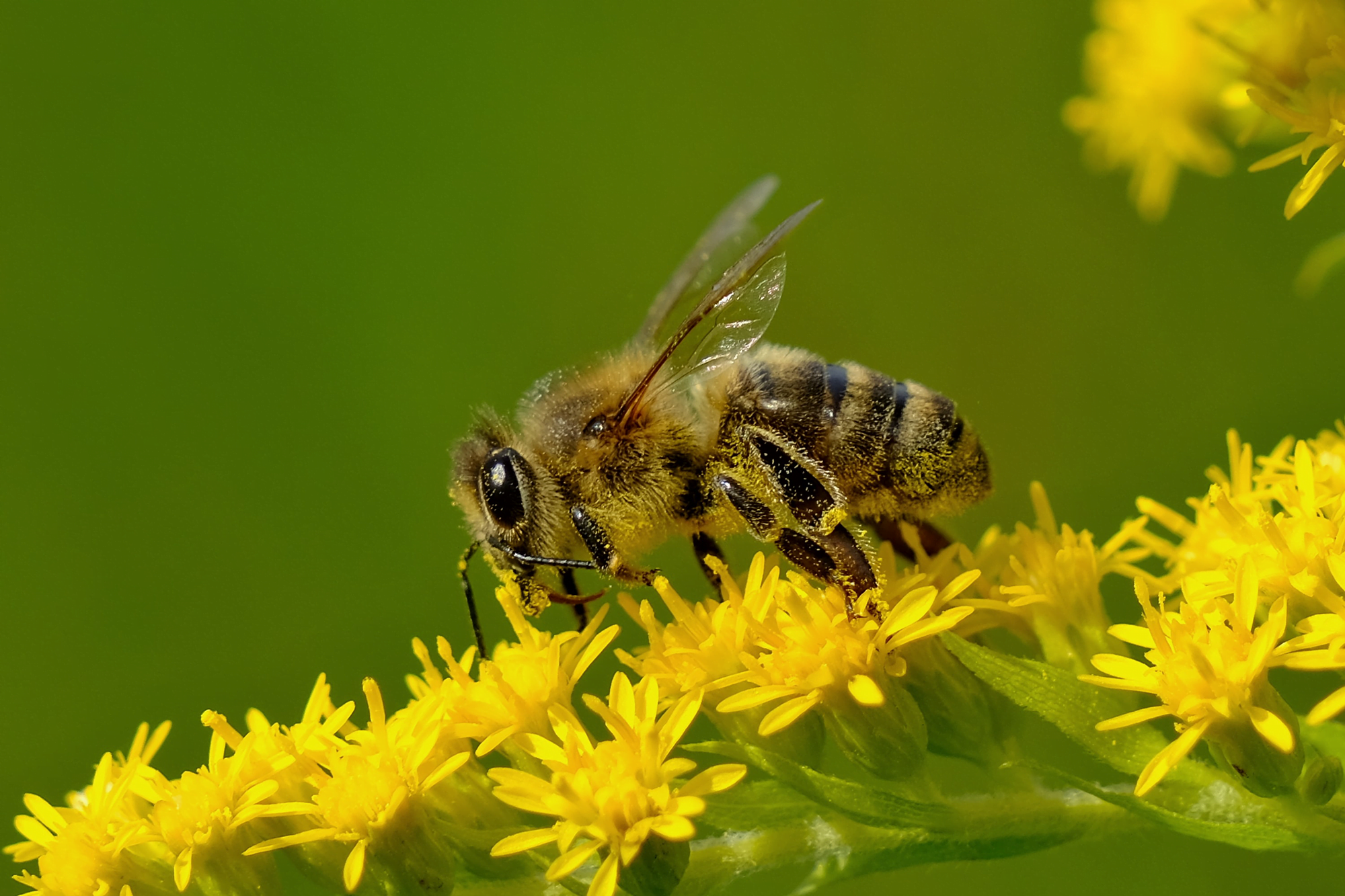
Busy bees feed on millions of flowers for each kilogram of honey they produce. To gather nectar, bees use their hairy tongues, which project out of a sheath-like cover. Protraction (i.e., sticking their tongue out) is relatively fast because all the hairs on the tongue initially lie flat. In the nectar, those hairs flare out, creating a miniature forest that traps viscous nectar and drags it back into the bee during retraction.

Bees feed by projecting their tongues into nectar. Tongue extension is faster because the tongue’s hairs lie flat. During the slower retraction phase, the hairs flare out, trapping nectar and pulling it back into the bee. Through modeling and experiments, researchers found that the time it takes a bee to retract its tongue depends on the bee’s overall mass. Smaller bees are slower to the retract their tongues, likely to allow enough time for their shorter tongues to capture enough nectar. With bee populations on the decline, the team’s predictions may help communities select flowers with nectar concentrations that best fit their local bees’ needs. (Image credits: top – J. Szabó, bee eating – B. Wang et al.; research credit: B. Wang et al.; via APS Physics)