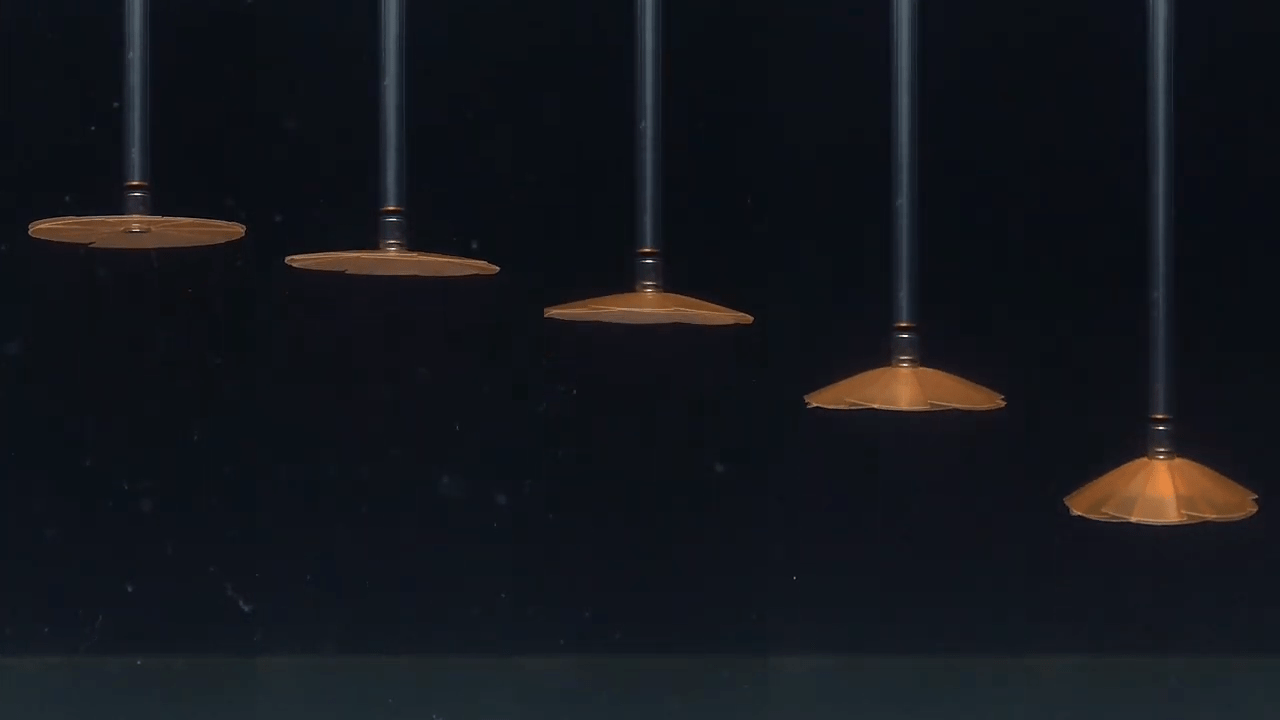
Leaves flutter and bend in the breeze, changing their shape in response to the flow. Here, researchers investigate this behavior using flexible disks pulled through water. The more flexible the disk and the faster the flow, the more cup-like the disk’s final shape. Adding tracer particles to the water allows them to visualize the flow behind the disk. Every disk leaves a donut-shaped vortex ring spinning in its wake, but the more reconfigured the disk, the narrower the vortex. This, ultimately, reduces drag on the disk. That’s why trees in heavy winds streamline their branches and leaves; that flexibility lowers the drag the tree’s roots have to anchor against. (Image and video credit: M. Baskaran et al.)
Search results for: “drag”

Moths and Beetles in Flight
Watching insects take flight in high-speed video is always mesmerizing. So often their wings look too small and fragile to lift their bulbous bodies, but they manage the feat easily. I especially like to watch how much their wings flex during each up- and downstroke. So often we think that stiffer wings — like those on airplanes — are better for flight, yet nature demonstrates at so many sizes that flexibility is better, especially in flapping flight. A flexible wing can maximize lift in the downstroke and curl to minimize drag on the upstroke. Even wings that fold away, as many beetle wings do, can do the job of lifting an insect once shaken out. (Image and video credit: Ant Lab)

Peering Into the Gap
This video offers a glimpse into turbulence developing in a classic flow set-up, a Taylor-Couette cylinder. The apparatus consists of two upright, concentric cylinders; the outer cylinder is fixed, and the inner one rotates. This video shows the gap between the cylinders, and it’s rotated so that the inner cylinder is at the bottom of the frame. Gravity points from left to right in the video. The fluid in the 8-cm gap between the cylinders is water, seeded with rheoscopic particles to visualize the flow.
The video begins as the inner cylinder has just begun to rotate, dragging nearby fluid with it. A thin, laminar boundary layer forms at the bottom of the frame, growing as time goes on. A few seconds in, the boundary layer transitions to turbulence; look closely and you’ll see hairpin-shaped vortices appear. Just after that, the boundary layer becomes entirely turbulent and continues to slowly move upward to take over the full gap. The video is available in a full 4K resolution if you really want to get lost in the flow. (Video credit: D. van Gils)

Under the Sea
Deep below the ocean surface, light is in short supply. But dive photographer Steven Kovacs specializes in capturing the ethereal creatures that live in this darkness. Many of his subjects are larval fish, whose forms defy our hydrodynamic expectations. Why would young (presumably less energetic) fish have so many long, drag-inducing appendages? Clearly there’s more to life under the sea than streamlining alone!
Perhaps our instincts are wrong and these shapes are not as detrimental as they look at first glance. Flexibility can make a drastic difference in hydrodynamics, after all. And some of these species are preparing themselves for a life not spent entirely underwater, anyway. (Image credit: S. Kovacs; via Colossal)

The Tea Leaves Effect
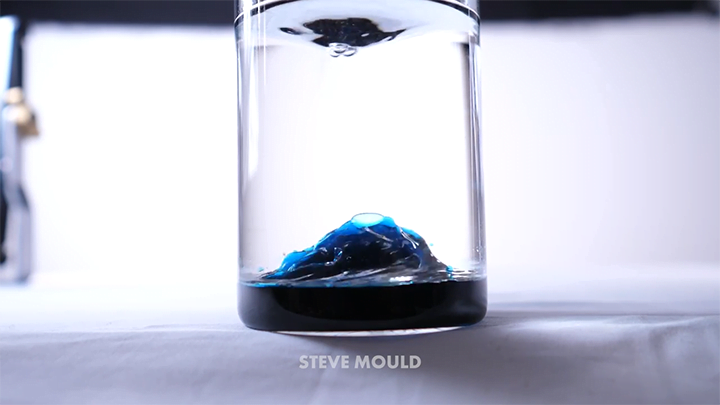
If you’ve ever stirred a cup of tea with loose leaves in it, you’ve probably noticed that the leaves tend to swirl into the center of the cup in a kind of inverted whirlpool. At first, this behavior can seem counter-intuitive; after all, a spinning centrifuge causes denser components to fly to the outside. In this video, Steve Mould steps through this phenomenon and how the balance of pressures, velocities, densities, and viscosity cause the effect. (Note that Mould uses the term “drag,” but what he’s really referring to is the boundary layer across the bottom of the container. But who wants to explain a boundary layer in a video when they can avoid it?) (Video and image credit: S. Mould)

When liquid in a cup is stirred, the densest layers move to the center. 
Sonic Booms and Urban Canyons
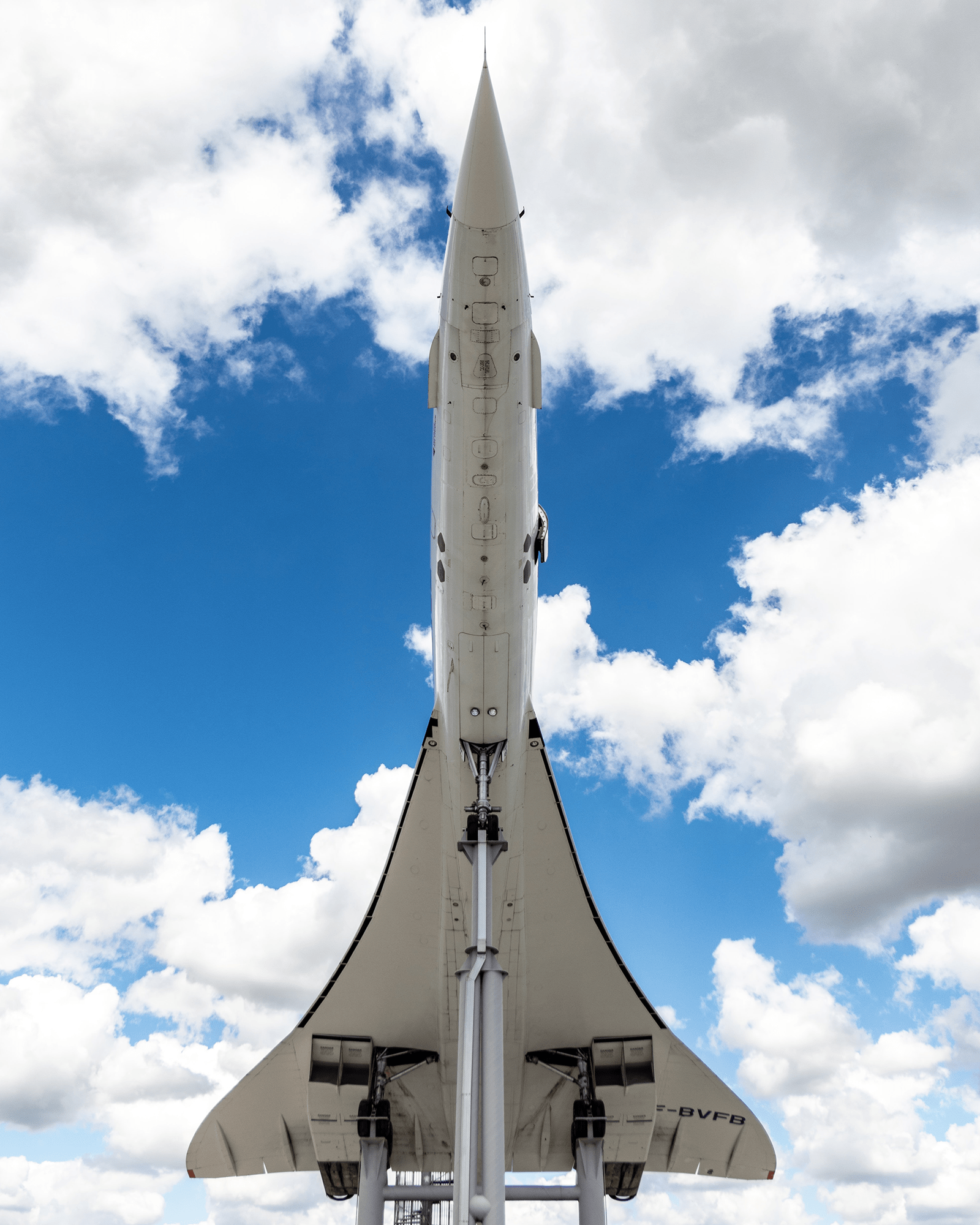
In the days of the Concorde — thus far the world’s only supersonic passenger jet — noise complaints from residents kept the aircraft from faster-than-sound travel except over the open ocean. With many pursuing a new generation of civil supersonic aircraft, researchers are looking at how those sonic booms could interact with those of us on the ground.
In this study, researchers simulated the shock waves from aircraft interacting with single and multiple buildings on the ground. They found that the presence of a building increases the perceived sound level of the boom by about 7 dB at the most. But the most interesting results are what happens between multiple buildings.
If the street between buildings is wide enough, they each act independently, as if they were single buildings. But for narrower streets, the acoustics waves reflect and diffract between the buildings, creating a resonance that makes the acoustic echoes last longer. The effect is especially pronounced for a sonic boom traveling across a series of buildings, which mimics the layout of a dense city full of urban canyons. (Image credit: Concorde – M. Rochette, simulation – D. Dragna et al.; research credit: D. Dragna et al.)

Acoustic waves reflect and propagate through 2D urban canyons with widths of 10 meters (top), 20 meters (middle), and 30 meters (bottom). 
Raindrops on the Windshield
When I was a child, I was fascinated by the raindrops that shimmied along the windshield of our car. Some would slide up the glass. Some would run down. And some just seemed to wiggle in place, until the car’s speed changed. As common as this sight is, the physics of these droplets is quite complicated and not completely understood.
Each droplet has a host of forces on it: gravity flattening it or pulling it down an incline; a drag force from the wind flowing over it; and friction between the drop and the surface trying to pin it in place. Recently, scientists have developed a new mathematical model that captures some of the behaviors behind these drops. The work describes the wind speed necessary to move a drop of a given size sitting on a flat surface. The authors also explored how that critical wind speed changes when a drop sits on a tilted surface aligned or against the wind. (Image credit: P. Gupta; research credit: A. Hooshanginejad and S. Lee; via Science News; submitted by Kam-Yung Soh)

Electronic Friction
Years ago, physicists discovered that water flows with surprisingly little friction through narrow carbon nanotubes. At our scale, flow behavior is typically the opposite: there’s greater friction (and, thus, slower flow) in a narrower pipe. To unravel the mystery, researchers had to delve into quantum mechanics and model the interactions between the atoms of a water molecule and the electrons of the carbon atom. Essentially, this meant building a quantum picture of the liquid-solid interface inside the nanotube.
The team found that the electrons of the nanotube exert a drag-like force on the water molecules, creating friction that slows the flow. Since narrow nanotubes have fewer electrons than larger tubes, there is less friction on the flow and the water flows faster! (Image credit: cintersimone; research credit: N. Kavokine et al.; via SciAm; submitted by Kam-Yung Soh)

Beijing 2022: Ski Jumping
In ski jumping, aerodynamics are paramount. Each jump consists of four segments: the in-run, take-off, flight, and landing. Of these, aerodynamics dominates in the in-run — where jumpers streamline themselves to minimize drag and maximize their take-off speed — and in flight. During flight, ski jumpers spread their skis in a V-shape and lift their arms to the sides to turn themselves into a glider. Their goal is to maximize their lift-to-drag ratio, so that the air keeps them aloft as long as possible. Because of the short flight time and high risk of taking jump after jump, many elite ski jumpers use wind tunnel time to practice and hone their flight positioning, as seen in the video below.
Weather also plays a significant role in ski jumping; it’s one of the few sports where a headwind is an advantage to athletes. To try to adjust for wind effects, scoring for the sport uses a wind factor. (Image credit: T. Trapani; video credit: NBC News)

Swept Along
When a car drives over a leaf-strewn autumn road, it pulls leaves up with its passage. This tendency to drag fluid along when an object passes is called entrainment, and it may be a key to transporting loads like medicine in microfluidic applications.
As shown above, a self-propelled microswimmer — in this case, an oil droplet — pulls the surrounding fluid and tracer particles with it (Image 1). Researchers modeled this single-swimmer entrainment (Image 2) to quantify just how much fluid the droplet pulls with it. Then they studied what happens when many swimmers pass through an area (Image 3). They found that the droplet swarm entrained ten times the volume of fluid compared to the fluid entrained by the same number of isolated droplets. The fluid volume pulled along was also far larger than any payload the droplets themselves could carry. So future microswimmer swarms may simply sweep their cargo along in their wake. (Image and research credit: C. Jin et al.; via APS Physics)