Category: Research

  • Icy or Rocky Giants?

    Icy or Rocky Giants?

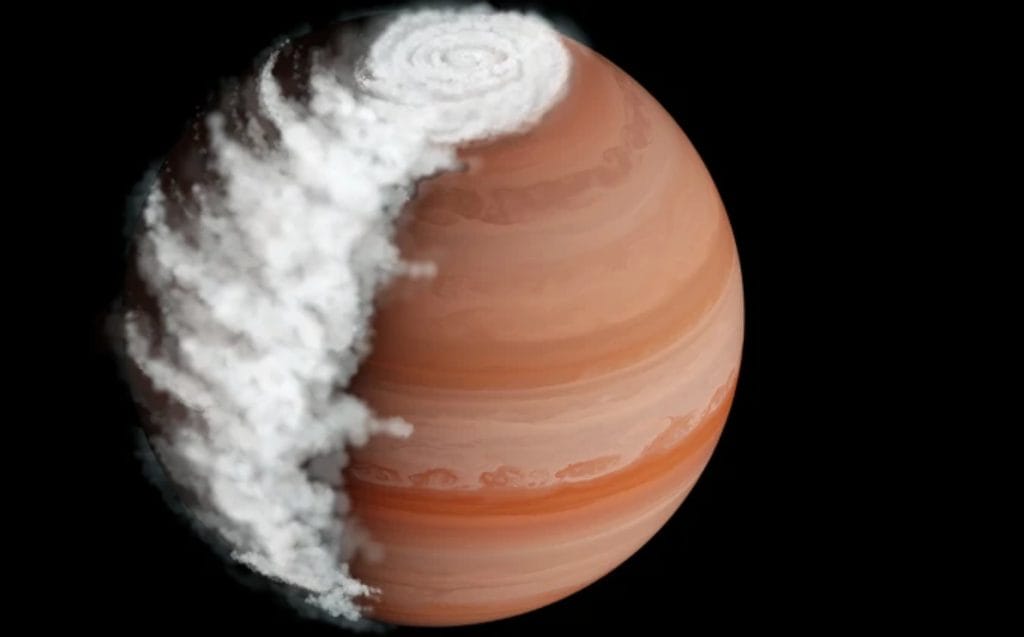
    On the outskirts of our solar system, two enigmatic giants loom: Uranus and Neptune. In terms of mass and size, both resemble many of the exoplanets discovered in recent years. Within our own solar system, these planets are known as “icy giants,” but a new study suggests that moniker may be wrong.

    Pinning down the interior composition of a planet is tough on limited measurements. In the case of these outer planets, our main data is gravitational, recorded from visiting spacecraft. That information cannot tell us directly what the composition of a planet is, but it gives constraints for what materials could produce such a gravitational field.

    Hubble images of Uranus (left) and Neptune (right).

    In their simulation, researchers began with random interior configurations for Uranus and Neptune, then had the model iterate through configurations to simultaneously match the gravitational measurements while satisfying the thermodynamic and physical constraints of a stable planet. By repeating the process several times, the researchers created a catalog of potential interiors for Uranus and Neptune. And while some were water-rich–consistent with the “icy giant” title–others were remarkably rocky.

    The team suggests that we may need to retire that moniker and consider the possibility that these worlds are more like our own than we thought. To find out which is true, we will need more spacecraft to visit our frigid neighbors, to provide new gravitational measurements and other observations. (Image credit: NASA/ESA/A. Simon/M. Wong/A. Hsu; research credit: R. Morf and L. Helled; via Physics World)

    Fediverse Reactions
  • Milano Cortina 2026: Ski Jumping Suits

    Milano Cortina 2026: Ski Jumping Suits

    Ski jumping is in the news this Olympic cycle after rumors that male competitors may be cheating in order to wear larger suits. In particular, the suggestion is that male athletes are injecting fillers into their genitals before their pre-season 3D body scan in order to appear large enough to allow them to wear a larger suit. This comes after two Norwegian ski jumpers were punished for illegally restitching the crotches of their suits to make them larger.

    Ski jumping is a sport that relies heavily on aerodynamics; during the flight phase, jumpers try to maximize their lift-to-drag ratio so that they stay aloft as long as possible. A 2025 study underscores the importance of suit size in this calculus. In the work, the researchers used a baseline suit that was 4 centimeters larger in circumference than their jumper–the loosest configuration that regulations allow. They compared that suit’s flight performance (in wind tunnels and simulation) to a suit 2 cm larger and one 2 cm smaller. The extra 2 centimeters of circumference made a notable difference: the larger suit increased the drag by ~4% and lift by ~5%. That was enough, in their simulation, to let a jumper fly an extra 5.8 meters.

    It’s worth noting, though, that the study was looking at the effects of adjusting the suit’s circumference along the entire length between the arm pits and the knees; they never changed anything about the suit’s crotch. I don’t think there’s enough scientific data to say that packing a bit more there would really offer aerodynamic advantages. And the risks of such injections are non-negligible. (Image credit: T. Trapani; research credit: M. Virmavirta et al.; via Ars Technica)

    A ski jumper in flight, viewed from behind.
    Fediverse Reactions
  • Milano Cortina 2026: Ice’s Many Forms

    Milano Cortina 2026: Ice’s Many Forms

    Welcome to another Olympic year and another FYFD celebration of the fluid physics that enable these sports! All Winter Olympic sports are required, per the IOC, to take place on snow or ice–one of the strangest substances we know of.

    Despite consisting of two simple elements–hydrogen and oxygen–water manages to find a shocking number of ways to configure itself into a solid. So far, scientists have described 21 different configurations for solid water ice. The latest one was created at room temperature and extreme pressures. (The apparatus used can reach pressures 20,000 times atmospheric pressure.)

    This particular form of ice is metastable, meaning that it balances on a knife’s edge, existing briefly at conditions where other ice structures are energetically preferable. It’s likely that many such high-temperature, metastable ice forms exist. How many more do you suppose researchers will discover before the next Olympics? (Image credit: L. Borghese; research credit: Y. Lee et al.; via Gizmodo)

    P.S. – Dig into past Olympics with posts from Beijing, PyeongChang, and Sochi.

    Fediverse Reactions
  • Gliding Like a Grasshopper

    Gliding Like a Grasshopper

    Many biorobots are built after flies and bees–insects that rely heavily on flapping flight. For small robots, this means carrying heavy batteries or remaining tethered in order to power their motors. Instead, researchers have turned to grasshoppers for a lesson in small-scale gliding.

    Grasshoppers have two sets of wings. The forward set provide protection and camouflage, while the hindwings are used to fly. The team studied the corrugated, foldable hindwings of the American grasshopper, then 3D-printed model wing designs and attached them to gliders. They found that the corrugated wings performed well at low angles of attack, but that non-corrugated wings–which still shared the outline and camber of the insect’s wings–were more efficient gliders over a range of conditions.

    The team hopes that their grasshopper-inspired gliders give insect-like biorobots more efficient flying options. (Image credit: Princeton/S. Khan/Fotobuddy; research credit: K. Lee et al.; via Physics World)

    Fediverse Reactions
  • Watching Waves on the Nanoscale

    Watching Waves on the Nanoscale

    It’s tough to simulate nonlinear wave dynamics, so scientists often test theories in wave flumes, where they can create more controlled waves than what we see in the wild. But conventional wave flumes are big–meters-long, complicated equipment–and can only test a small range of conditions. To reach more extreme nonlinear dynamics, researchers have turned to a chip-based approach. These 100-micron-long wave flumes carry a film of superfluid helium less than 7 nanometers thick. But despite that tiny size, the system can reach levels of nonlinearity five orders of magnitude greater than their full-sized counterparts. (Image and research credit: M. Reeves et al.; via Physics Today)

    Labeled diagram of a 100-micron-long wave flume.
    Fediverse Reactions
  • Bouncing Indefinitely

    Bouncing Indefinitely

    On the surface of a gently vibrating liquid, a droplet can bounce indefinitely without coalescing, kept aloft by an air film too small to see. As long as the droplet lifts off before the air layer drains out from under it, the droplet won’t contact the water below. Now scientists have shown that this is possible with a solid surface, too.

    Using an atomically smooth mica plate, researchers were able to bounce a droplet indefinitely without wetting the surface. At higher vibration rates (below), the droplet essentially hovers in place, bouncing so quickly that we simply see its shape vibrating in response to the surface. (Image and research credit: L. Molefe et al.; via APS)

    At a high vibrational frequency, a bouncing droplet effectively hovers in space and changes its shape rather than bouncing.
    Fediverse Reactions
  • Making Bubbles in Magma

    Making Bubbles in Magma

    When bubbles form in magma deep below the earth, volcanic eruptions follow. Scientists believe this happens when decompression of the magma allows volatile compounds to come out of solution and form bubbles–just as opening a bottle of seltzer allows carbon dioxide to bubble out. But a new study indicates that decompression may not be the only source of bubbles.

    Video of bubbles nucleating when a magma analog supersaturated with CO2 gets sheared.

    The team found that supersaturated fluids can nucleate bubbles when they’re sheared–even without decompression. They demonstrated this in the lab, not with magma but with a low-temperature magma analog, seen above. The more saturated with volatiles the fluid is, the less shear is needed to trigger bubbles.

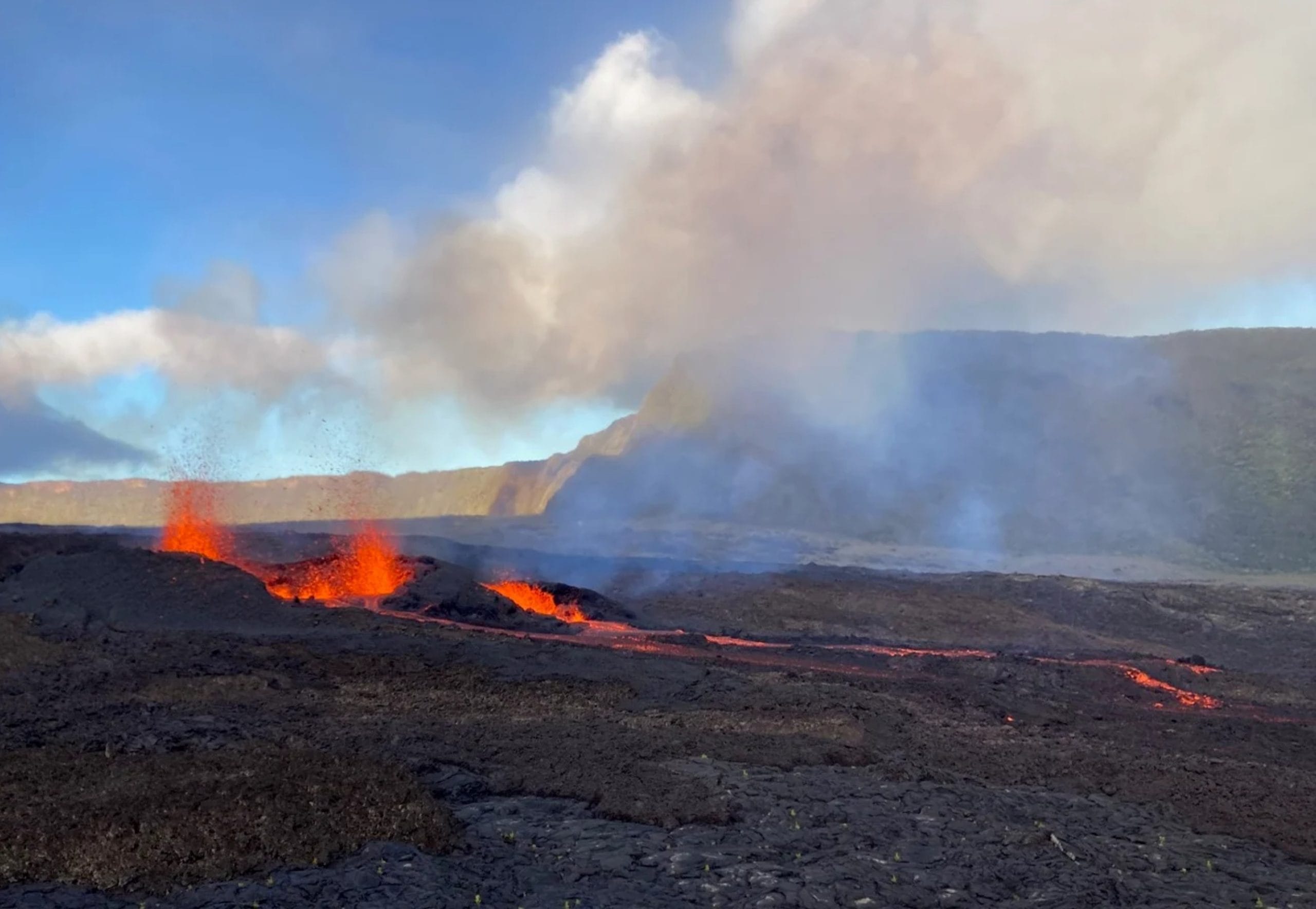
    Viscous shear is everywhere for magma, so this bubble formation mechanism is likely common. Better understanding how and when bubbles form in magma directly affects predictions for eruptions–especially for determining whether they’re likely to be explosive or effusive. (Image credit: volcano – A. Bonnerdeaux, experiment – O. Roche et al.; research credit: O. Roche et al.; via Physics World)

    Fediverse Reactions
  • Toward Predicting Rogue Waves

    Toward Predicting Rogue Waves

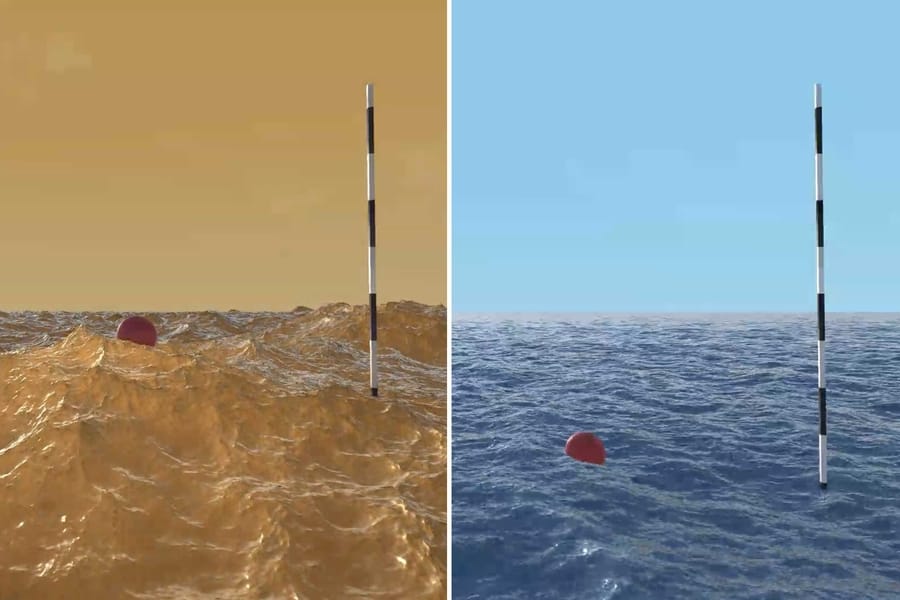
    Rogue waves were once the stuff of nautical legend. Tales of giant lone waves were considered sailors’ tall tales, until an oil rig in the North Sea was hit by a 25.6-meter wave on 1 January 1995. The wave was more than twice the height of any others around it and much steeper, too. Since then, scientists have been working to understand how and why these rogue waves form.

    A recent study, like many others, attributes rogue waves to the subtle nonlinearities of ocean waves, which don’t match a smooth sinusoid even though they are sometimes modeled that way. When it comes to rogue waves, the sharpness of a wave’s peak and flattening of its trough affect whether waves come together into a lone giant.

    The study is based on 18 years worth of wave data collected at an offshore platform in the North Sea. With such an extensive data set, researchers were able to find patterns in the waves that precede the arrival of a rogue wave. That’s an important step toward being able to predict a rogue wave, which would help protect platforms, ships, and personnel. (Image credit: C. Wou; research credit: S. Knobler et al.; via SciAm)

    Fediverse Reactions
  • Necroprinting By Mosquito

    Necroprinting By Mosquito

    Engineers have been adapting biological materials into robotics in recent years. One of the latest versions of this trend is “necroprinting,” in which researchers built a microscale 3D printer around a mosquito’s proboscis. Made to pierce thick skin to reach blood, the mosquito proboscis offered the kind of size, geometry, and stiffness needed for small-scale printing. The team found that their necroprinter performed well at the ~20 micron scale, with the mosquito-based nozzle costing only a fraction of what a conventional human-made nozzle would. (Image credit: NIAID; research credit: J. Puma et al.; via Ars Technica)

    Fediverse Reactions
  • Thermal Tides Drive Venusian Winds

    Thermal Tides Drive Venusian Winds

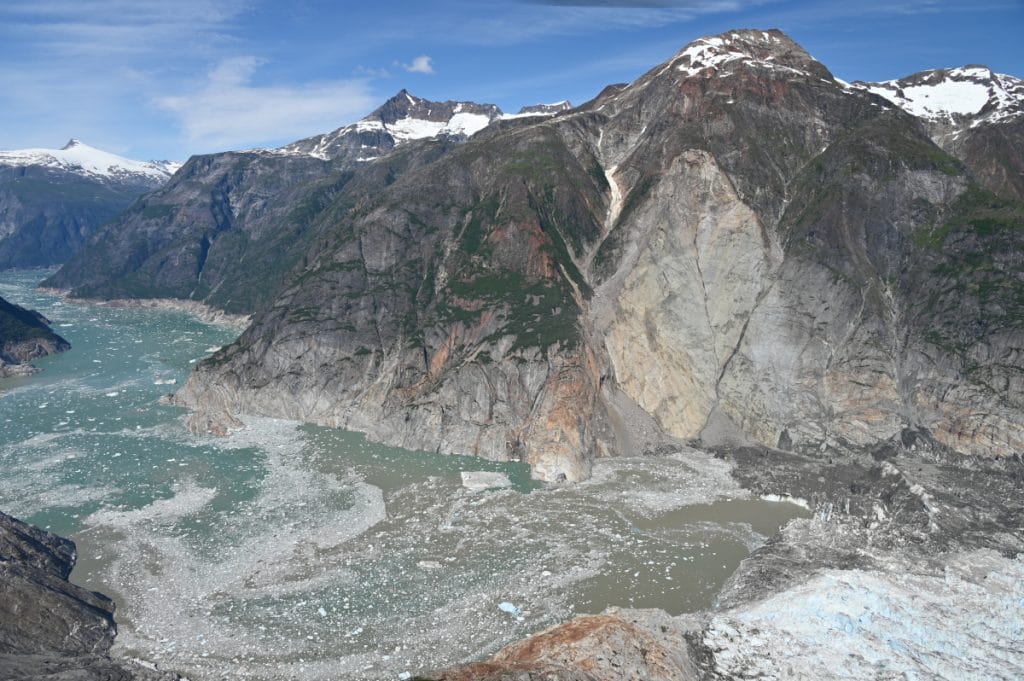
    Venus is a world of extremes. A full rotation of the world takes 243 Earth days, but winds race around the planet at a speed that makes a Category 5 hurricane look sedate. Just what drives these winds has been an ongoing question for planetary scientists. A recent study suggests that tides are a major contributor to this superrotation.

    Unlike Earth’s tides, Venus’s are not gravitational in origin. Instead, Venusian tides are thermal, driven by heating in the sunward side of the atmosphere. This creates a diurnal tide, which cycles once per Venusian day and pumps momentum toward the tops of Venus’s clouds. The new analysis–rooted in both observations and numerical simulation–finds that diurnal tides are the primary driver behind the planet’s incredibly fast winds. (Image credit: NASA/JPL-Caltech; research credit: D. Lai et al.; via Eos)

    Fediverse Reactions