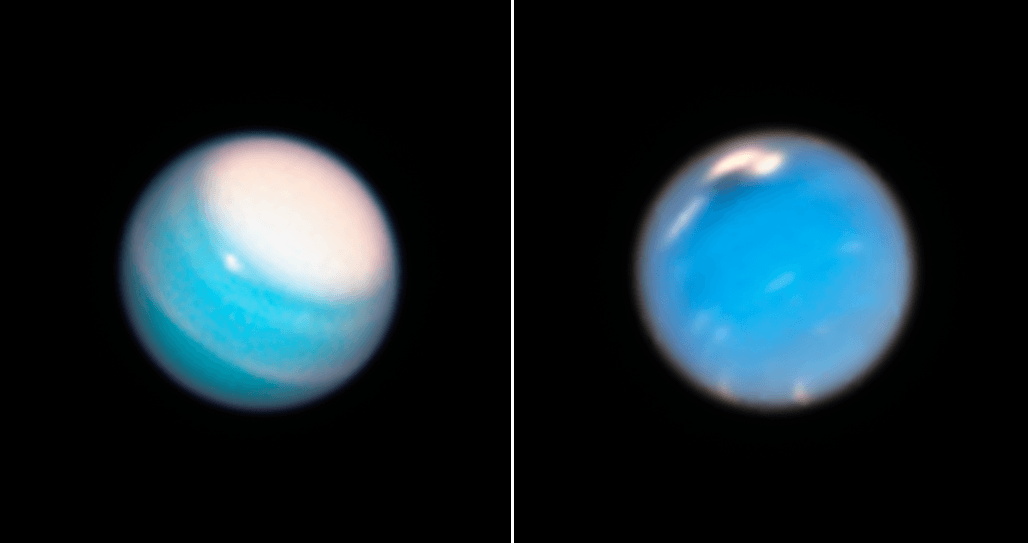
On the outskirts of our solar system, two enigmatic giants loom: Uranus and Neptune. In terms of mass and size, both resemble many of the exoplanets discovered in recent years. Within our own solar system, these planets are known as “icy giants,” but a new study suggests that moniker may be wrong.
Pinning down the interior composition of a planet is tough on limited measurements. In the case of these outer planets, our main data is gravitational, recorded from visiting spacecraft. That information cannot tell us directly what the composition of a planet is, but it gives constraints for what materials could produce such a gravitational field.

In their simulation, researchers began with random interior configurations for Uranus and Neptune, then had the model iterate through configurations to simultaneously match the gravitational measurements while satisfying the thermodynamic and physical constraints of a stable planet. By repeating the process several times, the researchers created a catalog of potential interiors for Uranus and Neptune. And while some were water-rich–consistent with the “icy giant” title–others were remarkably rocky.
The team suggests that we may need to retire that moniker and consider the possibility that these worlds are more like our own than we thought. To find out which is true, we will need more spacecraft to visit our frigid neighbors, to provide new gravitational measurements and other observations. (Image credit: NASA/ESA/A. Simon/M. Wong/A. Hsu; research credit: R. Morf and L. Helled; via Physics World)





Leave a Reply