Category: Research

  • Our Best Look Yet at a Solar Flare

    Our Best Look Yet at a Solar Flare

    Scientists have unveiled the sharpest images ever captured of a solar flare. Taken by the Inouye Solar Telescope, the image includes coronal loop strands as small as 48 kilometers wide and 21 kilometers thick–the smallest ones ever imaged. The width of the overall image is about 4 Earth diameters. The captured flare belongs to the most powerful class of flares, the X class. Catching such a strong flare under the perfect observation conditions is a wonderful stroke of luck.

    Although astronomers had theorized that coronal loops included this fine-scale structure, the Inouye Solar Telescope is the first instrument with the resolution to directly observe structures of this size. Confirming their existence is a big step forward for those working to understand the details of our Sun. (Video and image credit: NSF/NSO/AURA; research credit: C. Tamburri et al.; via Gizmodo)

  • Salt and Sea Ice Aging

    Salt and Sea Ice Aging

    Sea ice’s high reflectivity allows it to bounce solar rays away rather than absorb them, but melting ice exposes open waters, which are better at absorbing heat and thus lead to even more melting. To understand how changing sea ice affects climate, researchers need to tease out the mechanisms that affect sea ice over its lifetime. A new study does just that, showing that sea ice loses salt as it ages, in a process that makes it less porous.

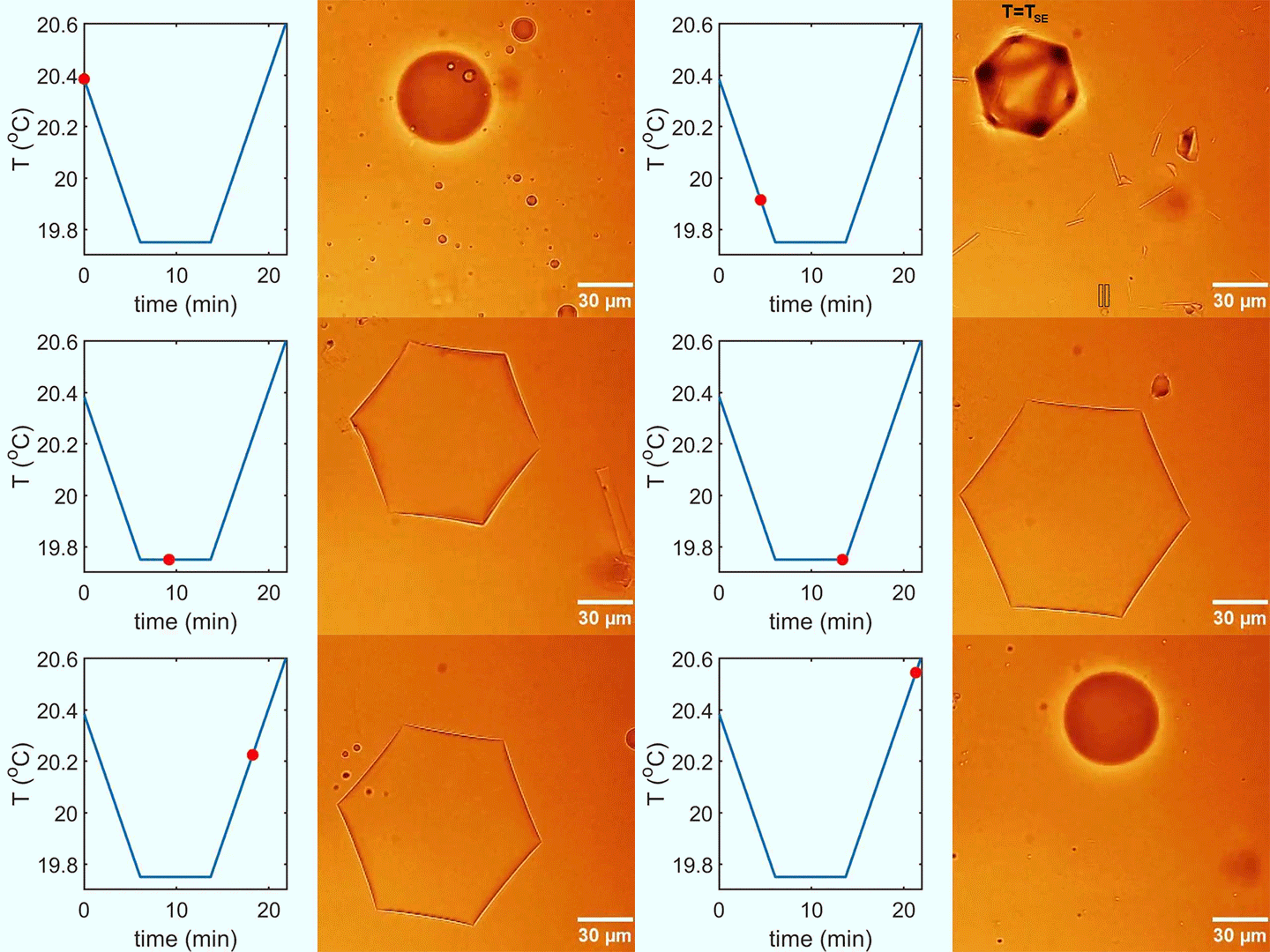
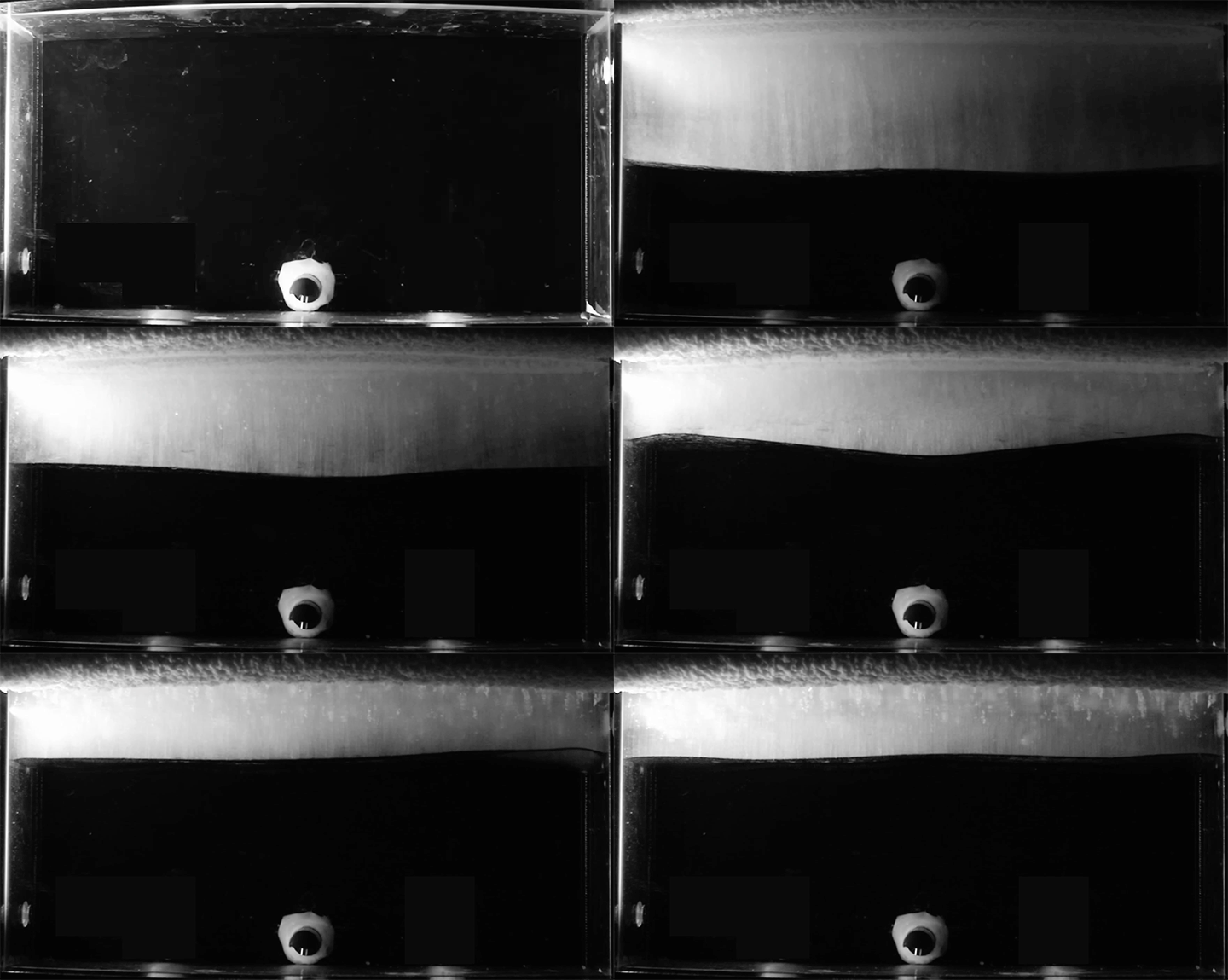
    Researchers built a tank that mimicked sea ice by holding one wall at a temperature below freezing and the opposite wall at a constant, above-freezing temperature. Over the first three days, ice formed rapidly on the cold wall. But it did not simply sit there, once formed. Instead, the researchers noticed the ice changing shape while maintaining the same average thickness. The ice got more transparent over time, too, indicating that it was losing its pores.

    Looking closer, the team realized that the aging ice was slowly losing its salt. As the water froze, it pushed salt into liquid-filled pores in the ice. One wall of the pore was always colder than the others, causing ice to continue freezing there, while the opposite wall melted. Over time, this meant that every pore slowly migrated toward the warm side of the ice. Once the pore reached the surface, the briny liquid inside was released into the water and the ice left behind had one fewer pores. Repeated over and over, the ice eventually lost all its pores. (Image credit: T. Haaja; research credit and illustration: Y. Du et al.; via APS)

    Fediverse Reactions
  • Kirigami Parachutes

    Kirigami Parachutes

    In kirigami, careful cuts to a flat surface can morph it into a more complicated shape. Researchers have been exploring how to use this in combination with flow; now they’ve created a new form of parachute. Like a dandelion seed, this parachute is porous, with a complex but stable wake structure. This allows the parachute to drop directly over its target, unlike conventional parachutes, which require a glide angle to avoid canopy-collapsing turbulence.

    When dropping conventional parachutes, users either have to tolerate random landings far off target or invest in complicated active control systems that guide the parachute. Kirigami parachutes, in contrast, offer a potentially simple and robust option for accurately delivering, for example, humanitarian aid. (Image and research credit: D. Lamoureux et al.; via Physics World)

    Fediverse Reactions
  • Geoengineering Trials Must Consider Unintended Costs

    Geoengineering Trials Must Consider Unintended Costs

    As the implications of climate change grow more dire, interest in geoengineering–trying to technologically counter or mitigate climate change–grows. For example, some have suggested that barriers near tidewater glaciers could restrict the inflow of warmer water, potentially slowing the rate at which a glacier melts. But there are several problems with such plans, as researchers point out.

    Firstly, there’s the technical feasibility: could we even build such barriers? In many cases, geoengineering concepts are beyond our current technology levels. Burying rocks to increase a natural sill across a fjord might be feasible, but it’s unclear whether this would actually slow melting, in part because our knowledge of melt physics is woefully lacking.

    But unintended consequences may be the biggest problem with these schemes. Researchers used existing observations and models of Greenland’s Ilulissat Icefjord, where a natural sill already restricts inflow and outflow from the fjord, to study downstream implications. Right now, the fjord’s discharge pulls nutrients from the deep Atlantic up to the surface, where a thriving fish population supports one of the country’s largest inshore fisheries. As the researchers point out, restricting the fjord’s discharge would almost certainly hurt the fishing industry, at little to no benefit in stopping sea level rise.

    Because our environment and society are so complex and interconnected, it’s critical that scientists and policymakers carefully consider the potential impacts of any geoengineering project–even a relatively localized one. (Research and image credit: M. Hopwood et al.; via Eos)

    Fediverse Reactions
  • Waves Over Sand Ripples

    Waves Over Sand Ripples

    Look beneath the waves on a beach or in a bay, and you’ll find ripples in the sand. Passing waves shape these sandforms and can even build them to heights that require dredging to keep waterways passable to large ships. To better understand how the sand interacts with the flow, researchers build computer models that couple the flow of the water with the behavior of individual sand grains. One recent study found that sand grains experienced the most shear stress as the flow first accelerates and then again when a vortex forms near the crest of the ripple. (Image credit: D. Hall; research credit: S. DeVoe et al.; via Eos)

    Fediverse Reactions
  • Sand Dikes Can Date Earthquakes

    Sand Dikes Can Date Earthquakes

    When a strong earthquake causes liquefaction, sand can intrude upward, leaving behind a feature that resembles an upside-down icicle. Known as a sand dike, researchers suspected that these intrusions could help us date ancient earthquakes. A new study shows how and why this is possible.

    Using optically stimulated luminescence, researchers had already dated quartz in sand dikes and found that it appeared to be younger than the surrounding rock formations. But that information alone was not enough to tie the sand dike’s age to the earthquake that caused it.

    The final puzzle piece fell into place when researchers showed that, during a sand dike’s formation, friction between sand grains could raise the temperature higher than 350 degrees Celsius. That temperature is high enough to effectively “reset” the age that luminescence dates the quartz to. Since the quartz likely wouldn’t have had another reset since the earthquake that put it in the sand dike, this means scientists can date the sand dikes themselves to determine when an earthquake occurred. (Image credit: Northisle/Wikimedia Commons; research credit: A. Tyagi et al.; via Eos)

    Fediverse Reactions
  • Predicting Sea States

    Predicting Sea States

    Transferring cargo between ships and landing aircraft on carriers requires predicting how the waves will behave for the next few minutes. That’s a notoriously difficult task for several reasons: rough seas can hide a ship radar’s view and the inherent nonlinearity of ocean waves means that they can occasionally coalesce unexpectedly large (“rogue“) waves, seemingly from nowhere.

    A new study describes a technique for improving sea state predictions. In their model, the team first use multiple radar returns to average out gaps in the current wave state data, then feed that interpolated data into a prediction algorithm that includes nonlinearities up to the third-order. The results, they found, gave far better predictions than current techniques, some of which had errors 3 times as high. (Image credit: R. Ding; research credit: J. Yao et al.; via APS News)

    Fediverse Reactions
  • Watch Hagfish Slime Unfurl

    Watch Hagfish Slime Unfurl

    The eel-like hagfish has one of the best defenses in the ocean. When threatened, it releases a slime that clogs the gills of its predator but allows the hagfish itself to slough off the slime and escape. The hagfish slime’s secret weapon is long protein threads, which are initially rolled into bundles called skeins. Seen above, these skeins resemble the yarn skeins knitters and crocheters buy, but a hagfish’s skeins are only as big as the width of a human hair.

    When water flows by quickly enough, the thread in a skein begins to unwind and stretch out. With enough threads unwound, the slime gets stretchy and viscous. Researchers found that it takes relatively little flow to begin this unwinding because the adhesion between threads and the surrounding fluid is higher than the thread-to-thread sticking power. (Research and image credit: M. Hossain et al., video)

    Fediverse Reactions
  • Tracing the Origins of Ocean Waters

    Tracing the Origins of Ocean Waters

    The Sub-Antarctic Mode Waters (SAMW) lie in the southern Indian Ocean and the east and central Pacific Ocean, where they serve as an important sink for both heat and carbon dioxide. Scientists have long debated the origins of the SAMW’s waters, and a new study may have an answer.

    Researchers combined data from ocean observations with a model of the Southern Ocean to essentially trace the SAMW’s ingredients back to their respective origins. The results showed that about 70% of the Indian Ocean’s SAMWs came from subtropical waters, but those waters contributed to only about 40% of the Pacific’s SAMWs. Pacific SAMWs had their largest contributions from upwelling circumpolar waters.

    Understanding where a SAMW’s waters came from helps scientists predict how those waters will mix and how much heat and carbon they can absorb. (Image credit: NASA; research credit: B. Fernรกndez Castro et al.; via Eos)

    Fediverse Reactions
  • Ice Discs Surf on Herringbones

    Ice Discs Surf on Herringbones

    Inspired by the roaming rocks of Death Valley, researchers went looking for ways to make ice discs self-propel. Leidenfrost droplets can self-propel on herringbone-etched surfaces, so the team used them here, as well. On hydrophilic herringbones, they found that meltwater from the ice disc would fill the channels and drag the ice along with it.

    But on hydrophobic herringbone surfaces, the ice disc instead attached to the crest of the ridges and stayed in place–until enough of the ice melted. Then the disc would detach and slingshot (as shown above) along the herringbones. This self-propulsion, they discovered, came from the asymmetry of the meltwater; because different parts of the puddle had different curvature, it changed the amount of force surface tension exerted on the ice. Thus, when freed, the ice disc tried to re-center itself on the puddle.

    The team is especially interested in how effects like this could make ice remove itself from a surface. After all, it requires much less energy to partially melt some ice than it does to completely melt it. (Image and research credit: J. Tapochik et al.; via Ars Technica)

    Fediverse Reactions