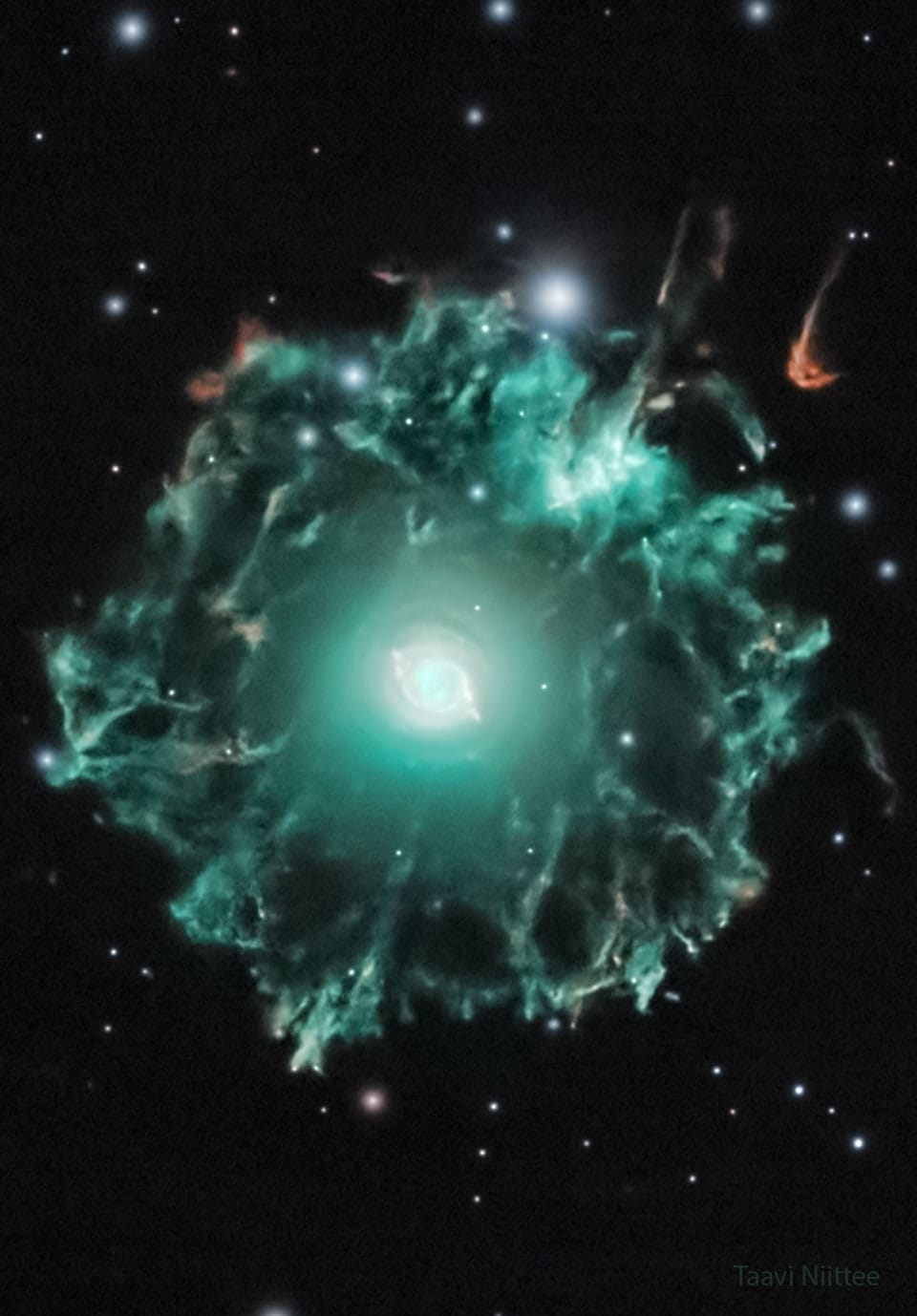
The Cat’s Eye Nebula is a planetary nebula located in the Draco constellation. At its center is a dying star. Seen here is the faint halo that stretches 3 light-years around the central nebula. The filaments of the halo are estimated to be 50,000 to 90,000 years old and were shed during earlier periods in the star’s evolution. Their shape is reminiscent of Rayleigh-Taylor instabilities, to my eye. (Image credit: T. Niittee; via APOD)
Tag: Richtmyer Meshkov instability

Mimicking Supernovas


The Hubble archives are full of incredible swirls of cosmic gas and dust, many of which were born in supernovas. Predicting the forms these massive explosions will generate is extremely difficult, thanks in large part to the complicated fluid dynamics generated by their blast waves. But new lab-scale experiments may help shed light on those underlying processes.
Researchers mimic supernovas in the lab by launching blast waves through an interface between a dense gas (shown in white) and a lighter one (which appears black). As the blast wave passes, it drives the dense fluid into the lighter one, triggering a series of instabilities. Notice how any initial perturbations in the interface quickly grow into mushroom-like spikes that rapidly become turbulent. This behavior is exactly what’s seen in supernovas (and in inertial confinement fusion)! (Video credit: Georgia Tech; research credit: B. Musci et al.; submitted by D. Ranjan)

Inside a Supernova
During a supernova, shock waves moving outward push denser material into less dense plasma and gas. This causes what is known as a Richtmyer–Meshkov instability, where the interface between the two fluids first becomes wavy and then develops finger-like intrusions. Those too break down, as seen in the simulation above, causing large-scale mixing between the different fluids.
Here on Earth this instability shows up in the process of inertial confinement fusion. In that case, the outer shell material is denser than the fuel core and the instability is triggered during the implosion process. As the fusion material is suddenly compressed, waviness and mixing occurs along the interface between the shell and the fuel. That’s undesirable because it reduces the efficiency of the fusion reaction. (Image credit: E. Evangelista et al.)

Supernova Core Collapse
A core-collapse, or Type II, supernova occurs in massive stars when they can no longer sustain fusion. For most of their lives, stars produce energy by fusing hydrogen into helium. Eventually, the hydrogen runs out and the core contracts until it reaches temperatures hot enough to cause the helium to fuse into carbon. This process repeats through to heavier elements, producing a pre-collapse star with onion-like layers of elements with the heaviest elements near the center. When the core consists mostly of nickel and iron, fusion will come to an end, and the core’s next collapse will trigger the supernova. When astronomers observed Supernova 1987A, the closest supernova in more than 300 years, models predicted that the onion-like layers of the supernova would persist after the explosion. But observations showed core materials reaching the surface much faster than predicted, suggesting that turbulent mixing might be carrying heavier elements outward. The images above show several time steps of a 2D simulation of this type of supernova. In the wake of the expanding shock wave, the core materials form fingers that race outward, mixing the fusion remnants. Hydrodynamically speaking, this is an example of the Richtmyer-Meshkov instability, in which a shock wave generates mixing between fluid layers of differing densities. (Image credit: K. Kifonidis et al.; see also B. Remington)

Shocked Interfaces
The Richtmyer-Meshkov instability occurs when two fluids of differing density are hit by a shock wave. The animation above shows a cylinder of denser gas (white) in still air (black) before being hit with a Mach 1.2 shock wave. The cylinder is quickly accelerated and flattened, with either end spinning up to form the counter-rotating vortices that dominate the instability. As the vortices spin, the fluids along the interface shear against one another, and new, secondary instabilities, like the wave-like Kelvin-Helmholtz instability, form along the edges. The two gases mix quickly. This instability is of especial interest for the application of inertial confinement fusion. During implosion, the shell material surrounding the fuel layer is shock-accelerated; since mixing of the shell and fuel is undesirable, researchers are interested in understanding how to control and prevent the instability. (Image credit: S. Shankar et al.)The APS Division of Fluid Dynamics conference begins this Sunday in Pittsburgh. I’ll be giving a talk about FYFD Sunday evening at 5:37pm in Rm 306/307. I hope to see some of you there!

Shocking Instabilities
The Richtmyer-Meshkov (RM) instability occurs when the interface between two fluids of different density is impulsively accelerated – usually by the passage of a shock wave. The image above shows a thin layer of gaseous sulfur hexafluoride embedded in air. Each vertical line, from left to right, shows the distortion of the two fluids at subsequent time steps after a Mach 1.2 shock wave passes through the gases. The interface’s initial waviness grows into mushroom-like shapes that mix the two gases together, ultimately leading to turbulence. Scenarios involving the RM instability include supersonic combustion ramjet engines, supernovas, and inertial confinement fusion. The RM instability is closely related to Rayleigh-Taylor instability and shares a similar morphology. (Photo credit: D. Ranjan et al.)

Liquid Mushrooms
The Rayleigh-Taylor instability can form at the interface between two liquids of different density under the influence of gravity, but a similar instability can occur in the absence of gravity. The image sequence above shows the Richtmyer-Meshkov instability, which occurs between two liquids of differing densities (regardless of their orientation) when impulsively accelerated. In this case, the experiment was conducted in a drop tower to simulate microgravity with the apparatus dropped on a spring to provide the impulse. As the instability grows, asymmetries appear. Nonlinear dynamics will amplify these distortions, eventually leading to turbulent breakdown. (Photo credit: C. Niederhaus/NASA Glenn, J. Jacobs/University of Arizona)
Water Balloon Physics
[original media no longer available]
This video explores some of the physics behind the much-loved bursting water balloon. The first sections show some “canonical” cases–dropping water balloons onto a flat rigid surface. In some cases the balloon will bounce and in others it breaks. The bursting water balloons develop strong capillary waves (like ripples) across the upper surface and have some shear-induced deformation of the water surface as the rubber peals away. Then the authors placed a water balloon underwater and vibrated it before bursting it with a pin. They note that the breakdown of the interface between the balloon water and surrounding water shows evidence of Rayleigh-Taylor and Richtmyer-Meshkov instabilities. The Rayleigh-Taylor instability is the mushroom-like formation observed when stratified fluids of differing densities mix, while the Richtmyer-Meshkov instability is associated with the impulsive acceleration of fluids of differing density.