This timelapse video captures the past 10 years’ worth of weather as seen by the GEOS-12 satellite during its service. It’s a mesmerizing look at the large-scale convective flow of Earth’s atmosphere. The prevailing winds for each region are clear from the motion of the clouds, but short-term effects are visible as well. June through November marks the Atlantic hurricane season, and you can see as storm after storm gets generated near western Africa and shoots westward toward North and Central America. You can also see the pattern tracks of these storms in these maps, which show 170 years’ worth of worldwide hurricane tracks. (Video credit: NOAA; via Scientific American)
Category: Research

Why Honeycomb is Hexagonal
The regular hexagonal structure of honeycomb may owe more to fluid dynamics than the careful engineering of the bees that build it. Observations indicate that honeycomb cells start out circular and become hexagonal as the bees continue building. Both experiments and models show that an array of circular cells can transform into hexagons due to surface tension driving flow at the junctions where the three cell walls meet. But for the wax to flow, it has to be warm–about 45 degrees Celsius compared to the hive’s ambient temperature of 25 degrees. The researchers suggest that the worker bees constructing the comb knead and heat the wax with their bodies until it’s able to flow and form the hexagons. (Photo credit: G. Mackintosh; via Nature and B. L. Karihaloo et al.)

Shocking Instabilities
The Richtmyer-Meshkov (RM) instability occurs when the interface between two fluids of different density is impulsively accelerated – usually by the passage of a shock wave. The image above shows a thin layer of gaseous sulfur hexafluoride embedded in air. Each vertical line, from left to right, shows the distortion of the two fluids at subsequent time steps after a Mach 1.2 shock wave passes through the gases. The interface’s initial waviness grows into mushroom-like shapes that mix the two gases together, ultimately leading to turbulence. Scenarios involving the RM instability include supersonic combustion ramjet engines, supernovas, and inertial confinement fusion. The RM instability is closely related to Rayleigh-Taylor instability and shares a similar morphology. (Photo credit: D. Ranjan et al.)

Evaporating Drops
When still drops evaporate from a surface, they do so in several phases, as illustrated in the video above. Initially, the drop forms a spherical cap. At this point the velocity within the droplet is so small that it is difficult to resolve, but particles within the drop move outward toward the contact line. As the drop evaporates, they form a circle of sediment – the familiar coffee ring. As the drop flattens, radial velocity increases, drawing more and more particles to the coffee ring. Eventually the drop pulls away from the ring, leaving surface tension and evaporation to compete in driving the internal flow. During this phase, some parts of the contact line try to re-establish the flow pattern that made the first ring; this leaves behind circular segments broken up by the increasing instabilities in the contact line. In the final stage, surface tension smooths some of the irregularities and drives an inward velocity that leaves behind radial sediment segments. (Video credit: G. Hernandez-Cruz et al.)
Vibrating Droplets
When still, water drops sitting on a surface are roughly hemispherical, drawn into that shape by surface tension. But on a vibrating surface, the same water drop displays many different shapes, like those in the video above. Researchers have observed more than 30 different mode shapes by varying the driving frequency. The metal mesh placed beneath the glass on which the drops sit helps the researchers determine the drop’s shape. As the drop deforms, the mesh appears to distort due to the refraction of light through the changing shape of the drop’s water-air interface. The distortion allows observers to visualize (and in some experiments even reconstruct) the shape of the drop’s surface. Understanding this kind of droplet behavior is valuable for many applications, including ink-jet printing and microfluidic devices. (Video credit: C. Chang et al.; via Science)

Elastic Walls and Viscous Fingers
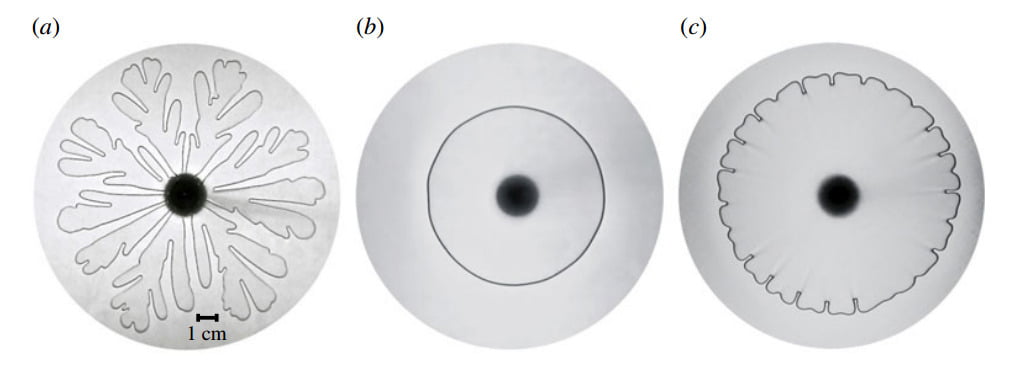
The Saffman-Taylor instability, characterized by the branchlike fingers formed when a less viscous fluid is injected into a more viscous one, is typically demonstrated between two rigid walls, as in part (a) of the figure above. But what happens if one of the rigid walls forming the Hele-Shaw cell is replaced with an elastic wall? This is the case for (b) and (c) in the figure. The flexibility of the wall causes the expansion of the air-fluid interface to slow down relative to the rigid wall case and causes the interface to move toward a narrowing fluid-filled gap (as opposed to a constant thickness one). Both of these effects reduce the viscous instability mechanism that drives the fingering instability. With a high enough mass flow rate as in ©, there is still some instability in the interface, but it is dramatically reduced. (Photo credit: D. Pihler-Puzovic et al.)
Rebounding Off Dry Ice
Droplet rebound is frequently associated with superhydrophobic surfaces but can also be generated by very large temperature differences. For very hot substrates, a thin layer of the drop vaporizes on contact via the Leidenfrost effect and helps a drop rebound by preventing it from wetting the surface. This video shows almost the opposite: a water droplet hitting solid carbon dioxide (-79 degrees C). Upon contact, the solid carbon dioxide sublimates, creating a thin layer of gas that separates the droplet from the surface. You can also see the vortex ring that accompanies the drop’s impact. Water vapor near the carbon dioxide surface has condensed into tiny airborne droplets that act as tracer particles that reveal the vortex’s formation and the rebounding droplet’s wake. (Video credit: C. Antonini et al.; Research paper)
Navigating the Interface
Walking on water may be the stuff of legend at human scales, but it’s a fact of everyday life for many smaller species. Waxy, hydrophobic coatings typically make such insects’ points of contact (feet, legs, etc.) water-repellent, and their light weight can be supported by surface tension. Navigating the interface between air and water is more complicated, though, and these creatures have evolved several mechanisms to help. Some, like water striders, use appendages they insert below the surface for propulsion. At 0:49 in the montage above, you can see flow visualization of the vortices generated by a stroke. Other insects release a chemical in their wake that lowers the local surface tension and drives them away via the Marangoni effect. For more, see here and especially this Physics Today article. (Video credit: D. Hu and J. Bush)
Contaminants Flowing Uphill
Here’s an example of some baffling fluid dynamics. Researchers have found that, when pouring a fluid from one container into a lower one containing a fluid with floating particulates, it’s possible for the floating particles to travel upstream against gravity and the flow. The phenomenon is driven by surface tension. The particulates floating in the lower container decrease the fluid’s surface tension relative to the pure fluid pouring in from above. This creates a gradient in surface tension that, via the Marangoni effect, drives a small flow upstream, in the direction of the greater surface tension. In the video above, this flow takes the form of two recirculating vortices in the pouring channel, oriented such that their upstream velocities run along the outside of the channel. Occasionally this flow draws particulates up the waterfall and into the recirculating zones, creating upstream contamination. We reported this previously, but the researchers have now released videos demonstrating the effect, including in pipettes and a water flume. Usually it’s taken for granted that matter cannot move upstream, so this could be a game-changer, especially at small scales where surface tension already dominates. For more, see their paper. (Video credit: S. Bianchini et al.)

Convection on the Sun

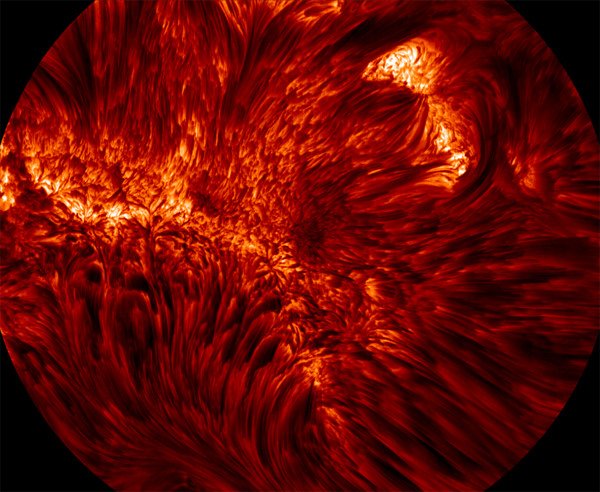
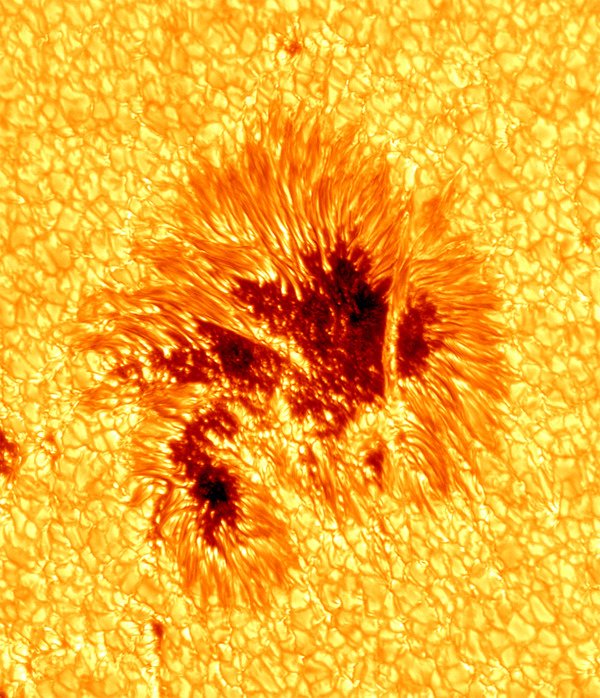
New photographs showing ultra-fine structure in the sun’s chromosphere and photosphere have been released. They offer a fascinating view into the magnetohydrodynamics of the sun, where the fluid behaviors of plasma are constantly modified by the sun’s magnetic field. The left image shows fine-scale magnetic loops rooted in the photosphere, while the right image shows our clearest photo yet of a sunspot. The dark central portion is the umbra, where magnetic field lines are almost vertical; it’s surrounded by the penumbra, where field lines are more inclined. Further out, we see the regular convective cell structure of the sun. (Photo credit: Big Bear Solar Observatory/NJIT; via io9 and cnet)