It’s that time of the year – the 2013 APS Division of Fluid Dynamics meeting is not far off, and entries to this year’s Gallery of Fluid Motion are starting to appear. This week we’ll be taking a look at some of the early video submissions, beginning with one that you can recreate at home. This video demonstrates a neat interaction between a slightly-inclined liquid jet and a lightweight ball. The jet can stably support–or, as the authors suggest, juggle–the ball under many circumstances, as seen in the video. Initially, the jet impacts near the bottom of the ball and then spreads into a thin film over the surface. This decrease in thickness between the jet and the film is accompanied by an increase in speed due to conservation of mass. That velocity increase in the film corresponds to a pressure decrease because of Bernoulli’s principle. This means that there is a region of higher pressure where the jet impacts the ball and lower pressure where the film flows around the ball. Just as with airflow over an airfoil, this generates a lift force that holds the ball aloft. (Video credit: E. Soto and R. Zenit)
Category: Research

Droplet Collisions
When droplets collide, there are three basic outcomes: they bounce off one another; they coalesce into one big drop; or they coalesce and then separate. Which outcome we observe depends on the relative importance of the droplets’ inertia compared to their surface tension. This is expressed through the dimensionless Weber number, made up of density, velocity, droplet diameter, and surface tension. For a low Weber number droplet, surface tension is still significant, so colliding droplets bounce off one another. At a moderate Weber number, the droplets coalesce. But when the fluid inertia is too high, as in the high Weber number example, the drops will coalesce but still have too much momentum and ultimately separate. (Video credit: G. Oldenziel)

Hydraulic Bumps
If you’ve ever noticed the circular jump in your kitchen sink when you turn on the faucet, you’re familiar with what a jet does when it plunges into a horizontal layer of liquid. If the liquid is deep enough, the jet will perturb the surface into a circular depression, as in Figure (a) above. As the flow rate increases, a recirculating vortex ring and hydraulic bump forms (Figure b photo and flow schematic). At a critical flow rate, the bump will become unstable and form polygons instead of circles. At even larger flow rates, the system will shift toward a hydraulic jump, with a larger change in fluid elevation. Like bumps, these jumps can also appear in a variety of shapes. (Image credit: M. Labousse and J. W. M. Bush)
Maze-Solving Droplets
The Leidenfrost effect occurs when liquids come in contact with a substrate much, much hotter than their boiling temperature. Rather than immediately boiling away, a thin layer of the liquid vaporizes and insulates the bulk of the liquid from the heat. This essentially turns droplets into tiny hovercrafts that skate over the surface. If you use a rough surface with rachets, the Leidenfrost drops will self-propel toward the steepest part of the rachet. The vapor underneath the drop is constantly trying to flow away, and the rachets in the surface prevent the vapor from escaping in the steeper direction. The vapor instead flows out the shallower side and–thanks to Newton’s third law–creates thrust that pushes the droplet the opposite direction. Here students from the University of Bath have used these effects to build a maze through which the droplets fly. (Video credit: C. Cheng et al.; via Flow Visualization FB page and several submissions)
For readers at Texas A&M University, I will be giving a talk Wednesday, October 2nd entitled “The Beauty of the Flow” as part of the Applied Mathematics Undergraduate Seminar series at 17:45 in BLOC 164.
Ig Nobel Fluids: Running on Water
While insects are small enough to use surface tension to stay atop water, larger species like the basilisk lizard run on water by slapping their feet against the surface hard enough to generate the force to stay above the surface. A. Minetti and colleagues won this year’s Ig Nobel Prize in Physics for demonstrating that humans, too, can achieve this feat – when outfitted with stiff, large area fins and exposed to gravity less than 22% of Earth’s. The researchers adapted a model for the running lizard to human scales and then tested the model using subjects suspended by harness and running in place atop a wading pool while subjected to various lighter-than-earth simulated gravities. Both the model and experiment agreed that human muscles were unable to produce sufficient force to stay above the water at higher than 0.22g. Interestingly, the authors also observed that the water-running gait for both lizards and humans has more in common with the pedaling motion of cycling than a human’s bouncing gait for terrestrial running. (Video credit: A. Minetti et al.)

Selective Suction
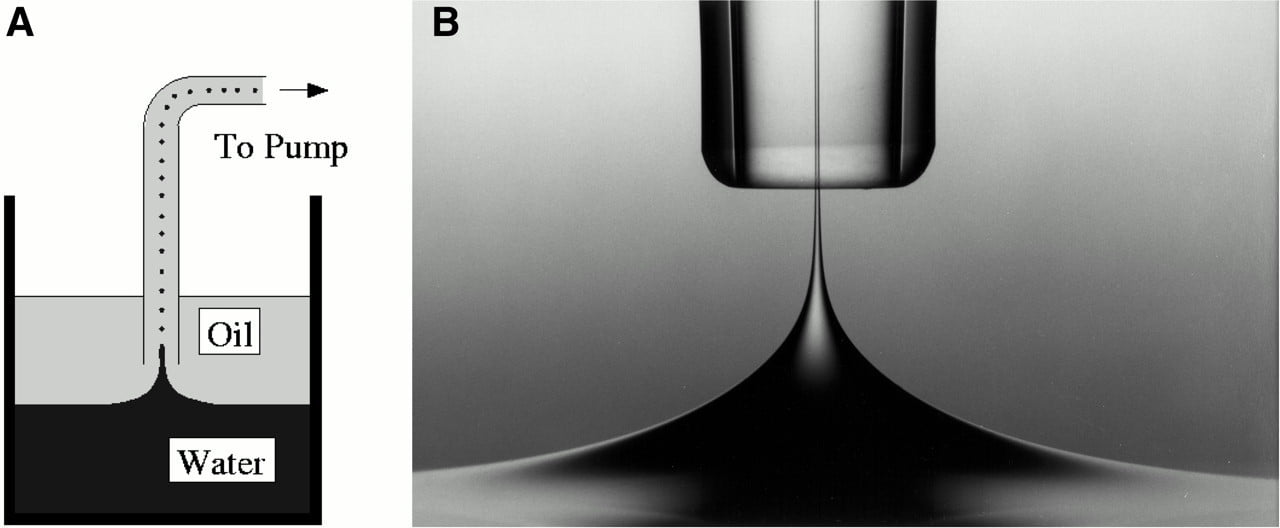
A thin spout of water is drawn up through a layer of oil in the photo on the right. This simple version of the selective withdrawal experiment is illustrated in Figure A, in which a layer of viscous oil floats above a layer of water. A tube introduced in the oil sucks fluid upward. At low flow rates, only the oil will be drawn into the tube, but as the flow rate increases (or the tube’s height above the water decreases), a tiny thread of water will be pulled upward as well. The viscous outer fluid helps suppress instabilities that might break up the inner fluid, and their relative viscosities determine the thickness of the initial spout. In this example, the oil is 195 times more viscous than the water. (Photo credit: I. Cohen et al.)

Rebounding Jets

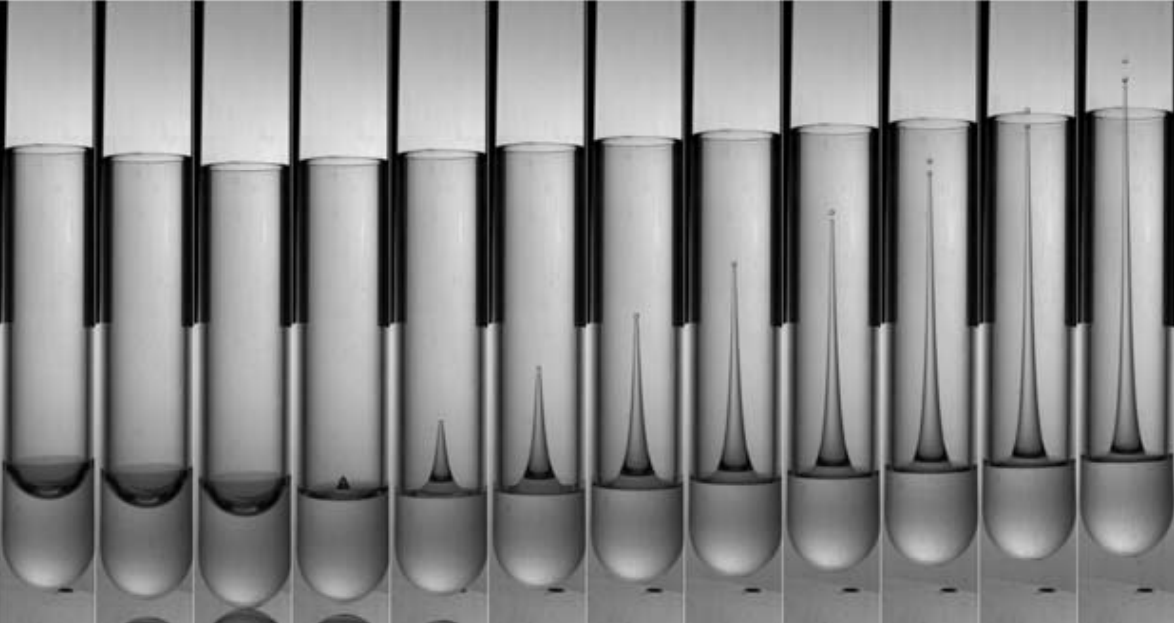
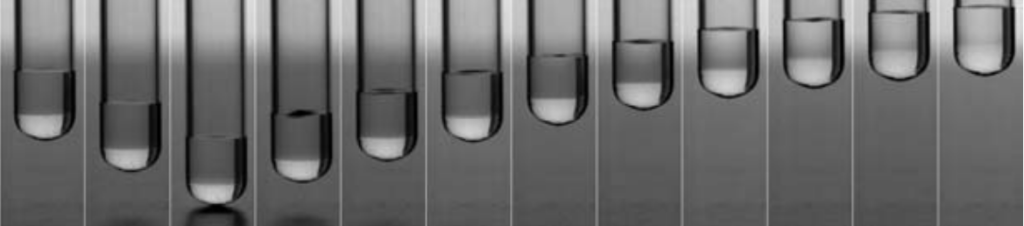
The photo sequence in the upper image shows, left to right, a fluid-filled tube falling under gravity, impacting a rigid surface, and rebounding upward. During free-fall, the fluid wets the sides of the tube, creating a hemispherical meniscus. After impact, the surface curvature reverses dramatically to form an intense jet. If, on the other hand, the tube is treated so that it is hydrophobic, the contact angle between the liquid and the tube will be 90 degrees during free-fall, impact, and rebound, as shown in the lower image sequence. The liquid simply falls and rebounds alongside the tube, without any deformation of the air-liquid interface. (Photo credit: A. Antkowiak et al.)
Stingray Wakes
This numerical simulation shows a swimming stingray and the vorticity generated by its motion. Stingrays are undulatory swimmers, meaning that the wavelength of their motion is much shorter than their body length. Manta rays, in contrast, move their fins through a wavelength longer than their body length, making them oscillatory swimmers. Observe the difference in this video. To swim faster, stingrays increase the frequency of their undulation, not the amplitude. This is quite common among swimmers because increasing the amplitude also increases projected frontal area, which causes additional drag. Increasing the frequency of motion does not affect the projected area, making it the more efficient locomotive choice. (Video credit: G. Weymouth; additional research credit: E. Blevins; submitted by L. Buss)
Also, FYFD now has a Google+ page for those who prefer to follow along and share that way. – Nicole

The Real Raindrop
What is the shape of a falling raindrop? Surface tension keeps only the smallest drops spherical as they fall; larger drops will tend to flatten. The very largest drops stretch and inflate with air as they fall, as shown in the image above. This shape is known as a bag and consists of a thin shell of water with a thicker rim at the bottom. As the bag grows, its shell thins until it ruptures, just like a soap bubble. The rim left behind destabilizes due to the surface-tension-driven Plateau-Rayleigh instability and eventually breaks up into smaller droplets. This bag instability limits the size of raindrops and breaks large drops into a multitude of smaller ones. The initial size of the drop in the image was 12 mm, falling with a velocity of 7.5 m/s. The interval between each image is 1 ms. (Photo credit: E. Reyssat et al.)
10 Years of Weather
This timelapse video captures the past 10 years’ worth of weather as seen by the GEOS-12 satellite during its service. It’s a mesmerizing look at the large-scale convective flow of Earth’s atmosphere. The prevailing winds for each region are clear from the motion of the clouds, but short-term effects are visible as well. June through November marks the Atlantic hurricane season, and you can see as storm after storm gets generated near western Africa and shoots westward toward North and Central America. You can also see the pattern tracks of these storms in these maps, which show 170 years’ worth of worldwide hurricane tracks. (Video credit: NOAA; via Scientific American)