Oobleck, a non-Newtonian fluid made up of water and cornstarch, is a perennial Internet favorite for its ability to dance and the fact that one can run across a pool of it. It’s typically described as a shear-thickening fluid and only exhibits solid-like behavior under impact. Strictly speaking, oobleck is a suspension of solid grains of cornstarch in water. When struck, the initially compressible grains jam together, creating a region more like a solid than a liquid. From this point of impact, a solidification front expands through the suspension, jamming more grains together and enabling the fluid to absorb large amounts of momentum. The process is known as dynamic solidification. (Video credit: University of Chicago; research credit: S. Waitukaitis & H. Jaeger)
Category: Research

How Erosion Shapes a Flow
Erosion creates all manner of strange shapes as wind and water cut away at solids. But why does the interaction of the fluid and solid result in the geometries we observe? Above is a collage from an experiment in which a soft clay sphere was immersed in a water tunnel. After 70 minutes, the sphere had worn into a roughly conical body (Image A) reminiscent of a re-entry capsule. Images B and C show instantaneous streaklines around the clay at 10 minutes and 70 minutes, respectively. Images D and E show diagrams of the flowfield seen in B and C. Fast-moving flow above and below the stagnation point (SP) wears the front of the body into a conical shape, whereas the recirculating vortices aft of the separation point (SL) create a sloped shoulder and flattened back in the clay. The results are consistent with a model in which erosion tries to create uniform shear stress at the solid surface – essentially the process is keeping the frictional force between the fluid and air constant along the surface. This makes sense. If a region’s shear stress is higher, it will be worn more quickly than the surrounding solid, causing it to recede and experience decreased shear stress (relative to the surrounding area) as a result. (Image credit: L. Ristroph et al.)

How Fast Do Holes Grow?
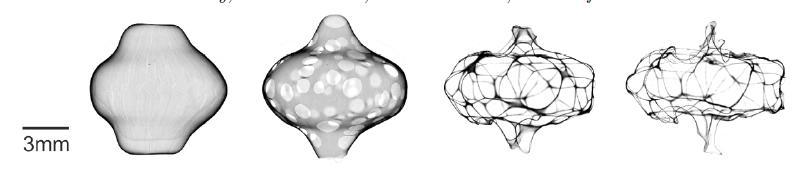
Taylor and Culick predicted a constant velocity for the rim of an opening hole in a soap film of uniform thickness. Unfortunately, it is difficult to experimentally produce a soap film of uniform thickness. It is much easier to create films of uniform thickness with liquid crystals in their smectic-A phase, in which the molecules are ordered in layers along a single direction. When smectic-A bubbles burst, however, it bears little resemblance to a soap bubble. Smectic-A bubbles burst spontaneously during oscillations, the holes in the film growing until a network of filaments is left behind. The filaments themselves will rapidly break up into droplets due to the Plateau-Rayleigh instability. (Photo credit: R. Stannarius et al.)

The Vortex Under a Falling Drop
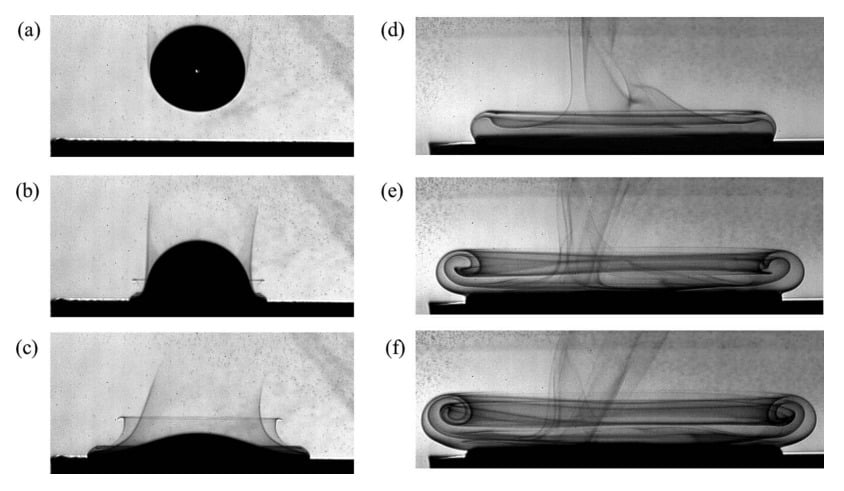
We take for granted that drops which impact a solid surface will splash, but, in fact, drops only splash when the surrounding air pressure is high enough. When the air pressure is low enough, drops simply impact and spread, regardless of the fluid, drop height, or surface roughness. Why this is and what role the surrounding air plays remains unclear. Here researchers visualize the air flow around a droplet impact. In (a) we see the approaching drop and the air it pulls with it. Upon impact in (b) and © the drop spreads and flattens while a crown of air rises in its wake. The drop’s spread initiates a vortex ring that is pinned to the drop’s edge. In later times (d)-(f) the vortex ring detaches from the drop and rolls up. (Photo credit: I. Bischofberger et al.)

Fluid Sculptures From Bursting Bubbles
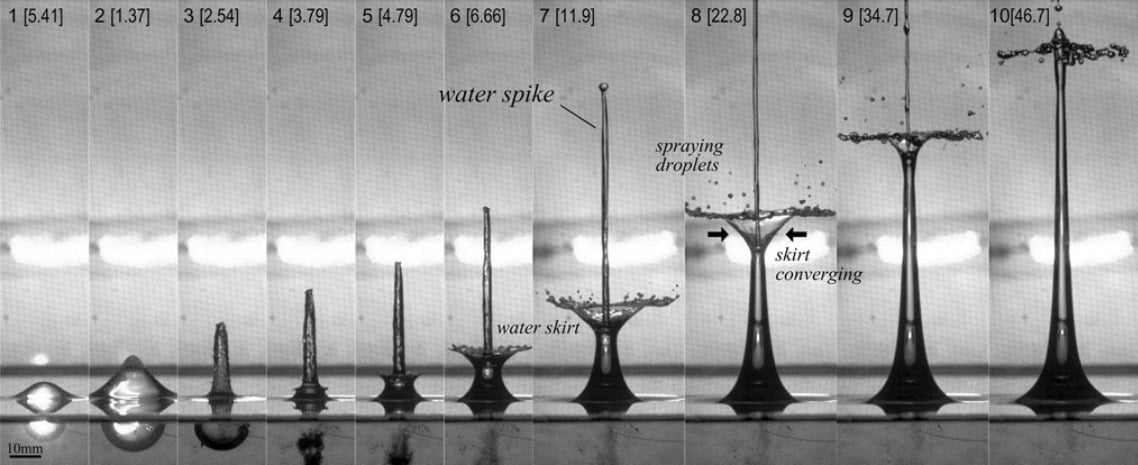
A bubble initiated near a free surface–like the air-water interface here–can generate some spectacular dynamics. Beginning at the far left, the expanding subsurface bubble causes a dome at the surface that sharpens into a spike. By Frame 3, the bubble is collapsing but overshoots and rebounds, which introduces the tiny instability in Frame 4 that grows in subsequent time steps to form the water skirt that surrounds the spike. Although generated entirely differently, the end result is reminiscent of the water sculptures made by artists like Marcus Reugels, Corrie White, Jack Long, and others. (Image credit: A. M. Zhang et al.)

Explosive Boiling
A superheated liquid can reach temperatures higher than its boiling point without actually boiling – similar to how liquids can be supercooled below their freezing point without solidifying. The photo sequence above shows how explosive the boiling of a superheated water droplet submersed in sunflower oil can be. Image (a) in the lower left shows the superheated droplet resting on the bottom of its container. Then droplet vaporizes explosively in (b), expanding dramatically. The bubble overexpands and and begins to oscillate around its equilibrium radius. This triggers a Rayleigh-Taylor instability in the bubble’s interface, creating the large lobes in © and enlarged in the upper image. Finally, the bubble fragments in (d). See the original paper for more on superheated droplet boiling. (Image credit: M. A. J. van Limbeek et al.; via @AIP_Publishing)

The Cheerios Effect and Tiny Swimmers
Anyone who has eaten a bowl of Cheerios is familiar with the way solid objects floating on a liquid surface will congregate. This is a form of capillary force driven by the wetting of the particles, surface tension, and buoyancy. Using ferromagnetic particles and a vertical magnetic field, one can balance capillary action and lock the particles into a fixed configuration relative to one another. By adding a second, oscillating magnetic field, it’s possible to make the beads dance and swim together. Like all of this week’s videos, this video is an entry in the 2013 Gallery of Fluid Motion. (Video credit: M. Hubert et al.)
Overflowing Foam
Hitting a glass bottle full of a non-carbonated drink can shatter the bottle due to cavitation, but doing the same with a carbonated beverage can make the bottle overflow with foam. The video above breaks down the physics of this bar prank. It all begins with nucleation and the tiny bubbles of carbon dioxide that form in the liquid. Striking the top of the bottle generates a compression wave that travels through the liquid, shrinking bubbles as it passes. When it hits the bottom of the bottle, it gets reflected as an expansion wave that expands the bubbles. This reflection happens several times between the free surface of the liquid and the bottom of the bottle. The rapid collapse-and-expansion of the bubbles makes them implode into a cloud of tinier bubbles that expands until the local supply of carbon dioxide is used up. At this point, the buoyancy of the bubbles carries them upward in plumes, creating more bubbles with the dissolved carbon dioxide nearby. And, all of a sudden, you’ve got foam everywhere. Like all of this week’s videos, this video is an entry in the 2013 Gallery of Fluid Motion. (Video credit: J. Rodriguez-Rodriguez et al.)
Self-Propelled Droplets
Leidenfrost drops hover and move above hot surfaces on a thin layer of their own vapor. Over a flat surface, this vapor flows radially out from under the droplet, but creating rachets in the surface forces the vapor to flow in a single direction. The vapor then acts like exhaust, generating propulsion in the droplet and making it roll. How quickly the drop moves depends both on the droplet’s size and the rachets’ aspect ratio. For a given length, deeper rachets propel a drop faster than their shallower counterparts. The droplet’s size also affects the thrust with different scalings depending on the drop’s initial size. Like all of this week’s videos, this video is an entry in the 2013 Gallery of Fluid Motion. (Video credit: A. G. Marin et al.)
Shaping and Levitating Droplets
Opposing ultrasonic speakers can be used to trap and levitate droplets against gravity using acoustic pressure. Changes to field strength can do things like bring separate objects together or flatten droplets. The squished shape of the droplet is the result of a balance between acoustic pressure trying to flatten the drop and surface tension, which tries to pull the drop into a sphere. If the acoustic field strength changes with a frequency that is a harmonic of the drop’s resonant frequency, the drop will oscillate in a star-like shape dependent on the harmonic. The video above demonstrates this for many harmonic frequencies. It also shows how alterations to the drop’s surface tension (by adding water at 2:19) can trigger the instability. Finally, if the field strength is increased even further, the drop’s behavior becomes chaotic as the acoustic pressure overwhelms surface tension’s ability to hold the drop together. Like all of this week’s videos, this video is a submission to the 2103 Gallery of Fluid Motion. (Video credit: W. Ran and S. Fredericks)