As powerful as explosions can be above ground, they are even more dangerous underwater. Since water, unlike air, is incompressible, the pressure wave at the front of an underwater explosion is not damped to the extent it would be in air. A high-pressure, high-temperature bubble of gas also forms in the explosion, and, as with cavitation, if the bubble collapses near metal, the damage can be extensive. (via Gizmodo)
Category: Phenomena

Droplet Impact on Superhydrophobic Surfaces
High-speed video of water droplets impacting on superhydrophobic surfaces demonstrates the impressive elasticity and surface tension of the droplets. Impacts vibrate and reflect through the droplet, but only a drop from the largest height actually causes breakup.
Hawaiian Fissures
[original media no longer available]
New fissures opened on Mount Kilauea in Hawaii earlier this month, resulting in some fountain-like eruptions of lava. This molten rock is a non-Newtonian fluid with shear-thinning and thixotropic properties. This is what allows the lava to flow long distances before it cools and solidifies. (via jpshoer)

Propeller Cavitation
Gas bubbles can form in a flowing liquid in areas where the pressure drops below its vapor pressure. This process, called cavitation, is a major problem for engineers because the collapse of the bubbles upon entering a high pressure area can damage metal surfaces. Shown here is cavitation on a fully submerged boat propeller.
Aerodynamics with Bill Nye and Samuel L. Jackson
Bill Nye, Samuel Jackson, golf balls, Reynolds number, dimples, and boundary layers. It doesn’t get much better than this. – Khristopher O (submitter)
It definitely beats Jackson’s other foray into aerodynamics! The dimples on a golf ball cause turbulent boundary layers, which actually decrease drag on the ball and make it fly farther. Why bluff bodies experience a reduction in drag as speed (and thus Reynolds number) increases was a matter of great confusion for fluid mechanicians early in the twentieth century, but it’s not too hard to see why it happens with some flow visualization.


On the top sphere, the laminar boundary layer separates from the sphere just past its shoulder. This results in a pressure loss on the backside of the sphere and, thus, an increase in drag. On the bottom sphere, a trip-wire placed just before the shoulder causes a turbulent boundary layer, which separates from the sphere farther along the backside. This late separation results in a thinner wake and a smaller pressure loss behind the sphere, thereby reducing the overall drag when compared to the laminar case. (Photo credit: An Album of Fluid Motion)
Tsunami Simulation
This simulation shows how tsunami waves are expected to spread from the epicenter of the Japanese magnitude-8.9 earthquake. Note the complicated interference and reflection patterns. The main wavefront moved at a speed of about 230 m/s (830 km/h) between Japan and Hawaii.
Earthquake-induced Whirlpool
In the wake of the 8.9-magnitude earthquake that hit Japan today, a massive whirlpool has appeared off the coast. It does not appear to have a downdraft, so it’s not a true vortex; it looks as though the residual energy released from the quake has caused circulation in this region.
Solar Prominence
[original media no longer available]
In this stunning video of a solar flare and prominence captured by NASA’s SDO mission, plasma erupts from the surface of the sun preceded by a massive shockwave (near center of frame, heading downward). The motion of the plasma is dictated not only by classical fluid mechanics but by the influence of the sun’s magnetic field in what is known as magnetohydrodynamics. (submitted by Caleb)

Discovery Wingtip Vortices
Wingtip vortices mark the path of Discovery as she makes her final landing. Though not always visible, these vortices are generated by any lifting body planform and can be a major source of induced drag on the craft. Here the vortices are visible because the low pressure in the core of the vortex caused a local temperature drop below the dew point, thus causing condensation. Such vortices persist for significant lengths of time in the wake of aircraft; they are a major source of wake turbulence, which limits how frequently aircraft can take-off or land on a single runway. (Photo by Jen Scheer)

Hungarian Fire Tornado
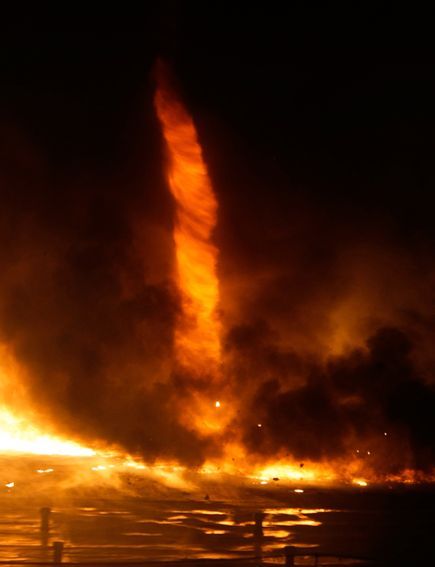
This fire tornado formed over a burning plastic-processing plant in Hungary a week ago. Fire tornadoes aren’t rare, but footage of them is because they typically occur amidst wild conflagrations. Take a look at our explanation of how they form. #