Smoke visualization in a wind tunnel reveals the airflow over a flying locust. Researchers are unraveling the aerodynamics of insect flight in order to produce better Micro Air Vehicles (MAVs) and miniature flying robots. #
Category: Phenomena

Singing Dunes
Some sand dunes can “sing”, but not because of the wind! When loose sand slides down over harder, packed sand, a standing wave is formed, causing the entire surface of the dune to vibrate on a single frequency. We hear this as a musical note – typically an E, F, or G. (via io9)
(Image credit: C. Larson)
Happy Anniversary
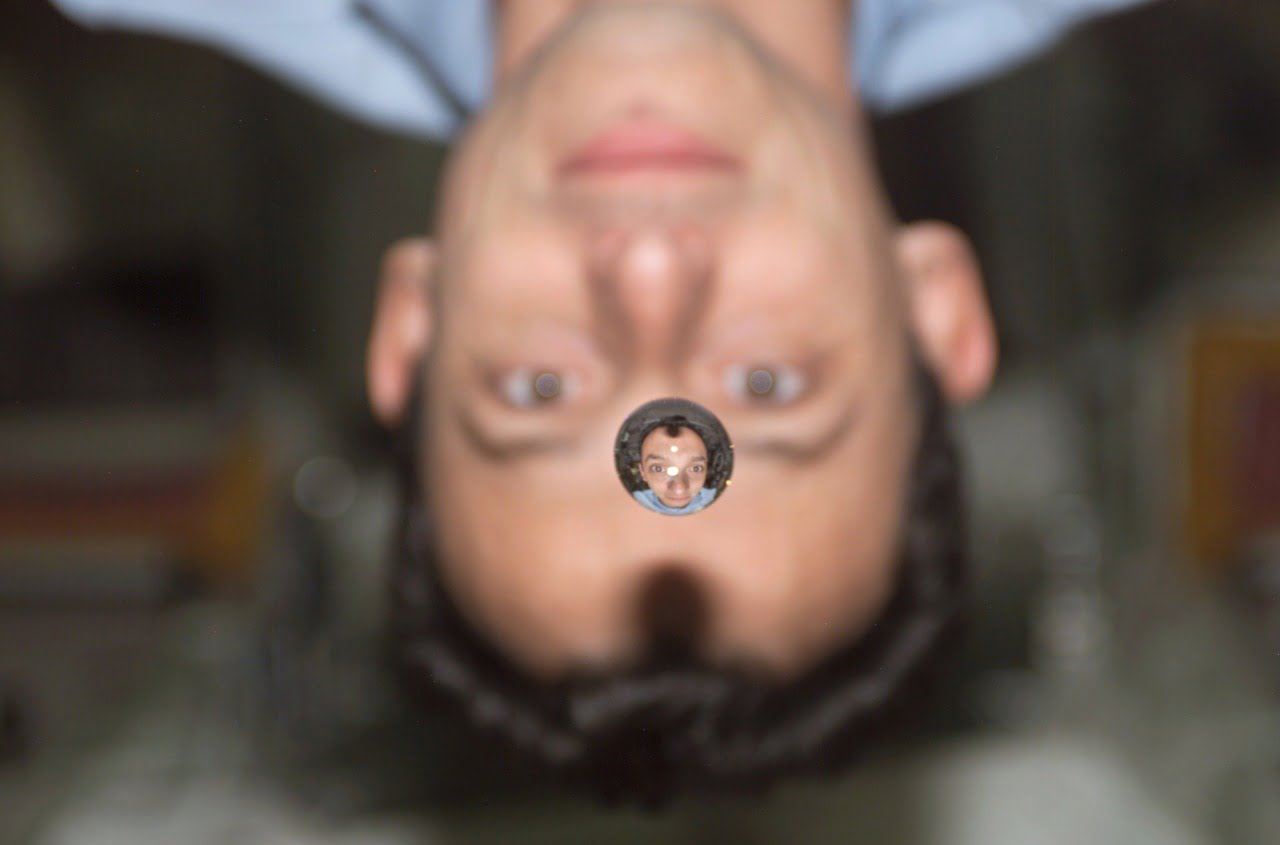
ESA astronaut Pedro Duque shown refracted through a water droplet in microgravity. Today marks the 50th anniversary of human space flight. #

Mythbusters Walking on “Water”
The Mythbusters walk on “water” using non-Newtonian fluids. I think everyone wants to do this at least once in their life.
Leapfrogging Vortices
This numerical simulation shows two pairs of vortices interacting in a leap-frogging motion. Another version shows the same situation but with a small perturbation in the rotational alignment that causes even more interesting interactions. Both simulations are of potential flow–an idealized flow without viscosity where velocity can be described as the gradient of a scalar function. The mathematics governing potential flow are notably easier than the full Navier-Stokes equations that govern fluid mechanics. (submitted by jessecaps)

Rocket Exhaust
This image of the Apollo 11 launch shows the Saturn V’s underexpanded nozzle (identifiable by the excessive width of the exhaust jet) shortly after liftoff. The faint diamond shape of the exhaust is a series of shock waves and expansion fans that equalize the exhaust pressure to the ambient. In general, a rocket nozzle is most efficient when it expands the exhaust to ambient pressure, but, since ambient pressure changes with altitude, designers have to choose a particular altitude for peak efficiency or design a nozzle capable of changing its shape with altitude.
Reynolds on Transition
For although only the disciplined motion is recognized in military tactics, troops have another manner of motion when anything disturbs their order. And this is precisely how it is with water: it will move in a perfectly direct disciplined manner under some circumstances, while under others it becomes a mass of eddies and cross streams, which may be well likened to the motion of a whirling, struggling mob where each individual particle is obstructing the others. The larger the army, and the more rapid the evolutions, the greater the chance of disorder; so with fluid, the larger the channel, and the greater the velocity, the more chance of eddies.
Volcanic Shock Waves
This footage of last year’s eruption of Eyjafjallajökull in Iceland shows shockwaves emanating from the mouth of the volcano as hot ash and gases explode from underground.

Solar Fluid Dynamics
The sun is a wild place fluid dynamically. The surface is riddled with convection cells the size of the Earth, and prominences of plasma (ionized gas) erupt from the surface following the sun’s magnetic field lines. Violent, but beautiful. #
Underwater Explosions
As powerful as explosions can be above ground, they are even more dangerous underwater. Since water, unlike air, is incompressible, the pressure wave at the front of an underwater explosion is not damped to the extent it would be in air. A high-pressure, high-temperature bubble of gas also forms in the explosion, and, as with cavitation, if the bubble collapses near metal, the damage can be extensive. (via Gizmodo)