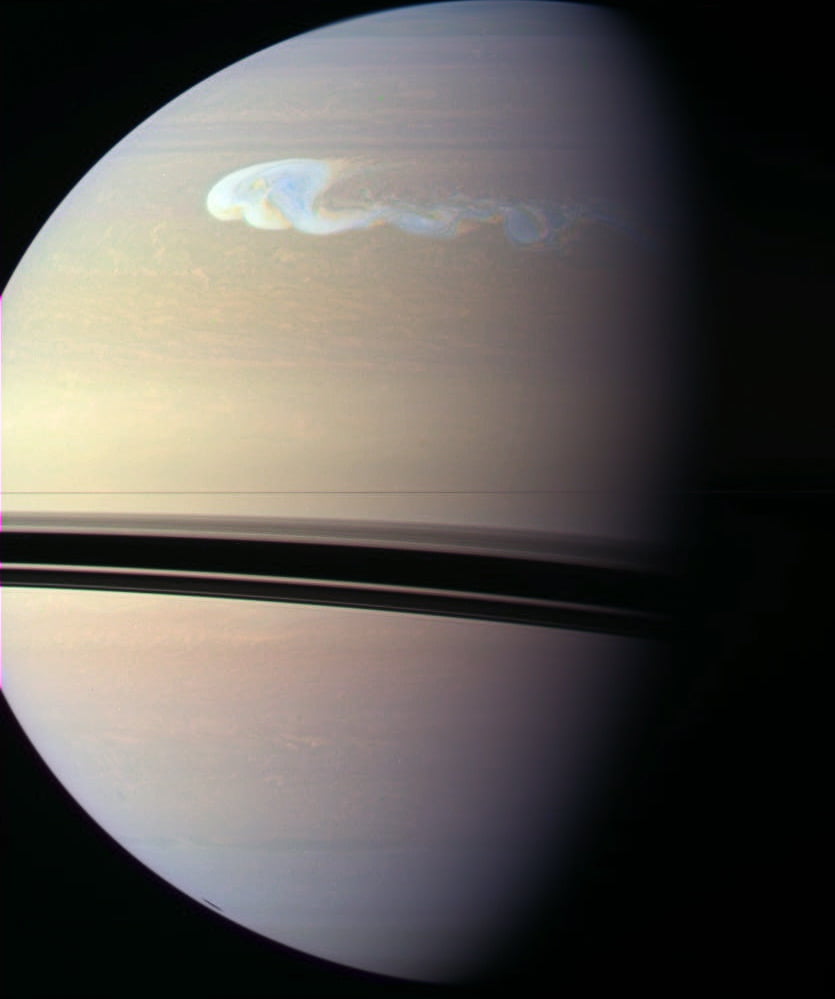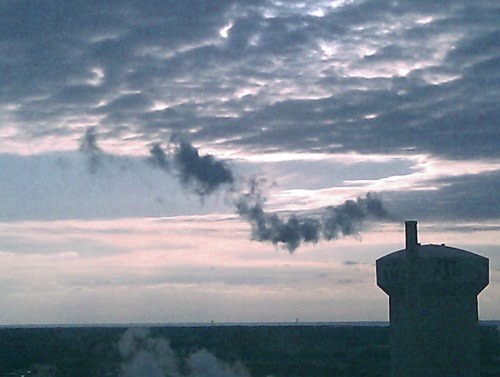
This photo shows a flow visualization of a turbulent boundary layer at Mach 2.8. The direction of flow is from right to left. In nature, the boundary layer between a surface and a fluid is usually turbulent but impossible to see. The visualization represents an instantaneous snapshot of the flow. Turbulence is known for its intermittency–its strong variation in time–a characteristic that is clear just from comparing the two snapsnots. #
Category: Phenomena

Kelvin-Helmholtz Instability
The Kelvin-Helmholtz instability occurs when velocity shear is present in a single fluid or when two different fluids have a velocity difference across their interface. As shown in this numerical simulation, the instability produces a fractal-like pattern of eddies turning over on themselves. The Kelvin-Helmholtz instability is commonly found in nature between cloud layers. #
ETA: It looks like animated GIFs may not work with Tumblr. Be sure to click on the picture to see the animation on Wikipedia.

Physics Tattoos
This is a man with great commitment to fluid dynamics. He writes:
This, on my leg, is the incompressible form of the conservation of mass equation in a fluid, also known as the continuity equation. When people ask what it means, I say it defines flow. Sometimes I say it means you should have studied more physics, but that is only when I am feeling like being funny. What it means in more detail is that, for an incompressible fluid, the partial derivative of the velocity of the fluid in the three spatial dimensions must sum to zero. It therefore concisely states the fundamental nature of a fluid. #
(via physicsphysics)

The Leidenfrost Effect
The Leidenfrost effect occurs when a liquid comes in contact with a mass significantly hotter than the liquid’s boiling point. Upon contact, a thin layer of the liquid will be vaporized, forming a lubricating gas layer that temporarily insulates the hot mass from the cold liquid. This effect is responsible for water skittering across a hot plate as well as protecting the hands of many a professor from a dunk in liquid nitrogen at the front of a classroom.
reblogged from fyeahchemistry:
(Thanks for the submission, singbird-sing!)

Flutter and the Tacoma Narrows Bridge
Sixty years ago yesterday the original Tacoma Narrows Bridge (a.k.a. Galloping Gertie) collapsed as a result of aeroelastic flutter during 42 mph winds. Flutter is a phenomenon in which the fluid dynamics and structural dynamics of a system are closely coupled, in this case resulting in a dramatic failure. The high sustained winds provided an energy source for self-excitation of one of the bridge’s torsional modes; as the bridge contorted, the motion caused additional vortices to be shed from the bridge deck, causing further vibrational forces on the bridge. For an analysis of the bridge’s collapse and its common misrepresentations, see Billah and Scanlan. The bridge’s spectacular collapse prompted reconsideration and redesign of the decks of modern suspension bridges.

Protecting an Egg with Oobleck
Using non-Newtonian fluids as “liquid armor” is an active area of research and development. Here students demonstrate the efficacy of shear-thickening as a defense against sudden impact by dropping a bag of oobleck containing a raw egg from different heights.

The No-Slip Condition
Viscosity plays an important role near surfaces in fluid mechanics. Friction between the fluid and the solid surface creates a “no slip” condition at the wall. In the video, dye injected near the wall remains there because there is little or no velocity of the fluid near the wall. As the dye filament is pulled away, the speed of the bulk flow–the freestream–is apparent. A strong velocity gradient exists between the wall and the freestream; this narrow region of changing velocity is called a boundary layer and is a major topic of research due to its importance in determining drag and thermal loads on vehicles.

Flow Visualization
This video, created by undergraduates as part of a fluid dynamics laboratory course, shows flow visualization of a von Karman vortex street in the wake of a cylinder in comparison to a computational fluid dynamics (CFD) simulation of the same phenomenon. If you’re wondering about the black-and-white segments and the peculiar speech patterns, look no further. The students are parodying a series of videos made by MIT in the 1960s that are still used in classrooms today.

Tip Vortices
Like airplane wings, helicopter blades have tip vortices. In this photo, the air’s humidity was great enough that the acceleration caused by the passing of the blades caused a pressure drop great enough to condense the moisture, making the tip vortices visible to the naked eye. (See also Prandlt-Glauert singularity.)
Photo credit: Gizmodo.
Effects of Viscosity
[original media no longer available]
Today’s video demonstrates the effect of viscosity, which measures a fluid’s resistance to deformation. On the left is a column of highly viscous fluid; the fluids become less viscous as one moves right. When a jet of dye is released into the highly viscous fluid, the jet is very slow to penetrate, whereas, in the rightmost column, the dye expands quickly into a turbulent jet. Between these extremes, we see a laminar dye jet entering the liquid. The mushroom-like shape the laminar jet takes is the result of the Rayleigh-Taylor instability, which occurs when a denser fluid is on top of a lighter fluid in a gravitational field.