Video footage of Iceland’s Grimsvotn volcano erupting shows a massive turbulent plume of ash. The largest scales of the plume are of the order of hundreds, if not thousands of meters, and the eddies of the plume appear to move very slowly, especially far from the base. According to Kolmogorov, however, at the smallest scales of the flow (< 1 mm), the turbulent motions are isotropic. No one has been able to achieve Reynolds numbers high enough to fully prove or disprove Kolmogorov’s hypothesis, but natural events like volcanic eruptions produce some of the largest Reynolds numbers on earth. (See also: interview with videographer; via Gizmodo, jshoer)
Category: Phenomena

Ferrofluid Self-Organization
The behavior of a ferrofluid subject to magnetic fields can be fascinating. Here a ferrofluid is subjected to a permanent magnet and thinner is added to the ferrofluid. As it spreads outward, the thinner carries ferrofluid with it. The thinner evaporates, increasing the concentration of ferrofluid in the outer ring and eventually forming peaks of ferrofluid that move inward toward the main body due to the attraction of the magnet. Near the main body, the peaks are repelled by the ferrofluid because they have the same magnetic orientation.

Airplane Vortex Wake
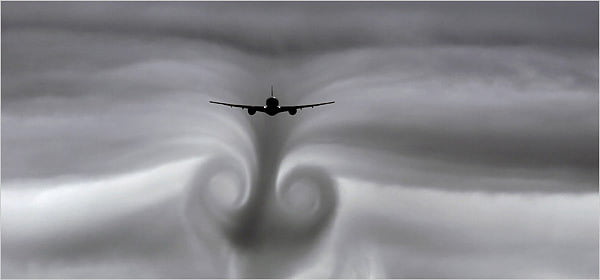
The wingtip vortices in the wake of a commercial airliner distort the clouds as the plane descends. Wingtip vortices form as a result of high pressure air from the underside of the wing accelerating around the wingtips to reach the low pressure on top of the wing. They can be hazardous to other (lighter) aircraft. They also contribute to downwash that decreases the effective lift of a wing. Geese use the same mechanism to their advantage when flying in a V-formation, and some snakes use it to glide.

Island Vortex Street
The von Karman vortex street is a series of vortices shed periodically in the wake of a bluff body. Although they are commonly observed in the lab behind cylinders, they also occur in nature, as seen here in the wake of Juan Fernandez Islands near Chile. The strong equatorward wind creates steady flow over the mountainous island, creating a pattern in the clouds that stretches 10,000 times longer than vortex streets created in a laboratory. (via freshphotons)

Combustion
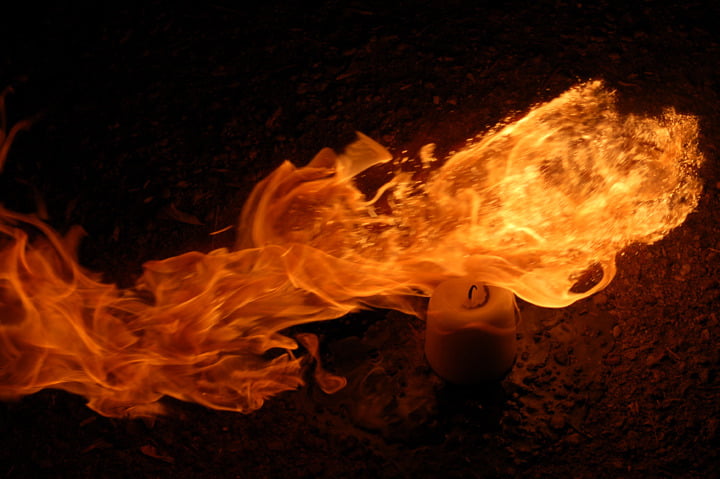
Fluid dynamics are vital to combustion. Like here, many practical flames–such as those responsible for internal combustion in automobiles, jet engines, and rockets–are turbulent. The turbulence aids mixing of the fuel and oxidizer, resulting in more complete combustion and greater efficiency. #
Giant Water Balloon Physics
Playing with a giant water balloon and high-speed cameras is like a giant experiment in surface tension, right up until the tensile strength of the balloon comes into play. The rippling in the balloon is reminiscent of the motion of droplet breakup or impact on superhydrophobic surfaces. (submitted by Daniel B)
DIY Non-Newtonian Fluids
[original media no longer available]
We’ve featured the non-Newtonian fluid oobleck here before, but it bears repeating as a fun and easy exercise for anyone to do at home or at school, especially with kids. For extra fun, try vibrating it, using it as liquid armor, or filling a pool and walking on it.

Meandering Mississippi
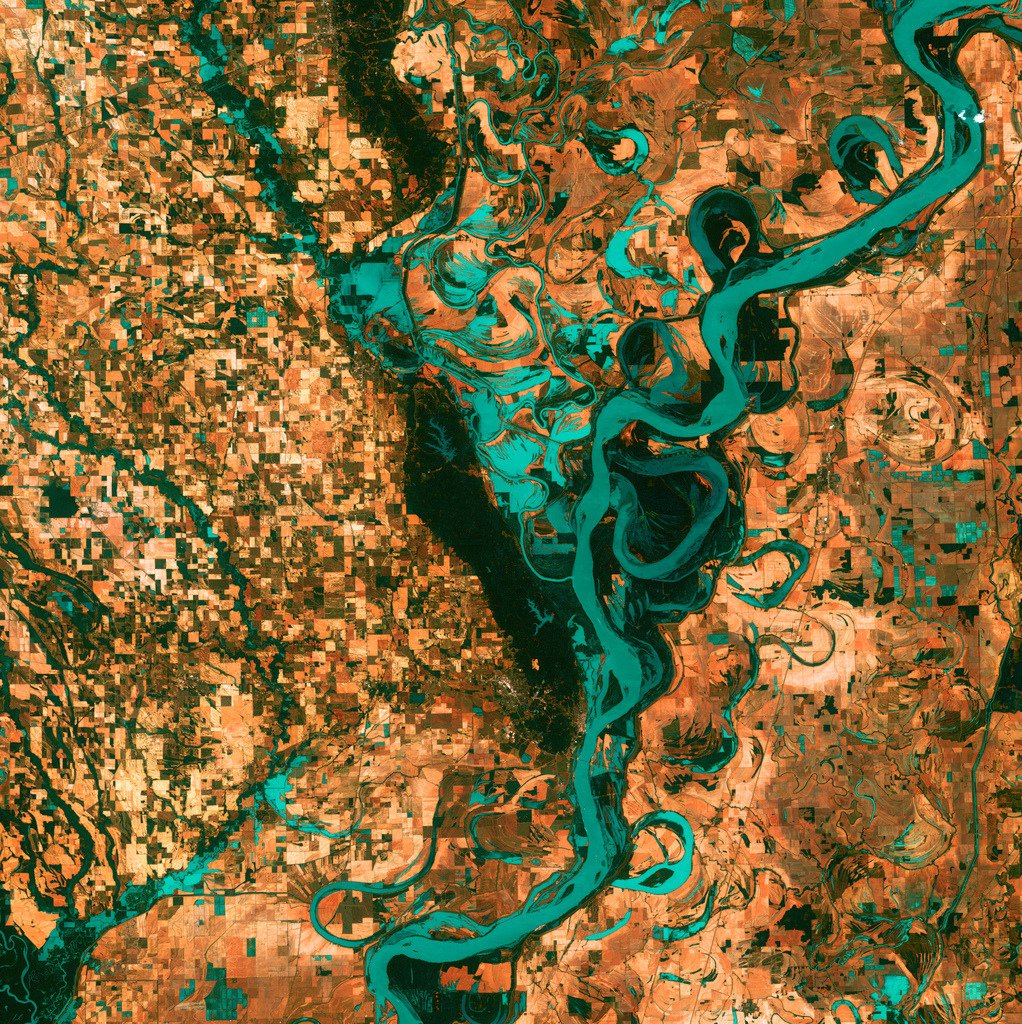
This satellite photo of the Mississippi River south of Memphis, TN shows how the river’s course has changed over time. When a river bends, the water near the inner bank flows faster than the water by the outer bank. This difference in speeds actually creates a vortical secondary flow in the boundary layer of the river that erodes sediment from the outer bank and deposits it on the inner bank. This increases the meander of the river bend. If this continues long enough, the river bend can get pinched off into an oxbow lake, like the ones scattered to either side of the current river path.
Tornado-Force Winds in a Wind Tunnel
[original media no longer available]
In order to demonstrate the effects of tornado-force winds, Fox News sent a reporter inside a wind tunnel and subjected him to 100 mph winds. Of course, actual measured winds in the recent storms topped 200 mph and four times the dynamic pressures the reporter experiences here. (via jerrodh)
How Not to Get Wet in the Rain
[original media no longer available]
Ever wonder how to minimize how wet you get if you’re caught in the rain without an umbrella? This lecture discusses just that problem and how to calculate an answer. I actually solved a version of this problem when studying for my PhD quals, only I first had to determine the terminal velocity of a rain drop (~10 m/s assuming a 4mm spherical drop) and work from there. We also had to compare moving upright to running at an angle. It makes for an interesting little diversion. (via physicsphysics)