This simulation shows how tsunami waves are expected to spread from the epicenter of the Japanese magnitude-8.9 earthquake. Note the complicated interference and reflection patterns. The main wavefront moved at a speed of about 230 m/s (830 km/h) between Japan and Hawaii.
Category: Phenomena

Earthquake-induced Whirlpool
In the wake of the 8.9-magnitude earthquake that hit Japan today, a massive whirlpool has appeared off the coast. It does not appear to have a downdraft, so it’s not a true vortex; it looks as though the residual energy released from the quake has caused circulation in this region.
Solar Prominence
[original media no longer available]
In this stunning video of a solar flare and prominence captured by NASA’s SDO mission, plasma erupts from the surface of the sun preceded by a massive shockwave (near center of frame, heading downward). The motion of the plasma is dictated not only by classical fluid mechanics but by the influence of the sun’s magnetic field in what is known as magnetohydrodynamics. (submitted by Caleb)

Discovery Wingtip Vortices
Wingtip vortices mark the path of Discovery as she makes her final landing. Though not always visible, these vortices are generated by any lifting body planform and can be a major source of induced drag on the craft. Here the vortices are visible because the low pressure in the core of the vortex caused a local temperature drop below the dew point, thus causing condensation. Such vortices persist for significant lengths of time in the wake of aircraft; they are a major source of wake turbulence, which limits how frequently aircraft can take-off or land on a single runway. (Photo by Jen Scheer)

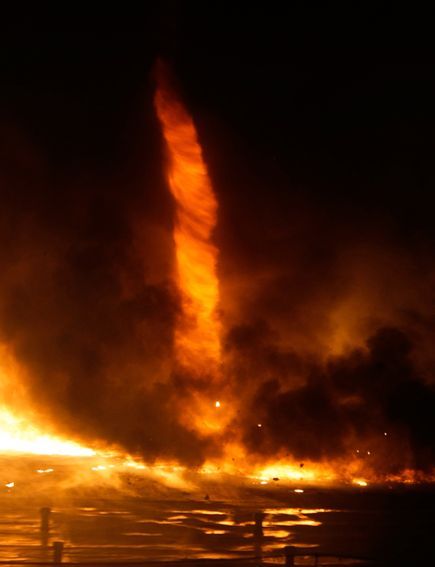
Hungarian Fire Tornado
This fire tornado formed over a burning plastic-processing plant in Hungary a week ago. Fire tornadoes aren’t rare, but footage of them is because they typically occur amidst wild conflagrations. Take a look at our explanation of how they form. #
Cornstarch Monsters
The patterns formed when vibrating a liquid on a speaker cone are standing waves known as Faraday waves. With a large enough amplitude, this produces some very cool effects with a shear-thickening non-Newtonian fluid like oobleck. (It would actually be interesting to see what happens when you vibrate a shear-thinning liquid like shampoo…) This video also details how you can set up this demonstration yourself at home.
Rafting for Rocks
Another look at the science behind the roaming rocks of Death Valley.

Rocket Launch Phenomena
The launch of the Solar Dynamics Observatory (SDO) last year provided a rarely seen glimpse of how shock waves affect the atmosphere during launch, but only recently have researchers explained the white column that seemed to follow SDO toward orbit. Simulations indicate that the shock waves from the rocket aligned the ice crystals in the atmosphere into an array of spinning tops. Individual crystals precess as a result of the rocket passing; the column is part of a larger oval that would have been visible had the ice crystals covered a larger range. See Wired for more. #

Hole-Punch Clouds
These hole-punch clouds seen over Myrtle Beach, SC were probably caused by three aircraft flying in military formation. When airplanes pass through supercooled water vapor, the acceleration of air over the wing causes a pressure drop that can flash-freeze the water vapor, resulting in a localized snow shower. See National Geographic for more. #
How Ferrofluids Work
Here’s a ferrofluid video with a little more explanation about how ferrofluids work. Surfactants prevent the tiny magnetic particles suspended in the fluid from separating out when exposed to a magnetic field.