Vibrating particles or granular materials can produce many fluid-like behaviors. In this video, researchers demonstrate how a granular gas made up of particles of two sizes behaves at different conditions. By tweaking the amplitude of the vibration, they alter how the particles cluster in a divided container. At large vibrational amplitudes, the particles behave much like a gas–energetic and spread out. At lower amplitudes, though, the particle density and the number of particle collisions increases. Each collision dissipates some of a particle’s energy; more collisions means less energy available to escape. As a result, the particles cluster, forming an attractor that draws in additional particles over time. (Video credit: R. Mikkelson et al.)
Category: Phenomena

Bouncing in Lockstep
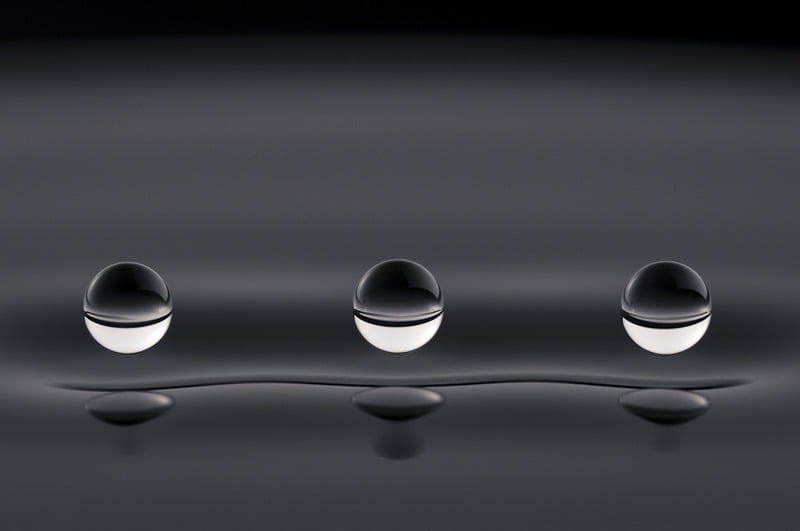
Droplets of silicone oil bounce on a pool of the same thanks to the vibration provided by a loudspeaker. Each droplet’s bounce causes ripples in the pool and the interference between these ripples fixes the droplets in lockstep with one another. As long as the vibration continues to feed the thin layer of air that separates the droplets from the pool during each bounce and no impurities break the surface tension at the interface, the droplets will bounce indefinitely on their liquid trampoline. Such systems can be used to observe quantum-mechanical behavior like wave-particle duality on a macro-scale. (Photo credit: A. Labuda and J. Belina)

Instability: Dense Over Light
Here on Earth, placing a dense layer of fluid atop a less dense layer is unstable. Specifically, the situation causes the interface between the two fluids to break down in what is known as the Rayleigh-Taylor instability.The video above shows a 2D numerical simulation of this breakdown, with the darker, denser fluid on top. The waviness of the initial interface provides a perturbation–a small disturbance–which grows in time. The two fluids spiral into one another in a fractal-like mushroom pattern. The continued motion of the dense fluid downward and the lighter fluid upward mixes the entire volume toward a uniform equilibrium. For those interested in the numerical methods used, check out the original video page. (Video credit: Thunabrain)
Brownian Motion
Have you ever noticed how motes of dust seem to dance around even in still air? The reason they do is because all the atoms and molecules in the air have a certain amount of random motion and all those tiny random motions result in collisions on the dust particles that shift them around. The technical term for this is Brownian motion, named for botanist Robert Brown who noticed through his microscope that particles of pollen floating on water moved constantly under no apparent force. The video above demonstrates the effect in 2D with vibrating brass particles representing atoms and a polystyrene ball as the pollen. Alternatively, you can see Brownian motion in the movement of nanoparticles in water. Although most areas of fluid dynamics do not explicitly consider the random motions of all these particles, the concept is fundamental to the nature of pressure and temperature, both of which are important quantities in fluid dynamics. (Video credit: Sixty Symbols; topic requested by just-a-random-nerd)

Bursting Bubble
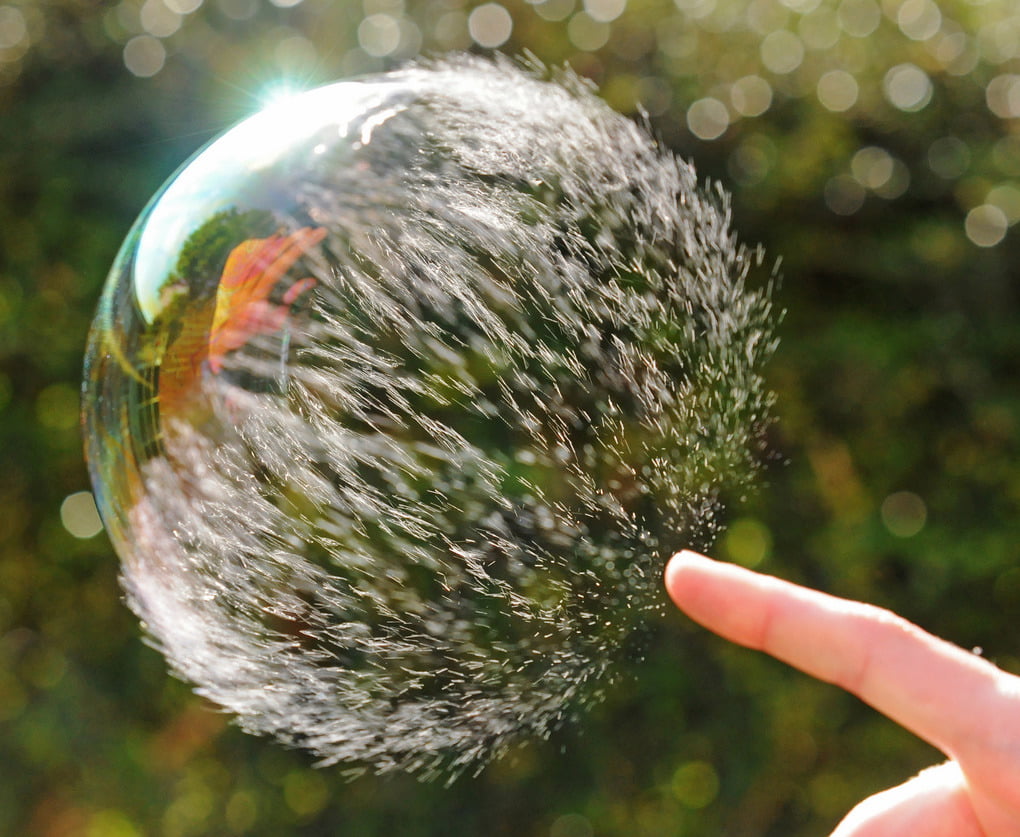
Originally posted: 24 Aug 2011 That soap bubbles burst in the blink of an eye is a pity considering how fascinating their disappearing act is. This photo set from photographer Richard Heeks captures the bubbles mid-burst. Once the bubble’s film is breached, surface tension rips the smooth film back like a broken balloon, causing the liquid that used to be part of the bubble to erupt into droplets. (Photo credit: Richard Heeks)
Reminder: Many thanks to those who have filled out the survey! There are some great responses so far. If you haven’t done so, won’t you please fill out our reader survey?
Rocket Sonic Boom
Originally posted: 22 July 2010 This video of the NASA Solar Dynamics Observatory’s launch is such a favorite of mine that it was part of the original inspiration for FYFD and was the very first video I posted. Watch closely as the Atlas V rocket climbs. At 1:51 you’ll see a rainbow-like cloud in upper right corner of the screen. This effect is created by sunlight shining through ice crystals of the cloud. A couple seconds later you see pressure waves from the rocket propagate outward and destroy the rainbow effect by re-aligning the ice crystals. Just after that comes the announcement that the vehicle has gone supersonic. The atmospheric conditions of the launch happened to be just right to make those pressure waves coming off the rocket visible just before they coalesced into a leading shockwave. (Video credit: B. Tomlinson)
Reminder: If you haven’t already, please fill out our reader survey and help us improve FYFD!

Sedimentary Swirls
Local currents swirl sediments and phytoplankton blooms in this satellite image of the Tarut Bay in Saudi Arabia. Such blooms typically occur where nutrients are being washed together, thereby creating a kind of natural flow visualization of currents and matter flow in the ocean. (Photo credit: NASA Earth Observatory)

Foam Array
Soap foams represent an interplay of gravitational, capillary, interfacial, and viscous forces, none of which is easily isolated in a laboratory experiment. This makes it difficult to sort out the various effects governing the foam since individual variables cannot be controlled independently. The image above is of a special foam, one in which the liquid phase has been replaced with a ferrofluid. This adds an additional parameter–external magnetic fields–to the problem, but, unlike the others, this is an independent variable. By manipulating the external magnetic field, researchers can control the foam’s drainage rate and even the structure it takes on. (Photo credit: E. Janiaud)
Fire-Breathing Physics
One of the most dangerous stunts for any fire-eater is breathing fire. Dr. Tim Cockerill explains some of the science behind the feat in this video. Volatility–the tendency of the liquid fuel to vaporize–is actually the enemy of a fire-eater. Use a fuel that is too volatile and it will catch fire too easily when the vaporous fuel mixes with the air. Instead fire-eaters use less volatile fuels and spray a mist of fine droplets to mix the air and fuel. This atomization of the fuel creates a spectacular fireball without endangering the fire-eater (as much). To see a similar fireball in high-speed, check out this post. (Video credit: T. Cockerill/The Ri Channel; via io9)
What is Pressure?
Pressure is a critical concept in fluid dynamics – a driving force behind everything from weather patterns to lift on a wing. But where does pressure come from? Like many macroscopic forces dealt with in fluid dynamics, pressure can be traced to the effects of individual molecules within a fluid. Kinetic theory describes gases as a collection of small particles which are all in constant, random motion. These particles’ collisions with each other and with their container create a multitude of tiny forces, as in the demonstration in the video above. When all of these collisions are summed together, their net effect is expressed as pressure, a force per area. (Video credit: Sixty Symbols)