In nature, birds and other flying animals often use unsteady flow effects to enhance the lift their wings generate. When a wing sits at a high angle of attack, it stalls; the flow separates from the upper surface, and its lift force is suddenly lost. If, on the other hand, that wing is in motion and pitching upward, lift is maintained to a much higher angle of attack. The reason for this is shown in the flow visualization above. This montage shows a rectangular plate pitching upwards. Flow is left to right. Each row represents a specific angle of attack and each column shows a different spanwise location on the plate. As the plate pitches upward, a vortex forms and grows on the leading edge of the plate. Eventually, the leading-edge vortex separates, but not until a much higher angle of attack than the plate could sustain statically. This effect allows birds to maintain lift during perching maneuvers and is also key to helicopter rotor dynamics. (Image credit: K. Granlund et al.)
Category: Phenomena

The Bathtub Vortex
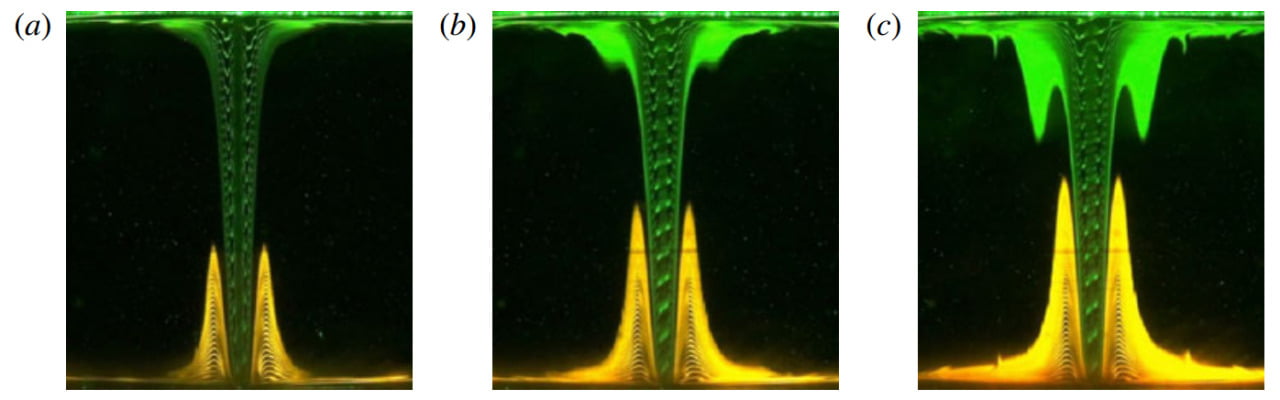
If you’ve ever watched a swirling vortex disappear down the drain of your bathtub and wondered what was happening, you’ll appreciate these images. This dye visualization shows a one-celled bathtub vortex, created by rotating a cylindrical tank of water until all points have equal vorticity before opening a drain in the bottom of the tank. A recirculating pump feeds water back in to keep the total fluid mass constant. Once a steady vortex is established, green dye is released from the top plate of the tank and yellow dye from the bottom. The green dye quickly marks the core of the vortex. Ekman layers–similar to the boundary layers of non-rotating flows–form along the top and bottom surfaces, and the yellow dye is drawn upward in a region of upwelling driven by Ekman pumping. (Photo credit: Y. Chen et al.)
Just a reminder for those at Texas A&M University: I will be giving a talk today Wednesday, October 2nd entitled “The Beauty of the Flow” as part of the Applied Mathematics Undergraduate Seminar series at 17:45 in BLOC 164.

Oil Flow Viz
Fluorescent oil sprayed onto a model in the NASA Langley 14 by 22-Foot Subsonic Wind Tunnel glows under ultraviolet light. Airflow over the model pulls the initially even coat of oil into patterns dependent on the air’s path. The air accelerates around the curved leading edge of the model, curling up into a strong lifting vortex similar to that seen on a delta wing. At the joint where the wings separate from the body those lifting vortices appear to form strong recirculation zones, as evidenced by the spiral patterns in the oil. Dark patches, like those downstream of the engines could be caused by an uneven application of oil or by areas of turbulent flow, which has larger shear stress at the wall than laminar flow and thus applies more force to move the oil away. Be sure to check out NASA’s page for high-resolution versions of the photo. (Photo credit: NASA Langley/Preston Martin; via PopSci)

Shock Trains
In compressible flows, shock waves are singularities, a tiny distance across which the density, temperature, and pressure of a fluid change suddenly and discontinuously. In this video, there is a wedge at the top and bottom of the frame and a Pitot probe roughly in the center. Flow is left to right and is initially subsonic. Once Mach 6 flow is established in the wind tunnel, a series of shock waves and expansion fans appear as light and dark lines in this schlieren video. Oblique shocks extend from the sharp tip of each wedge and interfere to create a normal shock in front of the Pitot probe. The air that passes through the normal shock is subsonic to the right of the shock, whereas air that goes through the oblique shocks remains supersonic. The fainter lines further to the right are weaker shock waves and expansion fans that reflect off the walls and probe. They exist to continue turning the airflow around the probe and to equalize conditions between different regions. (Video credit: C. Mai et al.)

Beach Cusps
Beach cusps are arc-like patterns of sediment that appear on shorelines around the world. Cusps consist of horns, made up of coarse materials, connected by a curved embayment that contains finer particles. They are regular and periodic in their spacing and usually only a few meters across. A couple of theories exist as to how cusps form, but once they do, they are self-sustaining. When an incoming wave hits a horn, the water splits and diverts. The impact of the wave on the horn slows the water, causing it to deposit heavy, coarse particles on the horns while finer sediment gets carried up to the embayment before the wave flows back outward. (Photo credit: L. Tella; inspired by E. Wiebe)
The Reynolds Number Illustrated
The dimensionless Reynolds number is a key concept in fluid dynamics, allowing scientists to distinguish regimes of flow between differing geometries and even different fluids. This video gives a great primer on the subject by examining the physics of swimming for a sperm versus a sperm whale. The Reynolds number is essentially a ratio between inertial forces (driven by velocity and size) and viscous forces, and its value can indicate how important different effects are. Sperm and other microbes live at very small Reynolds numbers, meaning that viscosity dominates as the force they must overcome to move. For more on the low Reynolds number world, check out how brine shrimp swim and what happens if a microbe tries to flap its tail. (Hint: it goes nowhere, and this is why.) (Video credit: A. Bhatia/TED Ed; via Jennifer Ouellette)
Bouncing Atop a Pool
When slowed down, everyday occurrences, like a drop of water falling into a pool, can look absolutely extraordinary. When a falling drop has low momentum, it doesn’t simply disappear into the puddle. It sits on the surface, separated from the main pool by a very thin layer of air. Given time, the air drains away and the droplet cascades its way into the pool via smaller and smaller droplets. By vibrating the surface, the droplet bounces, with each bounce refreshing the layer of air that separates it from the main pool. Minute Lab’s video does a great job of explaining the process from beginning to end, accompanied with wonderful video of each step in action. For even more mind-boggling, check out how these bouncing droplets can demonstrate quantum mechanical behaviors. (Video credit: Minute Laboratory; submitted by Pascal)

Other Ig Nobel Fluids
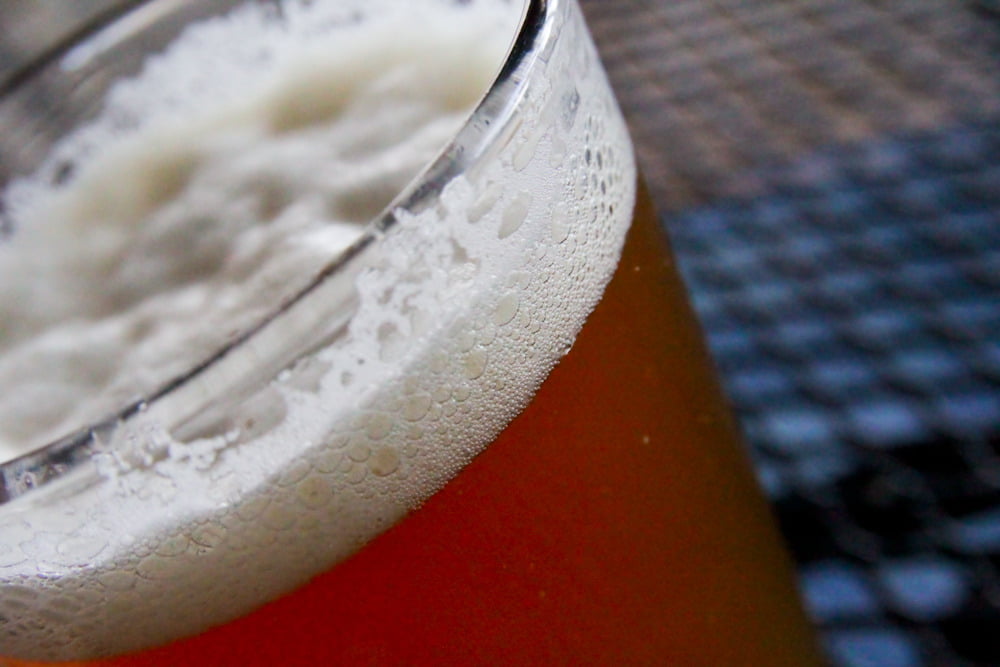
To round out our series on fluid dynamics in the Ig Nobel Prizes (which are not the same thing as the actual Nobel Prizes), here are some of the other winners. Last year Mayer and Krechetnikov won for a study on coffee sloshing when people walk. We’ve mentioned the pitch-drop experiment measuring the viscosity of an extremely viscous fluid a couple times; Mainstone and Parnell won a 2005 Ig Nobel for that (on-going) work. Another 2005 prize went to Meyer-Rochow and Gal for calculating the pressures involved in penguin defecation. (Yes, seriously.) A avian-related award was also handed out to B. Vonnegut for estimating tornado wind speeds by their ability to strip a chicken of its feathers. And, finally, for those looking to interest undergraduate lab students in mathematics and fluid dynamics, I suggest following the lead of 2002 winner A. Leike who demonstrates laws of exponential decay with beer head. (Photo credit: S. Depolo)

Ig Nobel Fluids: Shower Curtain Science
Nearly everyone has faced the frustration of a shower curtain billowing inwards to stick to one’s leg. Various explanations have been offered to explain the effect, but David Schmidt won the 2001 Ig Nobel Prize in Physics for a numerical simulation suggesting that the spray of droplets from the shower head drives a horizontal vortex whose axis of rotation is perpendicular to the shower curtain. Since vortices have a low-pressure region in their core, this weak shower vortex has the power to suck a light curtain inward, much to the chagrin of the shower’s occupant. Of course, a heavier or weighted shower curtain will help avoid the effect. This post is part of a series on fluids-related Ig Nobel Prizes. (Photo credit: W. Taylor; research credit: D. Schmidt)

Ig Nobel Fluids: Swimming in Syrup
Does a person swim faster in water or syrup? One expects the more viscous syrup would offer a swimmer greater resistance, but, at the same time, it could also provide more to push against. Gettelfinger and Cussler put this to a test experimentally with competitive and recreational swimmers in a pool of water and in one with a fluid measuring roughly twice the viscosity of water. Their results showed no significant change in swimming speed. When you consider that human swimming is highly turbulent, however, the result makes sense. In fluid dynamics, the dimensionless Reynolds number represents a ratio between inertial forces and viscous forces in a flow. The researchers estimate a Reynolds number of a typical human in water at 600,000, meaning that inertial effects far outweigh viscous effects. In this case, doubling the viscosity only reduces the Reynolds number by half, leaving it still well inside the turbulent range. Thus, swimming in syrup has little effect on humans. The Mythbusters also tackled this problem, with similar conclusions. This is a continuation of a series on fluids-related Ig Nobel Prizes. (Photo credit: Mythbusters/Discovery Channel; research credit: B. Gettelfinger and E. L. Cussler, winners of the 2005 Ig Nobel Prize in Chemistry)