
After visiting an aquarium or snorkeling near a reef, you may have wondered why fish come in so many different shapes. Given that all fish species need to get around underwater, why are some fish, like tuna, incredibly streamlined while others, like the box fish, are so, well, boxy? There are several major groupings for fish based on their shape and how they propel themselves, whether it’s by undulating their body and tail or primarily by flapping their fins. Which grouping a fish tends toward depends largely on its environment and needs. Open-water swimmers tend to use their bodies and tails. Their bodies are better streamlined, too, allowing them to outrace even some ships! Fish that live in more complicated environments, like along the seafloor or in a reef, tend to favor maneuverability over speed. These fish – which include rays, pufferfish, and surgeonfish – use their fins for their main propulsion. Many of these species are still faster swimmers than you or I, but their slower speeds have reduced their need for hydrodynamic streamlining, allowing these fish to evolve a wide variety of odd body shapes. (Video credit: TED-Ed)
Videos

Waves Below the Surface
Even a seemingly calm ocean can have a lot going on beneath the surface. Many layers of water at different temperatures and salinities make up the ocean. Both of those variables affect density, and one stable orientation for the layers is with lighter layers sitting atop denser ones. Any motion underwater can disturb the interface between those two layers, creating internal waves like the ones in this demo. In the actual ocean, these internal waves can be enormous – 800 meters or more in height! In regions like the Strait of Gibraltar where flowing tides encounter underwater topography, large internal waves are a daily occurrence. Internal waves can also show up in the atmosphere and are sometimes visible as long striped clouds. (Video and image credit: Cal Poly)

“Flowers and Colors”


Many children have done the simple experiment of placing a cut flower in dyed water and watching as it changed color. The latest video from Beauty of Science relies on some related physics. Since the color of flowers typically depends on acidity, immersing a flower in dilute acid will change its color from pinks and purples to yellows and greens. Watching this transformation, we can learn about how fluids get transported through flowers.
Like the leaves on a tree, flowers are covered in tiny cells called stomata that can open and close. In the daytime, stomata are typically open to allow carbon dioxide to diffuse into the plant. (At the same time, water pulled up from the roots is evaporating out the stomata, as seen previously.) Once immersed in acid, the open stomata are no longer bringing in carbon dioxide; instead, the acid is diffusing in and slowly spreading through the petals. In the timelapse video, some areas of the petal change faster than others. This could indicate more open stomata in the regions that change first or even that some areas inside the petal transport water (and acid) better than others. (Video and image credit: Beauty of Science; see also Making Of)
Bouncing, Floating, and Jetting


Get inside some of the latest fluid dynamics research with the newest FYFD/JFM video. Here researchers discuss oil jets from citrus fruits, balls that can bounce off water, and self-propelled levitating plates. This is our third entry in an ongoing series featuring interviews from researchers at the 2017 APS DFD conference. Missed one of the previous ones? Not to worry – we’ve got you covered. (Video and image credit: N. Sharp and T. Crawford)
Paint Balloons


The Slow Mo Guys have a history of personal sacrifice in the name of cool high-speed footage, and their Super Slow Show is no exception. In a recent segment, both Dan and Gav were knocked flat by giant swinging balloons of paint, and, as you might expect, the splashes are spectacular. The speed is just right for some of the paint to form nice sheets before momentum pulls them into long ligaments. Eventually, that momentum overcomes surface tension’s ability to keep the paint together, and the paint separates into droplets, which, as you see below, rain down on the hapless victims. (Video and image credit: The Slow Mo Guys)
Under Pressure, Part 2


Our adventures with pressure continue after the trip to the aquarium. To see just how much pressure we could generate with height, A.J. and I teamed up with the Corvallis Fire Department to recreate an experiment attributed to 17th-century French physicist Blaise Pascal. In Pascal’s experiment, he (supposedly) used a column of water to burst a wooden barrel. In ours, we use a ladder truck to make a 30-meter column of water burst a glass carboy! We also got a little help from our friends at the Lutetium Project to introduce you to Pascal and his work. (Thanks, Guillaume!) We’ll tell you more about Pascal and his contributions in an upcoming video, so stay tuned. (Video and image credit: A. Fillo and N. Sharp)
Under Pressure


Pressure is a concept that can be unintuitive, but it’s incredibly important in physics and engineering. So I’m excited to debut a collaborative video series that @mostlyenginerd and I are producing all about hydrostatic pressure! Today’s video is one of our openers: it focuses on where pressure comes from and why it’s a function of height but not volume. And to show you just how pressure increases with depth, we teamed up with divers from the Oregon State University Scientific Diving Team and headed to the Oregon Coast Aquarium’s Halibut Flats exhibit. Ever seen what a balloon looks like 7 meters underwater? You’re about to! (Video and image credit: N. Sharp and A. Fillo)
Want to see how this was made? Support FYFD on Patreon, and you can get access to behind-the-scenes content and a chance to see upcoming videos early!
“Dance Dance”


Artist Thomas Blanchard is no stranger to fluid dynamics. His previous short films focused on mixtures of oil and paint, but in “Dance Dance,” flowers are front and center. There are obvious splashes of color and clouds of diffusion toward the end of the video, but fluid dynamics are there throughout. The oozing, inexorable march of ice crystallizing over petals and leaves has a fluidity that’s heightened by timelapse. It’s a reminder that this phase change is unsteady and full of shifts too subtle to notice in real-time. In the second act, we see flowers blossoming in timelapse, bursting open dramatically before settling in with a subtle shift of their stamens. Motions like these are driven by the flow of fluids inside the plant. By shifting small concentrations of chemicals, plants drive the water in their cells via osmosis. This pumps up cells that cause the petals to spread and unfurl. (Video and image credit: T. Blanchard; via Colossal)
Caught in a Whirl
Vortex rings may look relatively calm, but they are concentrated regions of intensely spinning flow, as this poor jellyfish demonstrates. The rings form when a high-speed fluid gets pushed suddenly (and briefly) into a slower fluid. In the case of this bubble ring, a burst of air is pushed by a diver into relatively still water. The vorticity caused by the two areas of fluid trying to move past one another forms the ring. Like a spinning ice skater who pulls his arms inward, the narrow core of the vortex spins fast due to the conservation of angular momentum. Meanwhile, the bubble ring moves upward due to its buoyancy, pulling nearby water in as it goes. This catches the hapless jellyfish (who relies on vortex rings itself) and gives it quite a spin. But. don’t worry, the photographer confirmed that the jelly was okay after its ride. (Video credit: V. de Valles; via Ashlyn N.)
Skiing, Avalanches, and Freezing Bubbles

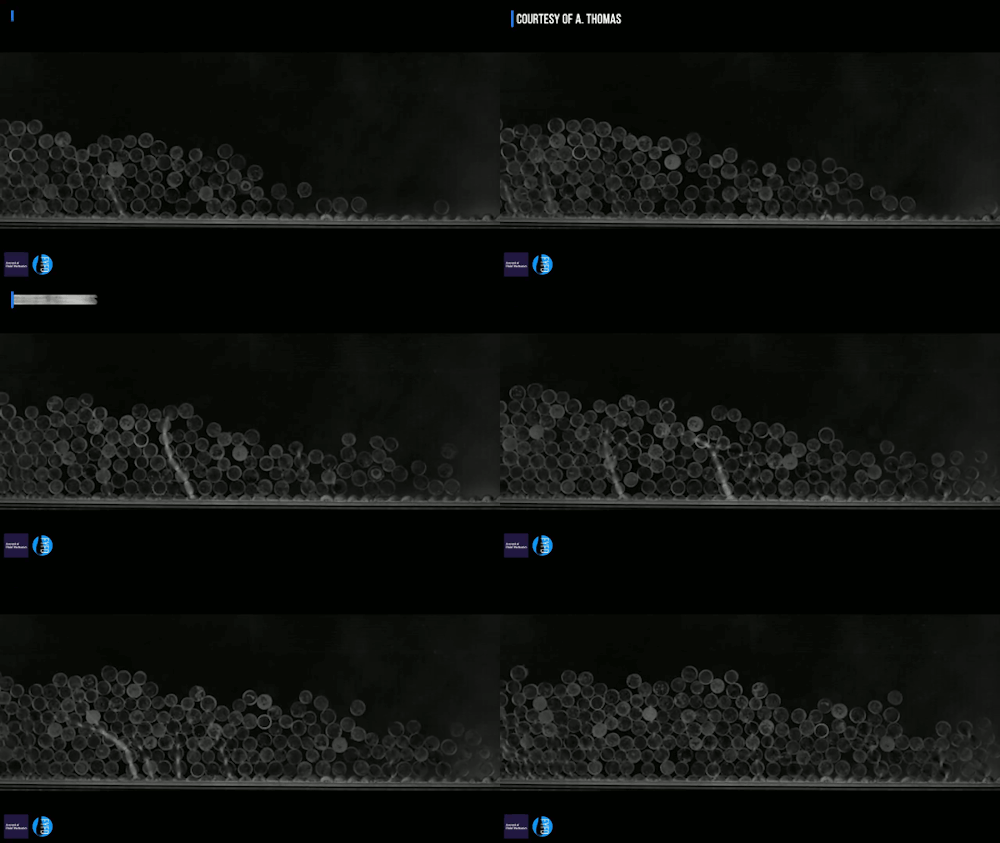

To wrap up our look at Olympic physics, we bring you a wintry mix of interviews with researchers, courtesy of JFM and FYFD. Learn about the research that helped French biathlete Martin Fourcade leave PyeongChang with 3 gold medals, the physics of avalanches, and how bubbles freeze.
If you missed any of our previous Olympic coverage, you can find our previous entries on the themed series page, and for more great interviews with fluids researchers, check out our previous collab video. (Video credit: T. Crawford and N. Sharp; image credits: GettyImages, T. Crawford and N. Sharp)
