Videos

  • Featured Video Play Icon

    What Keeps a Foam Intact

    Beer, soda, soap, meringue – foams are everywhere in our lives. But have you ever wondered why some foams disappear so quickly while whipped egg whites stick around? That’s the subject of this Gastrofisica video, which is in Spanish but has English captions.

    Foams form when air gets introduced into a liquid, but for those bubbles to stick around, they need a certain special something. With soapy water, that ingredient is surfactants, molecules with both hydrophobic (water-fearing) and hydrophilic (water-loving) ends, which line up at the interface of the foam and help hold it together. But surfactants are relatively weak, especially compared to to the albumin proteins in an egg white. By whipping egg whites, you’re effectively untangling those proteins, and, like surfactants, they line up at the interface of the foam so that their hydrophobic and hydrophilic parts can hang out in their preferred mediums. With so many similar molecules crowded together, the proteins coagulate, adding extra strength and stiffness to your whipped egg whites. (Video and image credit: Tippe Top Physics; h/t to MinutePhysics)

  • Featured Video Play Icon

    “Le Temps”

    Thomas Blanchard is back with another beautiful music video. This one features ink cascading over various shapes underwater. Lots of tiny mushroom-shaped Rayleigh-Taylor instabilities here caused by the ink’s greater density compared to the surrounding water. There are also some lovely examples of transitional flow, especially around the spheres. Initially, flow over the spheres looks completely smooth and laminar. But, on the latter half of the sphere, where the flow is under increasing pressure, you see disturbances growing until little fingers of ink break away entirely. Be sure to watch the whole video; you don’t want to miss this! (Video and image credit: T. Blanchard)

  • Featured Video Play Icon

    The Kaye Effect

    Allow a stream of shampoo to fall into a pile and you’ll catch a glimpse of the bizarre Kaye effect. A jet of shampoo will briefly rise up before becoming chaotic and falling. The key to this behavior is the shear-thinning of the shampoo. When the shampoo is just sitting on a surface, it’s quite viscous, but slide your hand across it, and the shampoo will become much less resistant to flowing.

    When the jet of falling shampoo hits the pile, it creates a little dimple. Sometimes the incoming jet hits that dimple and slips along it, thanks to a sudden decrease in viscosity. That can send an outgoing jet of shampoo riding off the dimple like a ramp. As the dimple deepens, the outgoing streamer rises up until it hits the incoming jet and becomes unstable. The shampoo streamer collapses, only to be restarted when a new dimple forms. (Image and video credit: S. Mould; h/t to Guillaume D.)

  • Lava Balls

    The continuing eruption of Kilauea is revealing phenomena rarely seen by those of us who are not volcanologists. One of the most surreal examples so far is colloquially known as a “lava boat,” seen above floating its way down a river of lava emanating from Fissure #8. The more technically accurate term is “accretionary lava ball,” but the colloquialism seems rather fitting, as long as this partially-solidified chunk of lava is still floating down the channel. 

    These lava balls form in a’a lava channels, which tend to be faster-moving and more turbulent. As chunks of lava solidify in the channel, they roll and gather more material, allowing them to get larger and larger. When broken open, the lava balls usually have a spiral interior as a result of this rolling formation. It’s essentially the lava equivalent of making a snowball. (Video credit: I. Marzo via M. Lincoln; via Ryan A.)

  • Featured Video Play Icon

    Vortex Ring Collisions

    One of the most enduringly popular submissions I receive is T. Lim’s experimental footage of two vortex rings colliding head-on. It’s an devilishly tough experimental set-up to master because perfectly aligning the rings is incredibly difficult. The pay-off, however, is huge because the breakdown of the colliding rings and their transformation into secondary rings is breathtaking. Destin at Smarter Every Day and his team have worked hard to recreate the experiment (top video), but they’re not the only ones – nor are they the first in decades – to do so.

    Ryan McKeown and a team at Harvard have a set-up of their own for vortex ring collisions, and you can see a little of it in action in the middle video. Ryan’s set-up is, frankly, incredible. It scans a light sheet through the vortex rings at high-speed, allowing him to capture the collision and break-up in minute detail in both space and time. What you see in the latter half of his video is a digital reconstruction of that data – not a simulation but real data! His work is capturing vortex collisions in unprecedented detail, allowing researchers to probe the smallest scales of the phenomenon.

    When two vortex rings approach one another, they can undergo what’s known as a vortex reconnection event. Bubbles rings are a great place to see this. The vortex cores get distorted when they’re close to one another due to the influence of the other vortex ring’s velocity field. This often stretches and flattens the vortex core. It’s impossible for the rings to simply break apart, though, (per Helmholtz’s second theorem). So when the original vortex rings thin to the point of breaking, they immediately reconnect to a piece of the other ring, creating a series of small vortex rings around the remains of the originals. The exact details of how this works are what investigators like Ryan and his colleagues are trying to understand. You can hear a little more about their work in my interview with Ryan in the bottom video, starting at ~2.54. (Video credits: Smarter Every Day, R. McKeown et al., and N. Sharp and T. Crawford; submission credit: a huge number of readers)

  • Star Wars Aerodynamics

    Star Wars Aerodynamics

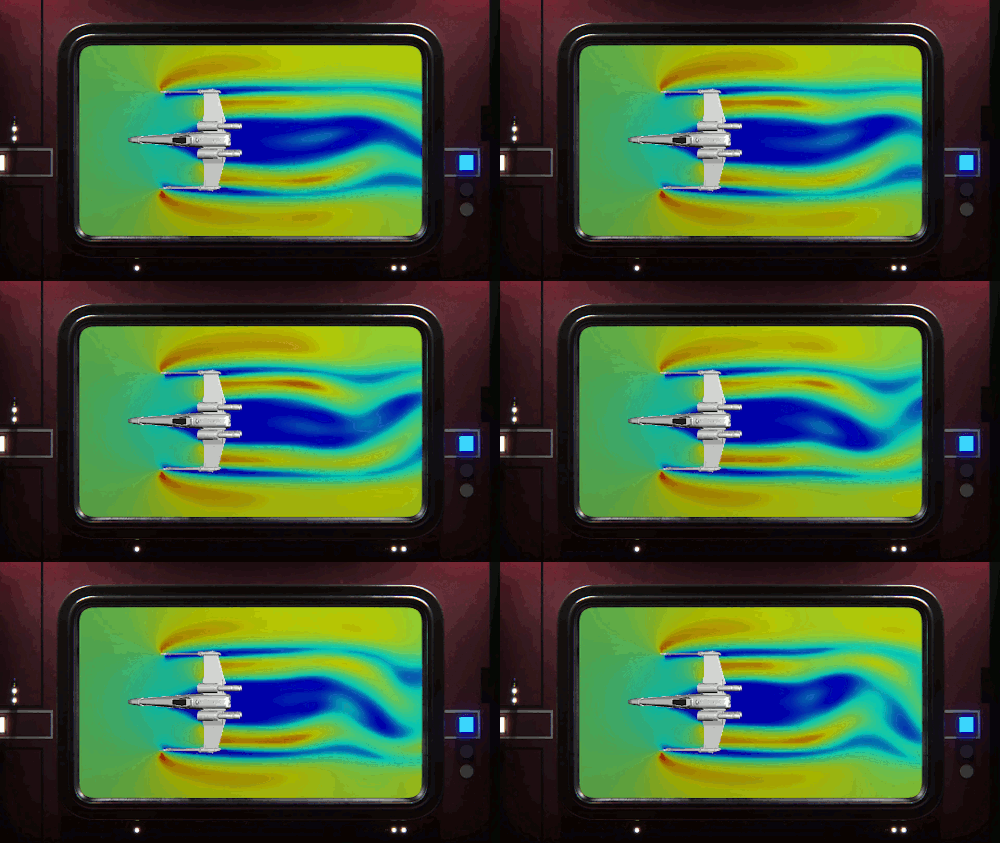
    Science fiction is not always known for hewing to scientific fact, so it will probably come as little surprise that Star Wars’ ships have terrible aerodynamics. But it’s nevertheless fun to see EC Henry’s analysis of drag coefficients of various Rebel and Imperial ships and just how poorly they fare against our own designs.

    Drag coefficients really only give a tiny piece of the story, though. We don’t know what speed Henry is testing the ships at, and we get no information about properties like lift or lift-to-drag ratio, which can be even more important than just the drag when it comes to evaluating an aircraft.

    There are some intriguing hints about other aerodynamic properties in the clips of flow around an X-wing and TIE fighter, though. Notice that the wake of both ships meanders back and forth. This is an indication of vortex shedding, and it means that both spacecraft would tend to be buffeted from side-to-side when flying in an atmosphere. Either the ships would need some kind of active control to counter those forces, or pilots would need iron constitutions to operate under those conditions! (Video and image credit: EC Henry)

    [original video no longer available]

  • Featured Video Play Icon

    360 Fireball

    Flames are inherently fascinating to watch. Most of the ones we see regularly, like candle flames and campfires, tend to flicker unsteadily due to their turbulence. But larger fires have a spell-binding nature all their own, one that’s highlighted in slow motion. Here the Slow Mo Guys take flame-gazing to a new level by circling a fireball with a high-speed camera. In the resulting footage, you can admire the incredible expansion of the flame front, and the beautiful, detailed turbulence that creates all the myriad tiny eddies you see in the slow motion. It’s well worth watching more than once! (Video and image credit: The Slow Mo Guys)

  • Featured Video Play Icon

    Bubble Art

    Everyone loves soap bubbles, and bubble artist Melody Yang reveals how to make some pretty awesome ones in this video for Wired. The surface tension of bubbles makes them naturally seek a shape that minimizes their surface area relative to the volume they contain. For a single bubble, that’s a sphere. But once you start joining multiple bubbles, as Yang demonstrates, that minimal surface area can change, even to something unexpected like a cube.

    Bubbles also have an impressive ability to self-heal. As long as whatever passes through them is wet – whether it’s a hand, a straw, or even a ball bearing – the soap film will probably heal itself rather than break. This is a key feature for many of Yang’s tricks, including the impressive planetary bubble. (Video credit: Wired; image credits: Wired/Colossal; via Colossal)

  • Featured Video Play Icon

    Bringing Beavers Back

    It’s easy sometimes to forget just how drastically humans alter landscapes. Before European fur trappers came to North America, its waterways were ruled by beavers, one of nature’s most impressive engineers. Now researchers, ranchers, and conservationists are installing beaver dam analogs (BDAs) in streams and creeks to help bring back the beavers and their benefits.

    Initially, the BDA starts as several human-driven posts with willow bark woven between. These structures help slow the water, which refills floodplains, deposits sediment, and can help recharge the water table. Beavers augment the structures and build new ones, helping bring complexity and fertility back to devastated waterways.

    The benefits have been multifold. In waterways re-engineered through BDAs, native trout species have flourished, sage grouse nesting is recovering, water tables have climbed by a meter (thereby reducing irrigation costs), and seasonal streams have had their flow extended. It sounds like an exciting story, both for conservation and agriculture. Check out the full story here. (Video credit: Science; see also their full article)

  • Featured Video Play Icon

    The Coexistence of Order and Chaos

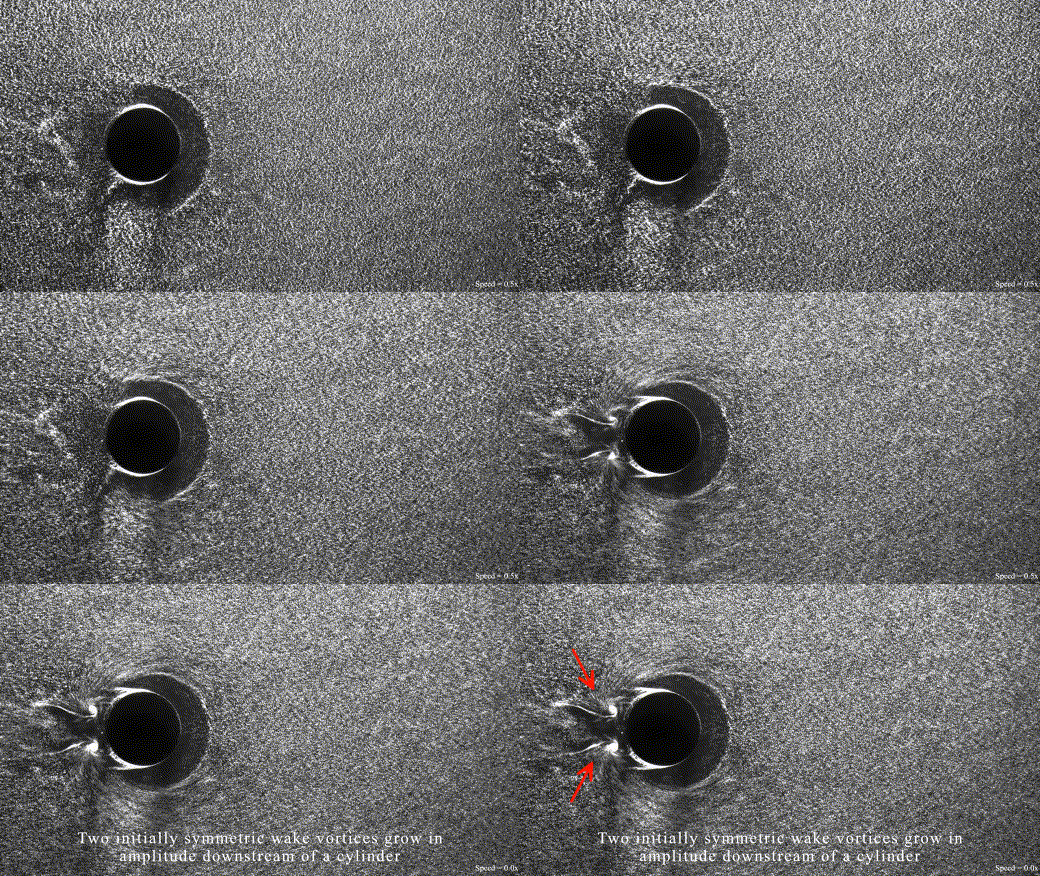
    One of the great challenges in fluid dynamics is understanding how order gives way to chaos. Initially smooth and laminar flows often become disordered and turbulent. This video explores that transition in a new way using sound. Here’s what’s going on.

    The first segment of the video shows a flat surface covered in small particles that can be moved by the flow. Initially, that flow is moving in right to left, then it reverses directions. The main flow continues switching back and forth in direction. This reversal tends to provoke unstable behaviors, like the Tollmien-Schlichting waves called out at 0:53. Typically, these perturbations in the flow start out extremely small and are difficult or even impossible to see by eye. So researchers take photos of the particles you see here and analyze them digitally. In particular, they are looking for subtle patterns in the flow, like a tendency for particles to clump together with a consistent spacing, or wavelength, between them. Normally, researchers would study these patterns using graphs known as spectra, but that’s where this video does something different.

    Instead of representing these subtle patterns graphically, the researchers transformed those spectra into sound. They mapped the visual data to four octaves of C-major, which means that you can now hear the turbulence. When the audio track shifts from a pure note to an unsteady warble, you’re hearing the subtle disturbances in the flow, even when they’re too small for your eye to pick out.

    The last part of the video takes this technique and applies it to another flow. We again see a flat plate, but now it has a roughness element, like a tiny hockey puck, stuck to it. As the flow starts, we see and hear vortices form behind the roughness. Then a horseshoe-shaped vortex forms upstream of it. Aside from the area right around the roughness, this flow is still laminar. But then turbulence spreads from upstream, its fingers stretching left until it envelops the roughness element and its wake, making the music waver. (Video and image credit: P. Branson et al.)