Videos

  • Featured Video Play Icon

    Watching a Sneeze

    What does a sneeze look like? You might imagine it as a violent burst of air and a cloud of tiny droplets. But this high-speed video shows, that’s only part of the story. The liquid leaving a sneezer’s mouth and nose is a mixture of saliva and mucus, and in the few hundred milliseconds it takes to expel this air/mucosaliva mixture, there’s not enough time for the liquid to break into droplets. Instead, liquid leaves the mouth as a fluid sheet that breaks into long ligaments.

    Because mucosaliva is viscoelastic and non-Newtonian, it does not break down into droplets as quickly as water. Instead, when stretched, the proteins inside the fluid tend to pull back, causing large droplets to form with skinny strands between them – the beads-on-a-string instability. The end result when the ligaments do finally break is more large droplets than one would expect from a fluid like water. Understanding this break-up process and the final distribution of droplet sizes is vital for better understanding the spread of diseases and pathogens.  (Video credit: Bourouiba Research Group; research paper: B. Scharfman et al., PDF)
  • Psychedelic Cymatics

    Psychedelic Cymatics

    image

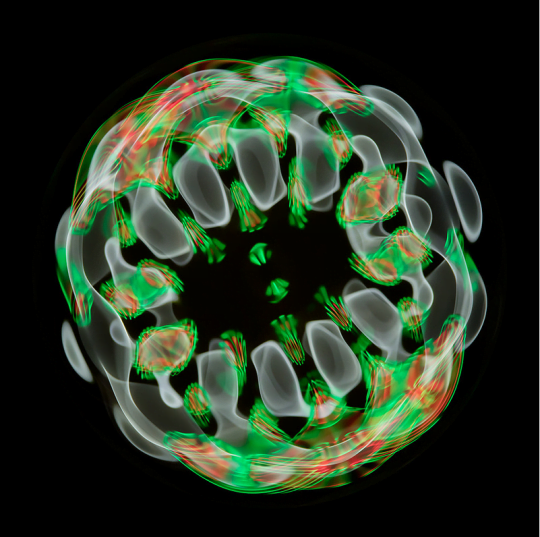
    Cymatics are the visualization of vibration and sound. Here photographer Linden Gledhill has taken a simple speaker vibrating a dish of water and turned it into some incredible art. When you vibrate liquids like water up and down, it disturbs the usually flat air-water interface and creates waves on the surface. These Faraday waves are a standing wave pattern that differs depending on which sound is being played. By combining the wave patterns with LED lighting and strobe effects, Gledhill creates some remarkable images that combine sound, light, and fluid dynamics all in one. If you watch the video (make sure to hit the HD button!), you’ll see the patterns in motion and hear the sounds used to generate them. In the last clip (around 0:19), he’s added glitter to the set-up, which highlights the circulation within the vibrating fluid. As you can see, there are strong recirculating regions in each lobe of the pattern, but other areas, like the center region are almost entirely stationary. You can see more photos from the project in his Flickr feed. Special thanks to Linden for letting me post the video of his work, too! (Video and image cred

    its and submission: L. Gledhill)

    If you enjoy FYFD, please consider becoming a patron to help make sure the Internet keeps getting its daily dose of fluid dynamics!

  • Featured Video Play Icon

    Seeing Blast Waves

    With a large enough explosion, it’s actually possible to see shock waves. This high-speed camera footage shows the detonation of a car packed with explosives. After the initial flash, you can see the thin membrane of the blast wave expanding outward. This shock wave is a traveling discontinuity in the air’s properties–temperature, pressure, and density all change suddenly over an incredibly small distance. It’s this last variable–density–that enables us to see the effect. Density has a significant impact on air’s index of refraction (which also explains heat mirages). In this case, the shift in refractive index is large enough that we see the difference relative to the background, enabling our eyes to follow an otherwise invisible effect.  (Video credit: Mythbusters/Discovery Channel; via Gizmodo)

    If you enjoy FYFD, please help support me by becoming a patron!

  • Featured Video Play Icon

    Sheep as a Fluid

    Not all fluids are, well, fluid. Traffic, flocks of birds, ants, and even sheep can behave like fluids. This video shows an aerial perspective on sheep being herded, and despite the four-legged nature of these particles, they have a lot of fluid-like characteristics. You can watch ripples and waves travel through the herd and see how disturbances propagate. The herd is actually a brilliant example of compressible flow; notice how the sheep slow down and bunch up as they near the gate then speed up and spread out once they pass the constriction. This is exactly how supersonic fluids behave! (Video credit: T. Whittaker; submitted by Simon H and John B)

    If you’re in the DC area, I’ll be speaking at the Annals of Improbable Research Show at the AAAS meeting Saturday evening. Our session is open to the public, but it’s likely to be crowded, so you may want to arrive early!

  • Featured Video Play Icon

    Freezing Soap Bubbles

    I’m not a winter person, but there’s something almost magical about the way water freezes. From instant snow to snow rollers and weird ice formations to slushy waves, winter brings all kinds of bizarre and unexpected sights. The video above is an artistic look at one of my favorites – freezing soap bubbles. Normally, the thin film of a soap bubble is in wild motion, convecting due to gravity, surface tension differences, and the surrounding air. Such a thin layer of liquid loses its heat quickly, though, and, as ice crystals form, the bubble’s convection and rotation slow dramatically, often breaking the thin membrane. Happily photographer Paweł Załuska had the patience to capture the beautiful ones that didn’t break!  (Video credit: P. Załuska; via Gizmodo)

    If you enjoy FYFD and want to help support it, please consider becoming a patron!

  • Featured Video Play Icon

    Tears of Wine

    Give your wine glass a swirl and afterward you may notice little rivulets of wine along the side of your glass. These so-called “tears of wine” or “wine legs” are caused by a combination of evaporation, surface tension, and gravity. After the glass has been swirled, alcohol from the thin layer of wine on the glass wall quickly evaporates, leaving behind a fluid that is more watery than the wine in the glass. Since water has a higher surface tension than alcohol or wine, it pulls more fluid up the wall via the Marangoni effect. This carries on until enough wine is pulled up to form a droplet that’s heavy enough to slide down the glass. This up-and-down exchange of fluid is nicely illustrated in the video above, where the tiny particles in the wine help show how flow gets drawn up even as your eye follows the drops sliding down. (Video credit: A. Athanassiadis and K. Khalil; submitted by Thanasi A.)

    Special thanks to our Patreon patrons, who help keep FYFD up and running.

  • Featured Video Play Icon

    Ode to Bubbles

    Boiling water plays a major role in the steam cycles we use to generate power. One of the challenges in these systems is that it’s hard to control the rate of bubble formation when boiling. In this video, researchers demonstrate their new method for bubble control in a clever and amusing fashion. The twin keys to their success are surfactants and electricity. Surfactant molecules, like soap, have both a polar (hydrophilic) end and a non-polar (hydrophobic) end. By applying an electric field at the metal surface, the researchers can attract or repel surfactant molecules from the wall, making it either hydrophobic or hydrophilic depending on the field’s polarity. Since hydrophobic surfaces have a high rate of bubble formation, this lets the scientists essentially turn nucleation on and off with the flip of a switch! (Video credit: MIT Device Research Lab; see also: research paperMIT News Video, press release)

    Do you enjoy FYFD and want to help support it? Then please consider becoming a patron!

  • Featured Video Play Icon

    Wave Clouds

    In this video, Sixty Symbols tackles the physics of wave clouds. When air flows over an obstacle like a mountain, the air can begin to oscillate downstream, forming what is known as a lee wave. As the air bobs up and down, it will cool or warm according to its altitude. At cooler conditions, if the air is moist, it can condense into a cloud at the peak of its oscillation. If you observe this behavior over time, you get what appear to be regularly-spaced stripes of clouds. This is actually a pretty common phenomenon to see, depending on where you live. It’s an example of internal waves in the atmosphere.  (Video credit: Sixty Symbols)

    Do you enjoy FYFD and want to help support it? Then please considering becoming a patron!

    Reminder: If you’re at the University of Illinois at Urbana-Champaign, I’m giving a seminar tomorrow afternoon. Not in Illinois? I’ve got other events coming up, too!

  • Underwater Landslides

    Underwater Landslides

    Turbidity currents are a gravity-driven, sediment-laden flow, like a landslide or avalanche that occurs underwater. They are extremely turbulent flows with a well-defined leading edge, called a head. Turbidity currents are often triggered by earthquakes, which shake loose sediments previously deposited in underwater mountains and canyons. Once suspended, these sediments make the fluid denser than surrounding water, causing the turbidity current to flow downhill until its energy is expended and its sediment settles to form a turbidite deposit. By sampling cores from the seafloor, scientists studying turbidites can determine when and where magnitude 8+ earthquakes have occurred over the past 12,000+ years!  (Video credit: A. Teijen et al.; submitted by Simon H.)

    Do you enjoy FYFD and want to help support it? Then please consider becoming a patron!

  • Featured Video Play Icon

    Help Support FYFD on Patreon

    tl;dr version: FYFD is launching a Patreon campaign. If you enjoy FYFD and want to help support its continued growth, please become a patron today!

    And the longer version: At the start of the year, I hinted that there were big things ahead for FYFD. Today’s announcement is part of that. In the past five years, FYFD has grown beyond my wildest dreams. I’m so excited, grateful, and happy to share my love for science with all of you. As FYFD’s audience has grown, so have my plans and dreams for expanding the site and what it does. I want to bring you more: videos that take you behind-the-scenes to see the scientific process firsthand, interviews that let you meet the people behind the work, and articles that explore new and exciting fluid phenomena.

    All of the research, filming, writing, and editing necessary to bring those dreams to life takes time and money. I can provide the first: from now on, I’ll be dedicating my full-time attention to FYFD. But I need your help and support to make this possible. That’s why I’m launching a campaign on Patreon. If you enjoy FYFD and want to help it continue and grow, please consider becoming a patron. Your monthly support will enable me to dedicate my full energy to FYFD and will provide funding for materials, equipment, and travel so that I can bring the science back to you.

    There are also some pretty cool rewards available to patrons! All patrons will have access to a patrons-only activity feed where I post behind-the-scenes content and extras like video outtakes. It’s also a place where I’ll look for feedback on new ideas. Think of it as an extra dose of FYFD. Other rewards include getting your name added to the FYFD supporter page, getting a handwritten postcard from me, and access to a monthly webcast where I’ll chat with guest scientists and patrons. (I’m really excited about that last one!)

    Whether you become a patron or not, I want to thank you for your support. None of those would be possible without you and your enthusiasm. As always, the best thing you can do to support FYFD is to tell others how much you like it. Thank you!

    If you have any questions, I’ll be online all day. You can reach me via Tumblr, Twitter, or email.