Peering into a vortex feels like staring into an abyss in the Julia Set Collective’s “Gargantua”. Like their previously featured works, this video uses a macro perspective on fluid phenomenon to create an alternate sense of scale. Instead of a whirlpool, we could be observing a wormhole. Part of this is a matter of fooling our brains with perspective, but it also works because, on some level, we recognize that these same fluid patterns occur at very different lengthscales and so it is believable that what we see is much bigger than in reality. (Video credit and submission: S. Bocci/Julia Set Collective)
Videos

Crushing Oobleck
Oobleck is probably the Internet’s favorite non-Newtonian fluid. People vibrate it, run across it, shoot it, drop it, and even use it to fix potholes. But how does oobleck hold up to a hydraulic press? Fortunately, that’s been covered, too. Oobleck is a mixture of cornstarch and water, and it’s a bit unusual in that it is a shear-thickening material. That means that the faster you try to deform it, the more it will resist that deformation. Knowing this makes the above video’s results make more sense. When they try to crush the balloon full of oobleck, the deformation happens pretty slowly, so the fluid just flows away.
The same thing happens initially with the pot full of oobleck; it overflows much like any other liquid. But as the press pushes deeper, the oobleck gets confined by the pot’s walls and things change. Research has shown that the shear-thickening of oobleck comes from cornstarch particles jamming up in the fluid. By confining the oobleck, the pot and hydraulic press magnify this jamming effect, causing a spurt of semi-solid cornstarch fingers and leaving the press tool thoroughly trapped by the jammed particles. (Video credit: Hydraulic Press Channel)
Ionic Sound
So, as we learned previously, sound can actually travel through space. But the recordings our spacecraft send us from other planets or from the edge of the Solar System aren’t really that kind of sound. Acoustic waves require a medium; they travel when particles bump into one another, which, given the sparseness of space, means that only very low frequency sounds can travel. But space has a lot of ions and plasmas – charged particles like electrons and protons – and those particles can interact without physically contacting one another. Instead their motion causes a changing magnetic field that affects nearby particles, which in turn affect more particles (and so on). This transmits what’s called ionic sound. Check out the video above to hear some awesome examples of the ionic sounds of our solar system! (Video credit: The Point Studios)
Fish, Feathers, and Phlegm
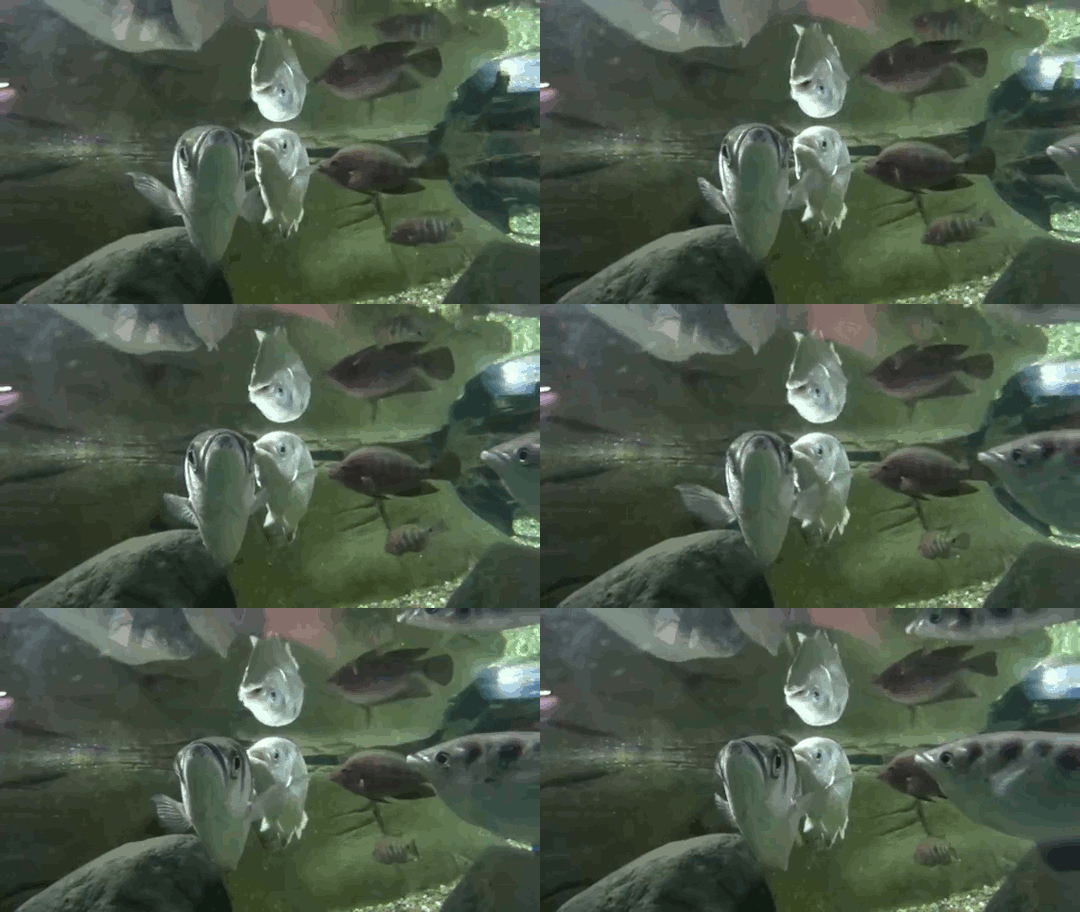
Inside Science has a new documentary all about fluid dynamics! It features interviews with five researchers about current work ranging from the physics of surfing to the spreading of diseases. Penguins, sharks, archer fish, 3D printing, and influenza all make an appearance (seriously, fluid dynamics has everything, guys). If you’d like to learn more about some of these topics, I’ve touched on several of them before, including icing, penguin physics, shark skin, archer fish, and disease transmission via droplets. (Video credit: Inside Science/AIP)


The Law of Urination
Tonight is the 26th Ig Nobel Prize ceremony. As I’ve covered previously, the subject of fluid dynamics has been quite successful at winning these awards designed to “make people LAUGH, then THINK,” and last year’s ceremony was no exception. Georgia Tech researchers won the Physics Prize last year for explaining why mammals of very different sizes all urinate for roughly 21 seconds.
Urination is a gravity-driven process, and larger animals have longer urethras, which means that gravity will have more time to accelerate fluid flowing from the the bladder to, well, the exit. Thus, larger animals will have higher flow rates. This allows them to empty their bigger bladders in essentially the same amount of time as a smaller animal. Recognizing this pattern can be helpful to both veterinarians diagnosing problems in animals and to engineers designing systems to move fluids efficiently.
There’s no way to know whether fluid dynamics will win another Ig Nobel Prize tonight, but I can guarantee that subject will come up. I’ll be giving a 24/7 lecture on Fluid Dynamics during tonight’s Ig Nobel Prize ceremony. You can see me – and find out this year’s winners – by watching the ceremony webcast here starting at 5:40pm EDT. (Video credit: DNews; research credit: P. Yang et al.)
Soap Film Turbulence
The brilliant colors of a soap film reveal the fluid’s thickness, thanks to a process known as thin film interference. The twisting flow of the film depends on many influences: gravity pulls down on the liquid and tends to make it drain away; evaporation steals fluid from the film; local air currents can push or pull the film; and the variation in the concentration of molecules – specifically the surfactants that stabilize the film – will change the local surface tension, causing flow via the Marangoni effect. Together these and other effects create the dancing turbulence captured above. (Video credit: A. Filipowicz)
Droplet Bounce
Water droplets don’t always immediately disappear into a pool they’re dropped onto. If the droplet is small and doesn’t have much momentum, it will join the pool gradually through a process known as the coalescence cascade, seen here in high speed video. The droplet bounces off the surface, then settles. A thin layer of air is caught between it and the pool. Slowly the weight of the drop pushes that air out until there is contact between the drop and pool. Before the drop can merge completely, though, surface tension pinches it off, creating a smaller daughter droplet. Ripples caused by the merger help bounce the little droplet, which repeats the same process until the tiniest droplet merges completely. (Video credit: B. ter Huume)
Happy 50th, Star Trek!
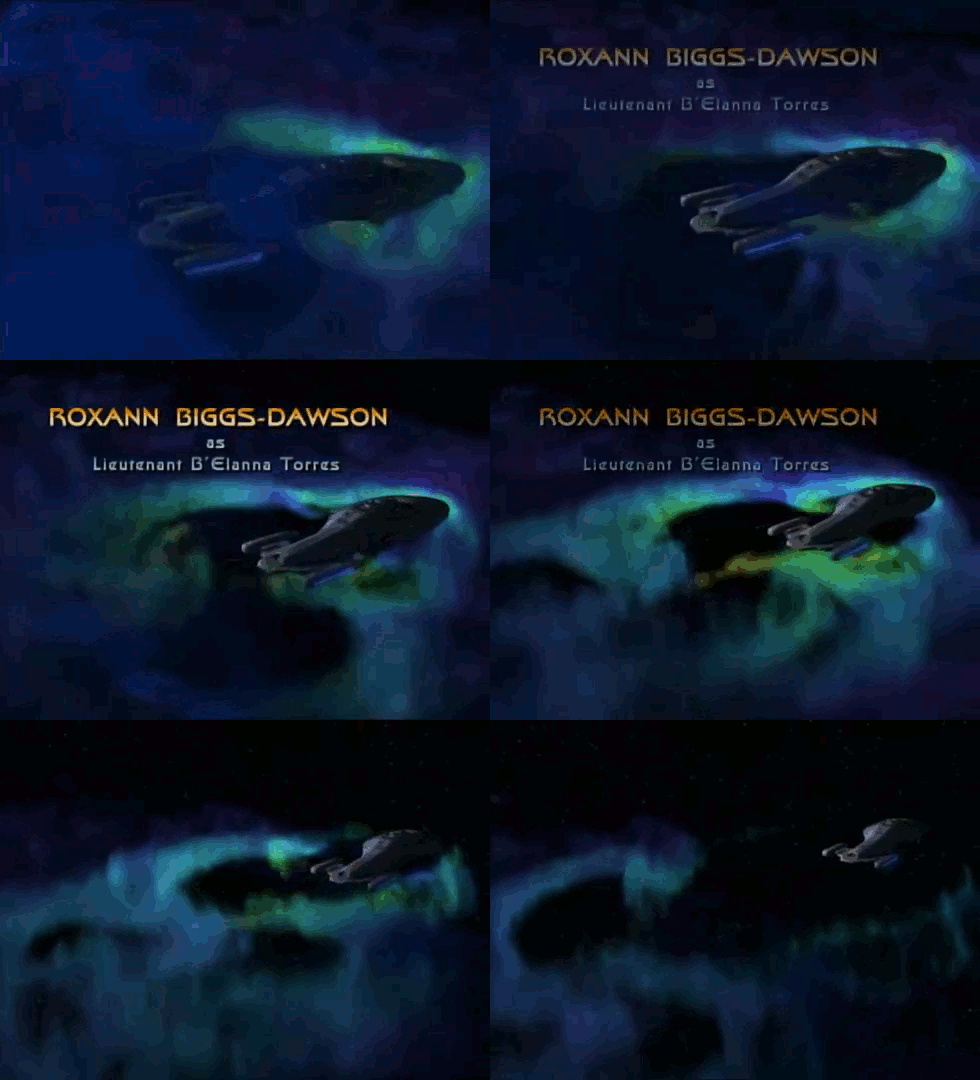
Today’s post is largely brought to you by the fact that I have been sick the past four days and my fiance and I have been bingeing on Star Trek Voyager. At some point, we began wondering about the sequence from 0:30-0:49 in which Voyager flies through a nebula and leaves a wake of von Karman vortices. Would a starship really leave that kind of wake in a nebula?

My first question was whether the nebula could be treated as a continuous fluid instead of a collection of particles. This is part of the continuum assumption that allows physicists to treat fluid properties like density, temperature, and velocity as well-defined quantities at all points. The continuum assumption is acceptable in flows where the Knudsen number is small. The Knudsen number is the ratio of the mean free path length to a characteristic flow length, in this case, Voyager’s size. The mean free path length is the average distance a particle travels before colliding with another particle. Nebulae are much less dense than our atmosphere, so the mean free path length is larger (~ 2 cm by my calculation) but still much smaller than Voyager’s length of 344 m. So it is reasonable to treat the nebula as a fluid.
As long as the nebula is acting like a fluid, it’s not unreasonable to see alternating vortices shed from Voyager. But are the vortices we see realistic relative to Voyager’s size and speed? Physicists use the dimensionless Strouhal number to describe oscillatory flows and vortex shedding. It’s a ratio of the vortex shedding frequency times the characteristic length to the flow’s velocity. We already know Voyager’s size, so we just need an estimate of its velocity and the number of vortices shed per second. I visually estimated these as 500 m/s and 2.5 vortices/second, respectively. That gives a Strouhal number of 0.28, very close to the value of 0.2 typically measured in the wake of a cylinder, the classical case for a von Karman vortex street.
So far Voyager’s wake is looking quite reasonable indeed. But what about its speed relative to the nebula’s speed of sound? If Voyager is moving faster than the local speed of sound, we might still see vortex shedding in the wake, but there would also be a bow shock off the ship’s leading edge. To answer this question, we need to know Voyager’s Mach number, its speed relative to the local speed of sound. After some digging through papers on nebulae, I found an equation to estimate speed of sound in a nebula (Eq 9 of Jin and Sui 2010) using the specific gas constant and temperature. Because nebulae are primarily composed of hydrogen, I approximated the nebula’s gas constant with hydrogen’s value and chose a representative temperature of 500 K (also based on Jin and Sui 2010). This gave a local speed of sound of 940 m/s, and set Voyager’s Mach number at 0.53, inside the subsonic range and well away from any shock wave formation.
Of course, these are all rough estimates and back-of-the-envelope fluid dynamics calculations, but my end conclusion is that Voyager’s vortex shedding wake through the nebula is realistic after all! (Video credit: Paramount; topic also requested by heuste11)
Happy 50th anniversary, Star Trek! Some of my earliest memories of TV are of watching TNG with my parents. Star Trek taught me that curiosity and scientific inquiry were vital and valuable, and that anyone could grow up to be a scientist, engineer, and leader. Thank you for such an inspiring and hopeful vision for humanity’s future!
And, seriously, those von Karman vortices are awesome.
Hearing in Space
Everyone knows that, in space, no one can hear you scream. Sound is a wave that requires a medium to travel through, and if space is empty, there’s no medium to carry that sound. Except, as Mike from The Point Studios explains, empty is a relative term. Space is full of dust and gas and plasma, just not as full of that matter as we’re used to. Thus, the question of whether sound can travel through space turns into a matter of scale. If the scale–the wavelength–of a sound is much larger than the distance between molecules, then the sound can propagate. So there CAN be sound in space – it just has to have a very long wavelength and, thus, a very low frequency. Check out the video for the full story! (Video credit: The Point Studios)
Where Does the Sun End?
How do you define the edge of our sun? There’s a distinct surface to it, but our star is also surrounded by the corona, an even hotter region of plasma twisted by magnetic fields. The corona is sort of like the sun’s atmosphere. Farther out in the solar system, we receive a constant barrage of charged particles, known as the solar wind, that streams out from the sun. So where does the corona end and the solar wind begin?
Scientists have been studying the flow structure of the solar wind in search of an answer to this question, and they’ve found that there’s a clear transition point about 32 million kilometers from the sun. At this distance, the sun’s magnetic field weakens to the point where it no longer exerts the same hold on the solar particles and they begin to move turbulently, behaving more like a gas than a plasma. With special measurements and image processing, scientists were able to actually see this flow change in the solar wind! (Video/image credit: NASA; research credit: C. DeForest et al.; via FlowViz)