From spilling coffee to driving through puddles, our daily lives are full of examples of liquids fragmenting into drops. A recently published study describes how this break-up occurs and predicts what the distribution of droplet sizes will be for a given fluid. Viscoelasticity is the property that governs this droplet size distribution. Viscoelasticity describes two aspects of a fluid–its viscosity, which acts like internal friction, resisting motion–and its elasticity, the fluid’s ability to return to its original shape after stretching. Most fluids have a little bit of each of these properties, which makes them somewhat sticky, both in the sense of not-flowing-easily and in the sense of sticking-to-itself. These same properties cause viscoelastic fluids to wind up with a broader droplet size distribution, ultimately creating both more small droplets and more large droplets than a Newtonian liquid like water. (Video credit: MIT News; research credit: B. Keshavarz et al.; submitted by mrvmt)
Tag: viscoelasticity

Hagfish Escape Mechanisms

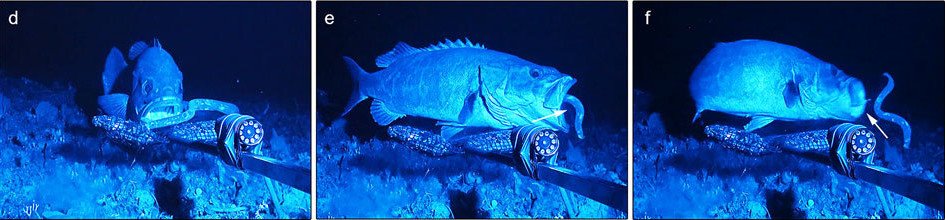
The hagfish is an eel-like creature that has not changed much in the past 300 million years in part because the hagfish is very good at escaping would-be predators. When attacked, the hagfish excretes mucins that combine with seawater to form slime. This gel-like viscoelastic fluid forms quickly and has some handy properties. For example, when stretched, the slime becomes extremely viscous. Many fish feed using a suction method, in which they thrust their jaws forward and enlarge their mouths to suck water and prey inside. This strong unidirectional flow stretches the slime, which thickens it and clogs the fish’s gills. Suddenly, the fish is much more concerned with being unable to breathe, allowing the hagfish to flee.
Being surrounded by all that slime could smother the hagfish, too, if it were not for another clever feature of the slime. When sheared, hagfish slime collapses, losing its viscosity. The hagfish actually ties itself in a knot to create this shear and slide the slime right off. (Image credit: V. Zintzen et al.; L. Böni et al., source)

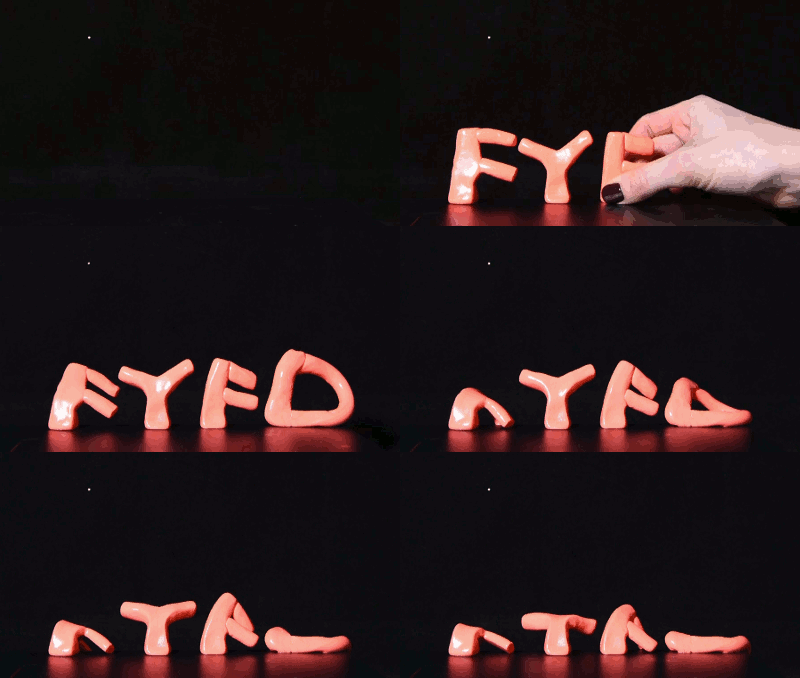
1500 Posts!

This is FYFD’s 1500th post! Can you believe it? Fifteen hundred posts is a heck of a lot of fluid dynamics. I’ve covered everything from the teeny tiniest scales to the astronomically huge, from events that happen in the blink of an eye to ones that require decades of patience. Today I encourage you to check out the archives whether by scrolling the visual archive, digging in by keyword, or by clicking here for something random.
Whether you’ve been here for 1 post or for all 1500, thank you! And special thanks, of course, to my Patreon patrons. If you’re a fan and want to help FYFD keep flowing and growing, please consider becoming a patron, too. (There’s cool perks available.) Here’s to the next 1500 posts!
P.S. Big thanks also to Randy Ewoldt and his lab for their fantastic viscoelastic FYFD timelapse. Isn’t it awesome?! (Image credits: N. Sharp – top image, Ewoldt Research Group – bottom image)

Climbing Up the Walls
You may have noticed when baking that fluids don’t always behave as expected when you agitate them. If you put a spinning rod into a fluid, we’d expect the rod to fling fluid away, creating a little vortex that stirs everything around. And for a typical (Newtonian) fluid, this is what we see. The fluid’s viscosity tries to resist deforming the fluid, but the momentum imparted by the rod wins out. With a viscoelastic fluid, on the other hand, the story is much different. As before, the spinning of the rod deforms the fluid. But the viscoelastic fluid contains long chains of polymers. As those polymers get stretched by the deformation, they generate their own forces, including forces parallel to the rod. Instead of being flung outward, the viscoelastic fluid starts climbing up the rod, with the stretchy elasticity of the polymers helping pull more fluid up and up. (Image credit: Ewoldt Research Group, source)

Rotating Jet
This photo, one of the winners of the Engineering and Physical Sciences Research Council’s (EPSRC) annual photography contest, shows a rotating viscoelastic jet. Rotating liquid jets are common to many manufacturing processes, and their sometimes-wild appearance comes from a balance of gravitational forces and centrifugal force against surface tension. But because this fluid contains a small amount of polymer additive, surface tension has the additional aid of some elasticity to help hold the jet together and keep the globules and ligaments you see from flying off. As centrifugal forces fling the fluid outward, it stretches the polymer chains within the fluid, and they pull back against that tension like a stretched rubber band. To see some of the other contest winners–including other fluids entries!–check out the Guardian’s run-down. (Image credit and submission: O. Matar et al., ICL press release)

Watching a Sneeze
What does a sneeze look like? You might imagine it as a violent burst of air and a cloud of tiny droplets. But this high-speed video shows, that’s only part of the story. The liquid leaving a sneezer’s mouth and nose is a mixture of saliva and mucus, and in the few hundred milliseconds it takes to expel this air/mucosaliva mixture, there’s not enough time for the liquid to break into droplets. Instead, liquid leaves the mouth as a fluid sheet that breaks into long ligaments.
Because mucosaliva is viscoelastic and non-Newtonian, it does not break down into droplets as quickly as water. Instead, when stretched, the proteins inside the fluid tend to pull back, causing large droplets to form with skinny strands between them – the beads-on-a-string instability. The end result when the ligaments do finally break is more large droplets than one would expect from a fluid like water. Understanding this break-up process and the final distribution of droplet sizes is vital for better understanding the spread of diseases and pathogens. (Video credit: Bourouiba Research Group; research paper: B. Scharfman et al., PDF)

From Dripping to Beading

When water drips, it quickly breaks up into a string of smaller droplets due to a surface-tension-driven instability called the Plateau-Rayleigh instability. But adding just a tiny bit of polymer to the fluid changes the behavior entirely. Instead of breaking into droplets, a narrow filament dotted with tiny satellite droplets forms between the larger drops. This is known as the beads-on-a-string instability. The viscoelasticity the polymers add is one key to seeing this behavior. Polymers consist of large molecule chains that, when stretched, act a little like rubber bands–they pull back against the stretch, providing an elastic effect. Without this elasticity, the tiny filament connecting the drops would break up immediately. (Image credit: M. Berman, source; research credit: P. Bhat et al.)

Sharkskin Instability
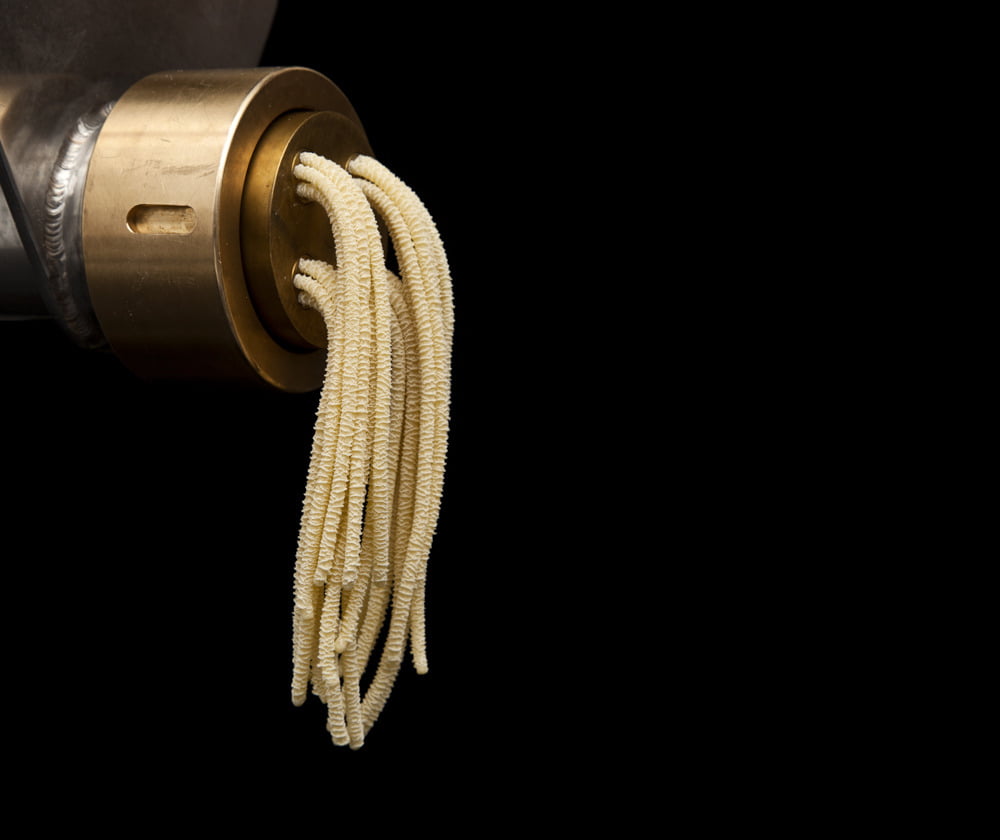
Homemade spaghetti noodles exhibit a roughened surface that’s the result of viscoelastic behavior known as the sharkskin instability. It’s usually observed in the industrial extrusion of polymer plastics. In the case of spaghetti, the long, complex polymer molecules necessary for the instability come from the proteins in eggs. The characteristically rough surface of the extruded material is caused by the transition from flow through the die to air. Inside the die, friction from the walls exerts a strong shear force on the outer part of the fluid while the inner portion flows freely. When the material exits the die, the sudden lack of friction on the outer portion of the fluid causes it to accelerate to the same velocity as the middle of the flow. This acceleration stretches the polymers until they snap free of the die; after the strained polymers relax, the material keeps a rough, saw-tooth pattern. In industry, the sharkskin instability can be prevented by regulating temperature or flow speed. In the case of spaghetti, though, Modernist Cuisine suggests the roughness is desirable because it helps trap the pasta sauce. Bon appetit! (Image credit: Modernist Cuisine)

Newtonian and Non-Newtonian Vortices

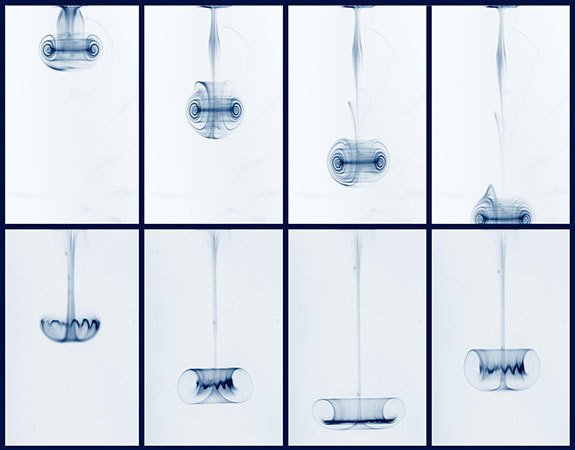
Not all vortex rings are created equal. Despite identical generation mechanisms and Reynolds numbers, the two vortex rings shown above behave very differently. The donut-shaped one, on the top left in green and in the middle row in blue, was formed in a Newtonian fluid, where viscous stress is linearly proportional to deformation. As one would expect, the vortex travels downward and diffuses some as time passes. The mushroom-like vortex ring, on the other hand, is in a viscoelastic fluid, which reacts nonlinearly to deformation. This vortex ring first furls and expands as it travels downward, then stops, contracts, and travels backward! (Image credit: J. Albagnac et al.; via Gallery of Fluid Motion)

Melt Fracture in Plastics
Liquid plastics are often extruded–or pressure-driven through a die–during manufacturing. Early on manufacturers discovered that they could only extrude plastic at low flow rates, otherwise the plastic’s surface begins undulating in what became known as melt fracture. These corrugations result from the viscoelasticity of the plastic. Viscoelastic fluids have a response to deformation that is part viscous–like any fluid–and part elastic. At low flow rates, viscous forces dominate in the plastic, but at higher speeds, elasticity increases and the polymers in the plastic get stretched along the direction of flow. In response to this stretching, the polymers exert normal stresses, much like a rubber band that’s being stretched. Because this force acts only along the flow direction, different parts of the fluid are experiencing different forces, and these internal stresses cause the plastic to change shape. (Image credit: D. Bonn et al.)