Tag: viscoelasticity

  • Melt Fracture in Plastics

    Melt Fracture in Plastics

    Liquid plastics are often extruded–or pressure-driven through a die–during manufacturing. Early on manufacturers discovered that they could only extrude plastic at low flow rates, otherwise the plastic’s surface begins undulating in what became known as melt fracture. These corrugations result from the viscoelasticity of the plastic. Viscoelastic fluids have a response to deformation that is part viscous–like any fluid–and part elastic. At low flow rates, viscous forces dominate in the plastic, but at higher speeds, elasticity increases and the polymers in the plastic get stretched along the direction of flow. In response to this stretching, the polymers exert normal stresses, much like a rubber band that’s being stretched. Because this force acts only along the flow direction, different parts of the fluid are experiencing different forces, and these internal stresses cause the plastic to change shape. (Image credit: D. Bonn et al.)

  • Stepping on Lava

    Stepping on Lava

    What happens when you step on lava? (First off, don’t try this yourself.) Lava is both very dense and very viscous, so, as illustrated in the animation above, it does not give all that much under pressure. If you were to fall on it, you’d land, sink a little bit, and then get burned. It’s also interesting to note that the lava springs back after being indented. Basaltic lava like that found in Hawaii, where this clip originates, does have viscoelastic properties, which might explain the elasticity of the deformed fluid. (Image credit: A. Rivest, source video; via Gizmodo)

  • Jet Impact

    Jet Impact

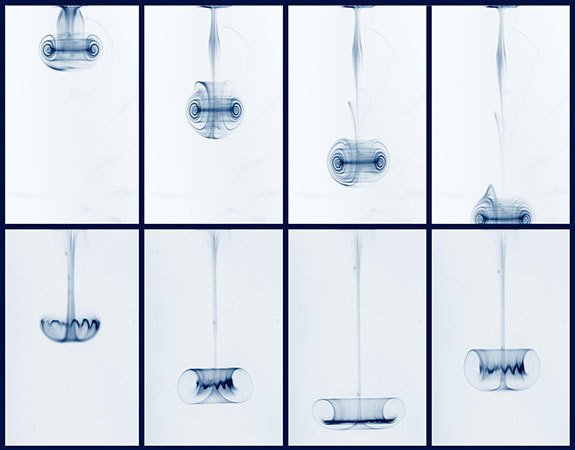
    Viscoelasticity can generate some bizarre fluid behaviors. Viscoelastic fluids are special class of non-Newtonian fluid in which the response to deformation is both viscous, like a fluid, and elastic, like rubber. Above, a jet of viscoelastic fluid impacts a plate as viewed from the side (top image) and beneath (bottom image). When the jet impacts the plate, elastic stresses in the fluid destabilize the cylindrical symmetry of the jet. The jet instead becomes webbed, with an odd, asymmetric number of webs. The number of webs depends on the viscoelastic properties of the fluid as well as the jet’s speed and distance from the plate. (Image credit: B. Néel et al.)

  • Beading Fluids

    Beading Fluids

    Adding just a few polymers to a liquid can substantially change its behavior. The presence of polymers turns otherwise Newtonian fluids like water into viscoelastic fluids. When deformed, viscoelastic fluids have a response that is part viscous–like other fluids–and part elastic–like a rubber band that regains its initial shape. The collage above shows what happens to a thinning column of a viscoelastic fluid. Instead of breaking into a stream of droplets, the liquid forms drop connected with a thin filament, like beads on a string. In a Newtonian fluid, surface tension would tend to break off the drops at their narrowest point, but stretching the polymers in the viscoelastic fluid provides just enough normal stress to keep the filament intact. If the effect looks familiar, it may be because you’ve seen it in the mirror. Human saliva is a viscoelastic liquid! (Image credit: A. Wagner et al.)

  • Featured Video Play Icon

    Hydrophobicity and Viscous Flow

    Hydrophobic surfaces are great for creating some wild behaviors with water droplets, but they make neat effects with other liquids, too. The viscous honey in the first segment of this Chemical Bouillon video is a great example. Because the honey doesn’t adhere to the hydrophobic surface, the viscoelastic fluid does not maintain the form it had when drizzled on the surface. Instead, the honey contracts, with surface tension driving Plateau-Rayleigh-like instabilities that break the contracting ligaments apart to form nearly spherical droplets of honey on the surface.  (Video credit: Chemical Bouillon)

  • Featured Video Play Icon

    Stirring Up

    When a viscoelastic non-Newtonian fluid is stirred, it climbs up the stirring rod. This behavior is known as the Weissenberg effect and results from the polymers in the fluid getting tangled and bunched due to the stirring. You may have noticed this effect in the kitchen when beating egg whites. In this video, researchers explore the effect using rodless stirring. The first example in the video shows a viscous Newtonian fluid being stirred. The stirring action creates a concave shape in the glycerin-air interface, and dye injection shows a toroidal vortex formed over the stirrer. Fluid near the center of the vortex is pulled downward and circulates out to the sides. In contrast, the viscoelastic fluid bulges outward when stirred. Dye visualization reveals fluid being pulled up the center into the bulge. It then travels outward, forming a mushroom-cap-like shape before sinking down the outside. This is also a toroidal vortex, but it rotates opposite the direction of the Newtonian one. Exactly how the polymers create this change in flow behavior is a matter of active research. (Video credit: E. Soto et al.)

  • Pitcher Plant Fluid Dynamics

    Pitcher Plant Fluid Dynamics

    Carnivorous pitcher plants owe much of their efficacy to the viscoelasticity of their digestive fluid. A viscoelastic fluid’s resistance to deformation has two components: the usual viscous component that resists shearing and an elastic component, often derived from the presence of polymers, that resists stretching – kind of like a liquid rubber band. It’s the latter effect that’s important when it comes to the pitcher plant trapping insects. When a fly or ant falls into the liquid within the plant, it will flail and try to swim, thereby straining the fluid. In part © of the image above, you can see how long fluid filaments stretch as the fly moves; this is because the digestive fluid’s extensional viscosity, the elastic component, is 10,000 times larger than its shear viscosity, the usual viscous component, for motions like the fly’s. This viscoelastic fluid is so effective at trapping insects that, as seen in part (b) above, it has to be diluted by more than 95% before insects can escape it! (Image credit: L. Gaume and Y. Forterre)

  • Beads-on-a-string

    Beads-on-a-string

    Viscoelastic fluids are a type of non-Newtonian fluid in which the stress-strain relationship is time-dependent. They are often capable of generating normal stresses within the fluid that resist deformation, and this can lead to interesting behaviors like the bead-on-a-string instability shown above. In this phenomenon, a uniform filament of fluid develops into a series of large drops connected by thin filaments. Most fluids would simply break into droplets, but the normal stresses generated by the viscoelastic fluid prevent break-up. For this particular photo, the stresses are generated by clumps of surfactant molecules within the wormlike micellar fluid. Similar effects are observed in polymer-laced fluids. (Photo credit: M. Sostarecz and A. Belmonte)

  • Featured Video Play Icon

    Liquids Pinching Off

    There is a surprising variety of forms in the pinch-off of a liquid drop. This short video shows three examples, and you’ll probably find yourself replaying it a few times to catch the details of each. On the left, a drop of water pinches off in air. As the neck between the nozzle and the drop elongates, the drop end of the neck thins to a point around which the drop’s surface dimples. This is called overturning. When the drop snaps off, the neck disconnects and rebounds into a smaller satellite droplet. The middle video shows a drop of glycerol, which is about 1000 times more viscous than water. This droplet stretches to hang by a thin neck that remains nearly symmetric on the nozzle end and the drop end. There is no satellite drop when it breaks. The rightmost video shows a polymer-infused viscoelastic liquid pinching off. This liquid forms a very long, thin thread with a fat satellite drop still attached. When gravity eventually becomes too great a force for the stresses generated by the polymers in the liquid, the drops break off. (Video credit: M. Roche)

  • Beads on a String

    Beads on a String

    Adding just a small amount of polymers to a liquid can drastically change its behavior. The polymers make the liquid viscoelastic, meaning that, under deformation, the liquid shows behaviors that are both viscous (like all fluids) and elastic (i.e. able to resume its original shape, like a rubber band). These properties are particularly identifiable under extensional loading, like in the animation above. Under these loads, the polymers in the fluid stretch and rearrange, creating an internal compressive stress that acts opposite the imposed tensile stress. It’s this balance of forces, along with ever-present surface tension that creates the beads-on-a-string effect seen above. (Image credit: B. Keshavarz)

    ETA: As usual, Tumblr gave me issues with an animated GIF. It should be fixed now. Sorry!