Tag: stellar evolution

  • The Start of a Supernova

    The Start of a Supernova

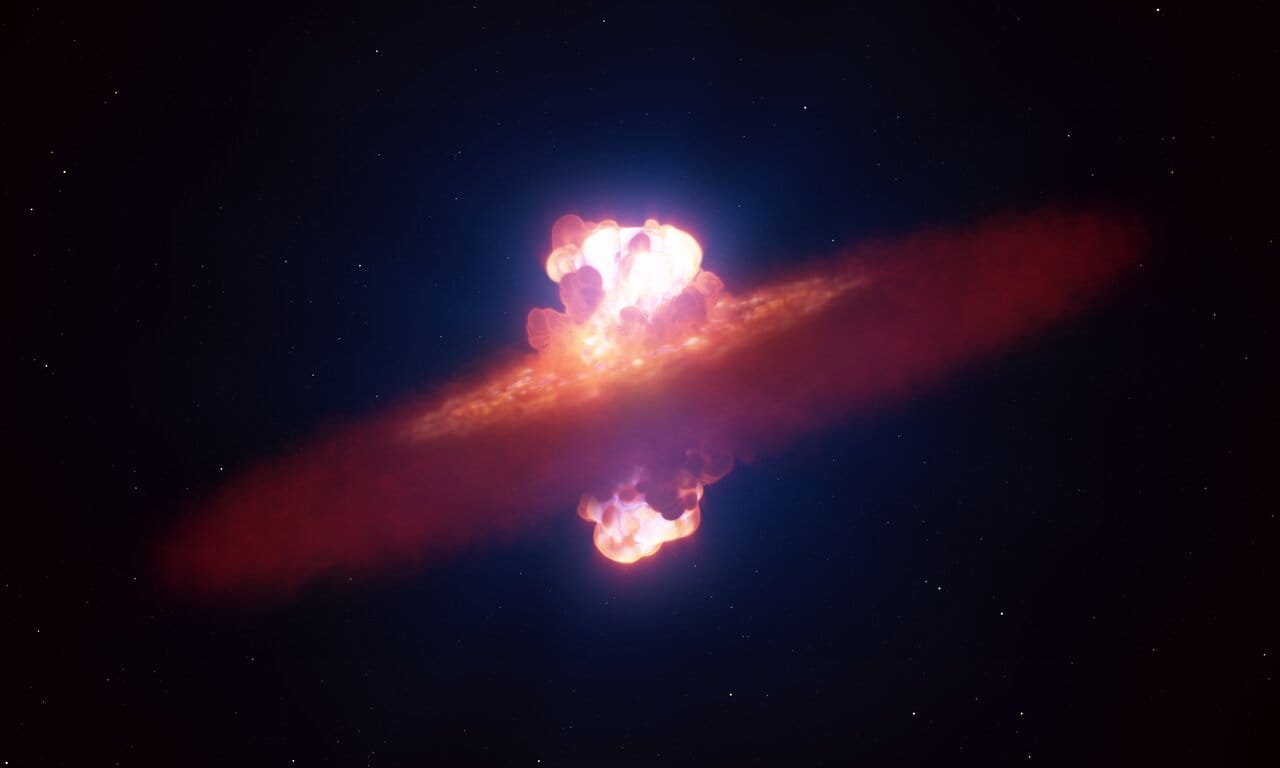
    Stars about eight times more massive than our sun end their lives in supernovas, incredible explosions that rip the star apart. The earliest stages of this explosion are something we’ve never observed firsthand, until now. A new study reports observations of the supernovaΒ explosionΒ SNΒ 2024ggi, detected here on Earth on 10 April 2024. Only 26 hours later, researchers pointed the Very Large Telescope at it, capture data that revealed its oblong shape as the initial explosion reached the star’s surface.

    What you see above and below are not the actual supernova. They are an artist’s conception of the event, based on the researchers’ observation data. That data is enough to rule out several existing supernova models and will no doubt guide new models of star death going forward. (Image credit: ESO/L. CalΓ§ada; research credit: Y. Yang et al.; via Gizmodo)

    Fediverse Reactions
  • Veil Nebula

    Veil Nebula

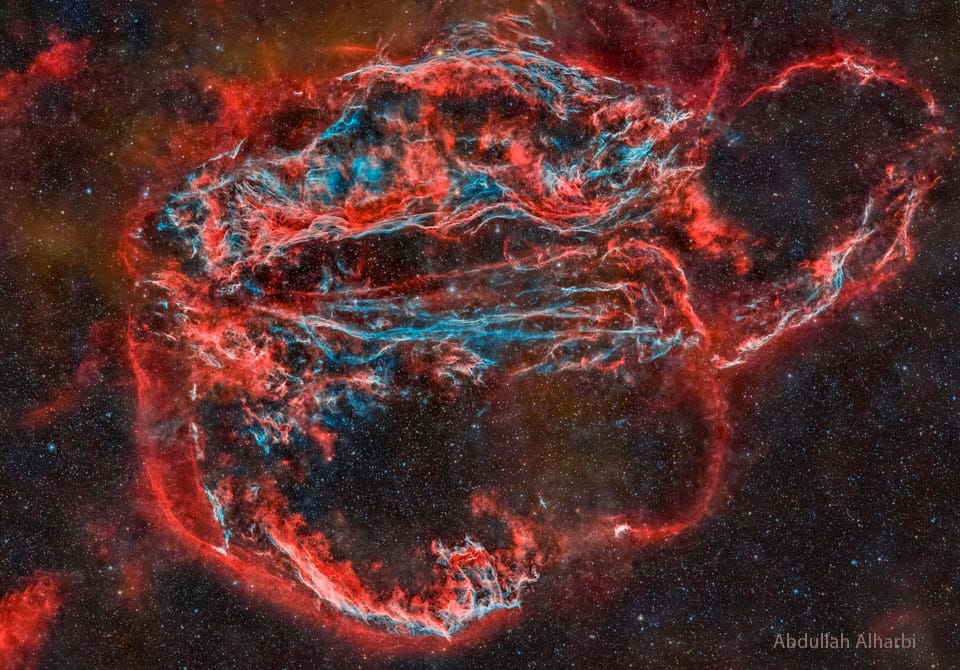
    These glowing wisps are the visible remains of a star that went supernova about 7,000 years ago. Today the supernova remnant is known as the Veil Nebula and is visible only through telescopes. In the image, red marks hydrogen gas and blue marks oxygen. First carried by shock waves, these remains of a former star now serve as seed material for other stars and planetary systems to form. (Image credit: A. Alharbi; via APOD)

    Fediverse Reactions
  • Glimpses of Coronal Rain

    Glimpses of Coronal Rain

    Despite its incredible heat, our sun‘s corona is so faint compared to the rest of the star that we can rarely make it out except during a total solar eclipse. But a new adaptive optic technique has given us coronal images with unprecedented detail.

    A solar prominence dancing in the Sun's magnetic field lines.

    These images come from the 1.6-meter Goode Solar Telescope at Big Bear Solar Observatory, and they required some 2,200 adjustments to the instrument’s mirror every second to counter atmospheric distortions that would otherwise blur the images. With the new technique, the team was able to sharpen their resolution from 1,000 kilometers all the way down to 63 kilometers, revealing heretofore unseen details of plasma from solar prominences dancing in the sun’s magnetic field and cooling plasma falling as coronal rain.

    Coronal rain -- cooler plasma falling back down along magnetic lines.

    The team hope to upgrade the 4-meter Daniel K. Inouye Solar Telescope with the technology next, which will enable even finer imagery. (Image credit: Schmidt et al./NJIT/NSO/AURA/NSF; research credit: D. Schmidt et al.; via Gizmodo)

  • Interstellar Jets

    Interstellar Jets

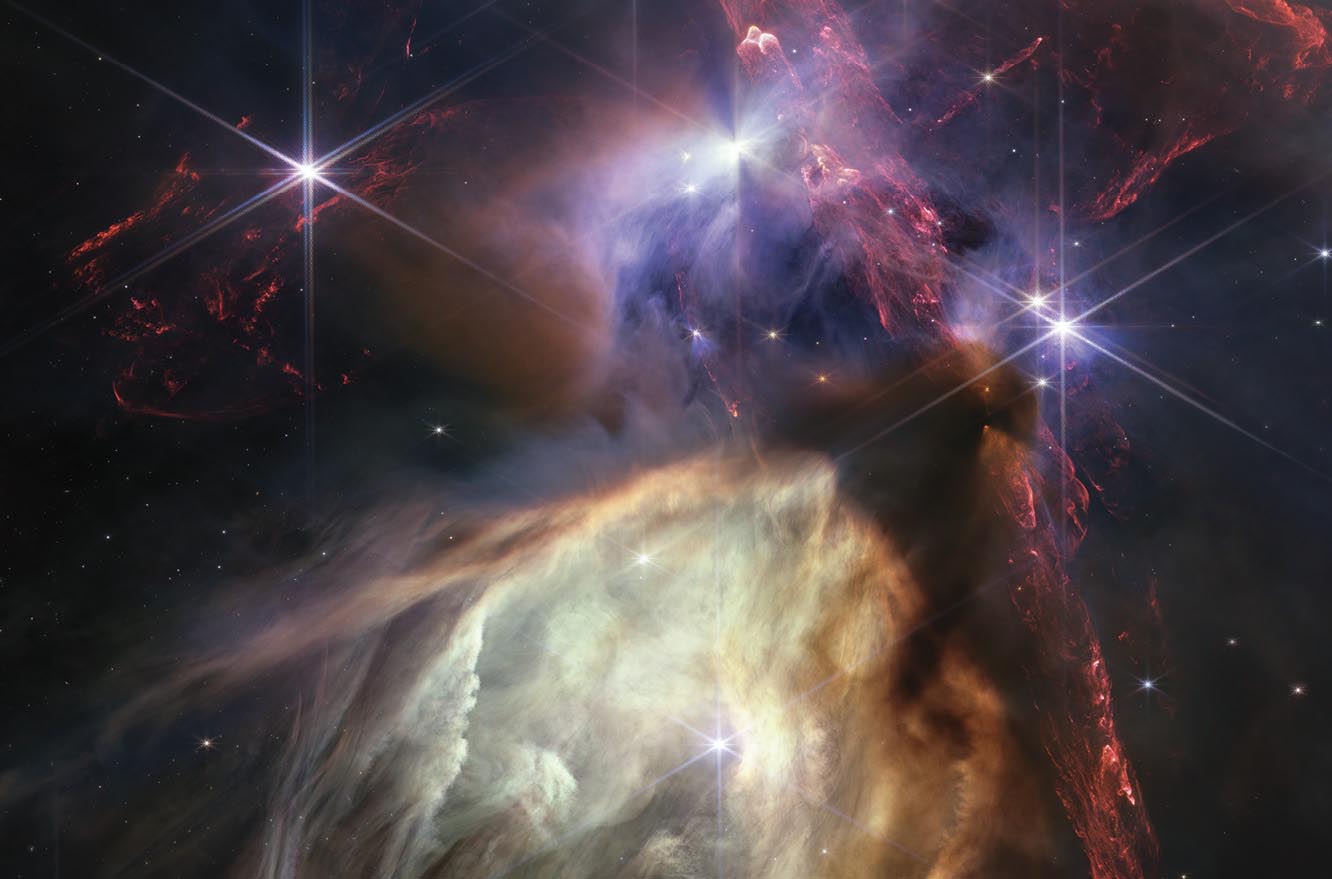
    This JWST image shows a couple of Herbig-Hero objects, seen in infrared. These bright objects form when jets of fast-moving energetic particles are expelled from the poles of a newborn star. Those particles hit pockets of gas and dust, forming glowing, hot shock waves like those seen here in red. The star that birthed the object is out of view to the lower-right. The bright blue light surrounded by red spirals that sits near the tip of the shock waves is actually a distant spiral galaxy that happens to be aligned with our viewpoint. (Image credit: NASA/ESA/CSA/STScI/JWST; via APOD)
    Fediverse Reactions
  • A Stellar Look at NGC 602

    A Stellar Look at NGC 602

    The young star cluster NGC 602 sits some 200,000 light years away in the Small Magellanic Cloud. Seen here in near- and mid-infrared, the cluster is a glowing cradle of star forming conditions similar to the early universe. A large nebula, made up of multicolored dust and gas, surrounds the star cluster. Its dusty finger-like pillars could be an example of Rayleigh-Taylor instabilities or plumes shaped by energetic stellar jets. (Image credit: NASA/ESA/CSA/JWST; via Colossal)

    Fediverse Reactions
  • Jets, Shocks, and a Windblown Cavity

    Jets, Shocks, and a Windblown Cavity

    As material collapses onto a protostar, these young stars often form stellar jets that point outward along their axis of rotation. Made up of plasma, these jets shoot into the surrounding material, their interactions creating bright parabolic cavities like the one seen here. This is half of LDN 1471; the protostar’s other jet and cavity are hidden by dust but presumably mirror the bright shape seen here. (The protostar itself is the bright spot at the parabola’s peak.) Although the cavity is visibly striated, it’s not currently known what causes this feature. Perhaps some form of magnetohydrodynamic instability? (Image credit: NASA/Hubble/ESA/J. Schmidt; via APOD)

    Fediverse Reactions
  • Star-Birthing Shock Waves

    Star-Birthing Shock Waves

    Although the space between stars is empty by terrestrial standards, it’s not devoid of matter. There’s a scattering of cold gas and dust, pocked by areas known as prestellar cores with densities of a few thousand particles per cubic centimeter. This is just enough matter to help gravity eventually win its tug of war with the forces that would drive molecules apart.

    When shock waves pass through these regions — whether thrown off a dying star or a newly birthed one — they compress the material, kickstarting the process of stellar formation. Passing shock waves can also shake loose molecules stuck to the dust, providing key tracer elements that astronomers can use to visualize shock waves and the areas they affect. To learn more, see this article over at Physics Today. (Image credit: NASA/ESA/CSA/STSCI/K. Pontoppidan/A. Pagan; see also Physics Today)

  • Simeis 147

    Simeis 147

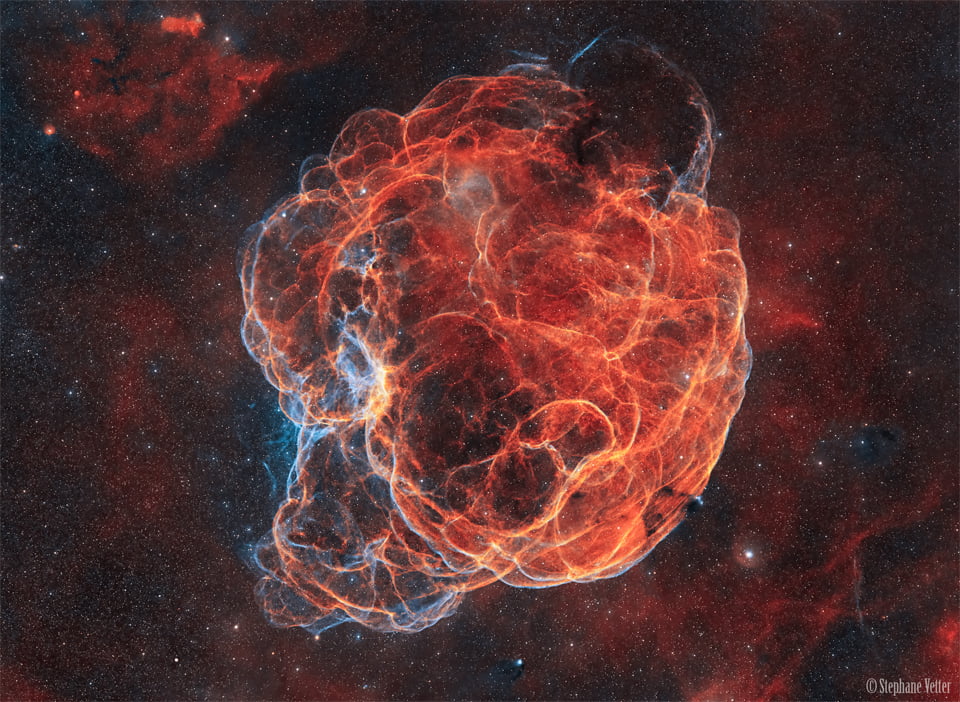
    Sometimes known as the Spaghetti Nebula, Simeis 147 is the remnant of a supernova that occurred 40,000 years ago. The glowing filaments of this composite image show hydrogen and oxygen in red and blue, respectively. These are the outlines of the shock waves that blew off the outer layers of the one-time star within. What remains of that star’s core is now a pulsar, a fast-spinning neutron star with a solar wind that continues to push on the dust and gas we see here. (Image credit: S. Vetter; via APOD)

  • Stellar-Wind-Shaped Nebula

    Stellar-Wind-Shaped Nebula

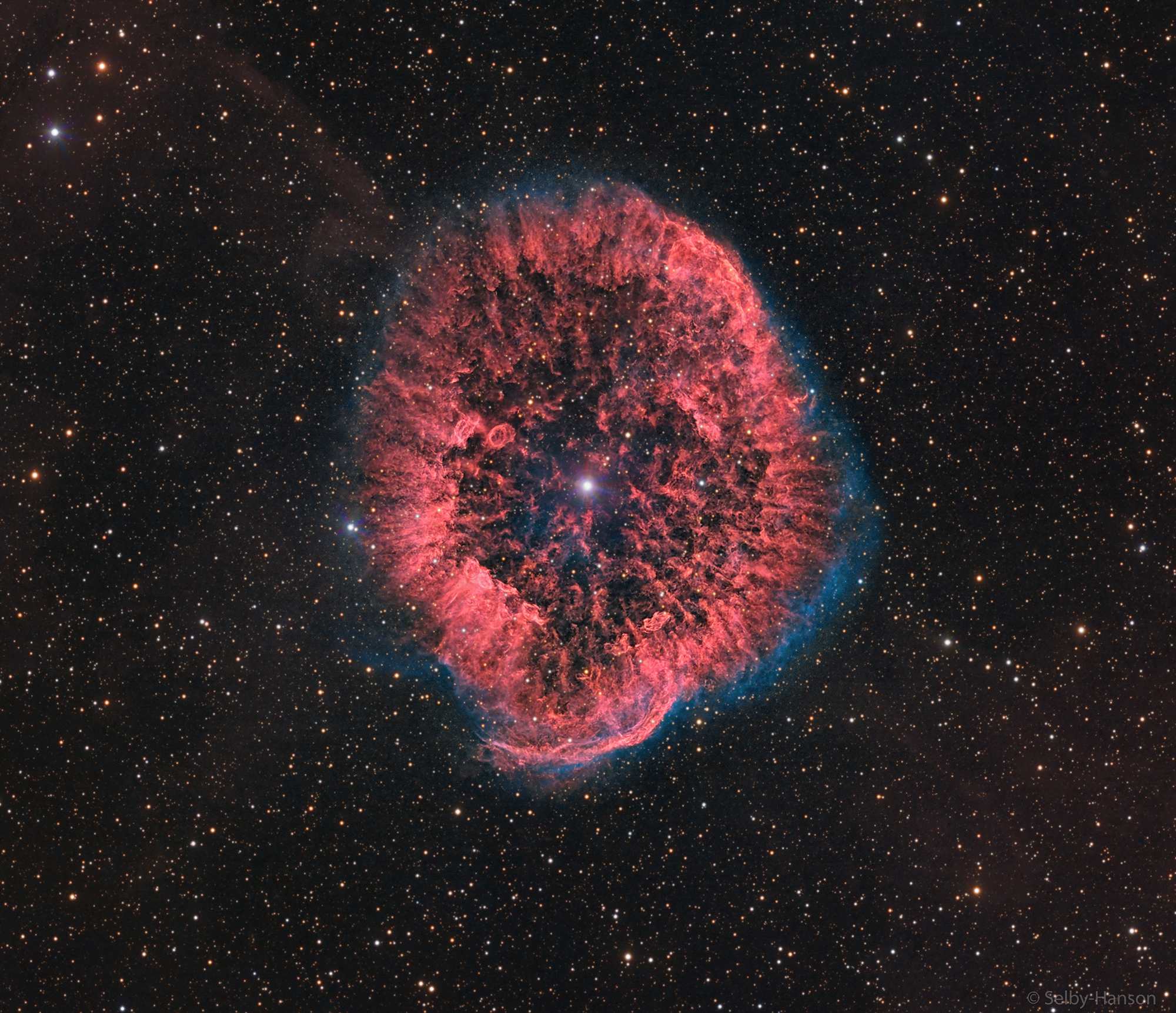
    Stars about 100 times more massive than our sun live fast and die young. They burn through their hydrogen supply quickly, then start fusing heavier elements. As they do, their strong stellar winds start blowing off the exterior layers of the star. That’s the story behind WR 40, the star at the center of Nebula RCW 58. The nebula itself is made up of material blown off the star, carved into turbulent filaments by stellar winds. (Image credit: M. Selby and M. Hanson; via APOD)

  • A Starry Nursery

    A Starry Nursery

    This mountain of interstellar gas and dust lies in the picturesque Eagle Nebula. Though it appears solid in this near-infrared image from JWST, the density of the structure is actually quite low. Jets and solar winds from the glowing, young stars inside the region sculpt the pillar’s shape. Over the next 100,000 years, the stars’ energetic jets, solar winds, and destructive supernovas will destroy the dusty nursery. (Image credit: NASA/ESA/CSA/STScI/M. Γ–zsaraΓ§)